New Delhi: The Union government has made it mandatory to render all six stanzas of Vande Mataram before the national anthem at designated official functions across the country, laying down a detailed protocol for the national song for the first time.
In fresh guidelines issued by the Ministry of Home Affairs, the full official version of Vande Mataram, lasting about three minutes, will now precede “Jana Gana Mana” at ceremonial state occasions. The order applies to events such as flag unfurling ceremonies, civil investitures, and formal functions attended by constitutional authorities, among others notified by the government.
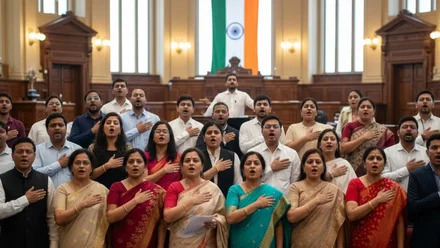
The new protocol also requires members of the audience to stand in attention during the rendition of the national song - a practice earlier mandated specifically for the national anthem. Where both are part of a programme, Vande Mataram must be performed first, followed by the anthem.
The Centre has circulated the guidelines to states, Union Territories and ministries, categorising occasions into those where the song must be played, those where it should be sung collectively, and others, such as school assemblies, where community singing is encouraged. Educational institutions have been advised to promote awareness about the national song and its historical significance.
The notification also prescribes uniformity in band performances and ceremonial cues, while clarifying that standing is not required when the song forms part of a documentary or newsreel to avoid disruption.
Written by Bankim Chandra Chatterjee in the 19th century, Vande Mataram became a rallying cry during the freedom movement and was accorded the status of the national song, distinct from the national anthem adopted in 1950. While only the first two stanzas have traditionally been used in official settings, the new directive restores the complete composition to formal observance, coinciding with the 150th year of its creation.
BI Bureau