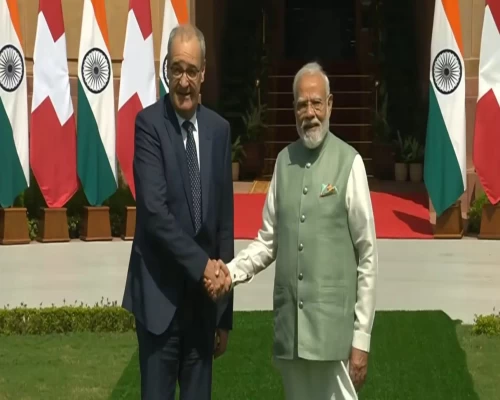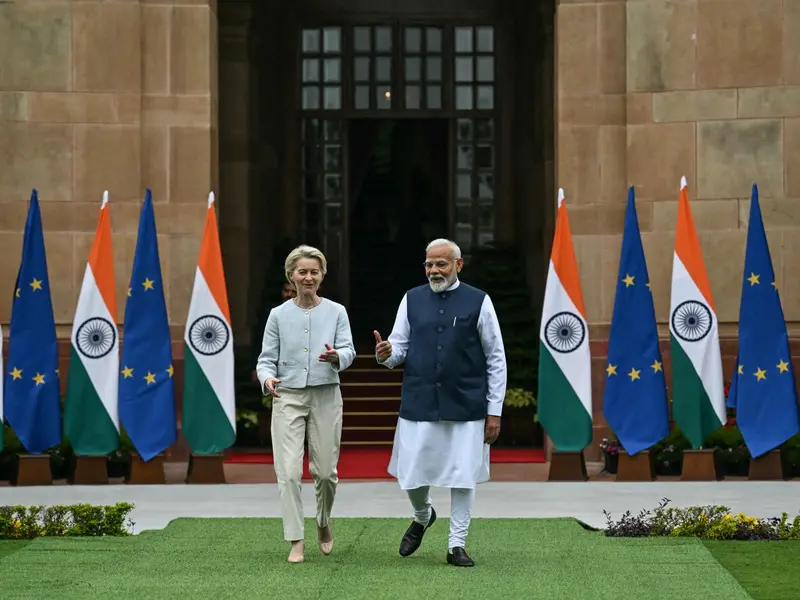
New Delhi | January 27, 2026: India and the European Union on Tuesday announced the conclusion of the long-awaited India–EU Free Trade Agreement (FTA), marking a decisive breakthrough in India’s global trade engagement and its economic partnership with one of the world’s largest trading blocs. The announcement was jointly made by Prime Minister Shri Narendra Modi and European Commission President H.E. Ms. Ursula von der Leyen at the 16th India–EU Summit.
The agreement brings together the world’s fourth-largest economy and the European Union, the second-largest, together accounting for nearly 25 per cent of global GDP and about one-third of global trade. Officials on both sides described the pact as a “trusted partnership” anchored in predictability, resilience and inclusive growth.
Negotiations for the FTA, re-launched in 2022 after a prolonged hiatus, culminated following sustained political engagement and technical discussions, reflecting a shared intent to craft a modern, balanced and commercially meaningful trade framework. The agreement significantly expands market access for Indian goods and services while safeguarding sensitive domestic sectors.
A key feature of the pact is the preferential access granted to over 99 per cent of Indian exports by value to the EU. Labour-intensive sectors such as textiles, apparel, leather, footwear, marine products, gems and jewellery, handicrafts and engineering goods, together accounting for nearly USD 33 billion in exports, are expected to gain substantially as tariffs of up to 10 per cent are eliminated upon entry into force of the agreement.
In 2024–25, bilateral trade in goods between India and the EU stood at Rs 11.5 lakh crore (USD 136.54 billion), with Indian exports valued at Rs 6.4 lakh crore (USD 75.85 billion). Trade in services reached Rs 7.2 lakh crore (USD 83.10 billion), underlining the growing importance of services in the bilateral economic relationship.
The FTA provides ambitious and commercially significant market access in services, including IT and IT-enabled services, professional services, education, financial services, tourism, construction and other business services. India has secured predictable access across 144 EU service subsectors, while the EU has been granted access in 102 Indian subsectors, enabling deeper integration and investment flows.
A dedicated mobility framework under the agreement facilitates the movement of skilled and semi-skilled professionals, covering intra-corporate transferees, business visitors, contractual service suppliers and independent professionals. The framework also provides entry and work rights for dependents of intra-corporate transferees, alongside provisions supporting student mobility and post-study opportunities.
Agriculture and processed food exports from India are set to gain enhanced access to the EU market, benefiting products such as tea, coffee, spices, fruits, vegetables and processed foods. At the same time, India has ring-fenced sensitive sectors, including dairy and select agricultural commodities, ensuring no market access commitments where domestic priorities are involved.
On automobiles, the agreement adopts a calibrated, quota-based liberalisation approach. While EU manufacturers will gain limited access to higher-end segments of the Indian market, reciprocal access opens future export opportunities for India-manufactured vehicles, aligning with the ‘Make in India’ programme and strengthening domestic manufacturing capabilities.
The agreement also addresses non-tariff barriers through regulatory cooperation, improved transparency, streamlined customs procedures and strengthened sanitary and phytosanitary measures. Provisions related to the EU’s Carbon Border Adjustment Mechanism (CBAM) include assurances on future flexibilities, technical cooperation, recognition of verifiers and targeted support to help Indian exporters adapt to evolving carbon norms.
Intellectual property protections under the FTA reaffirm TRIPS standards while recognising the importance of safeguarding traditional knowledge, including explicit acknowledgment of India’s Traditional Knowledge Digital Library (TKDL). The agreement also opens pathways for cooperation in emerging and strategic areas such as artificial intelligence, clean technologies and semiconductors.
Union Minister for Commerce and Industry Shri Piyush Goyal described the FTA as one of India’s most consequential trade agreements, noting that it goes beyond conventional tariff liberalisation to encompass strategic, technological and mobility dimensions. He emphasised that the pact would create jobs, empower MSMEs, women, artisans and youth, and enhance India’s competitiveness in global value chains.
With the conclusion of the India–EU FTA, the European Union becomes India’s 22nd FTA partner. Since 2014, India has signed trade agreements with Mauritius, the UAE, Australia, the UK, EFTA and Oman, and announced the conclusion of a trade deal with New Zealand. Collectively, India’s FTAs with the EU, UK and EFTA effectively open up the European market for Indian businesses and exporters.
Aligned with India’s vision of Viksit Bharat 2047, the India–EU Free Trade Agreement sets the foundation for deeper economic integration, strategic cooperation and future-ready growth, positioning India as a trusted and consequential partner in the evolving global trade order.
BI Bureau