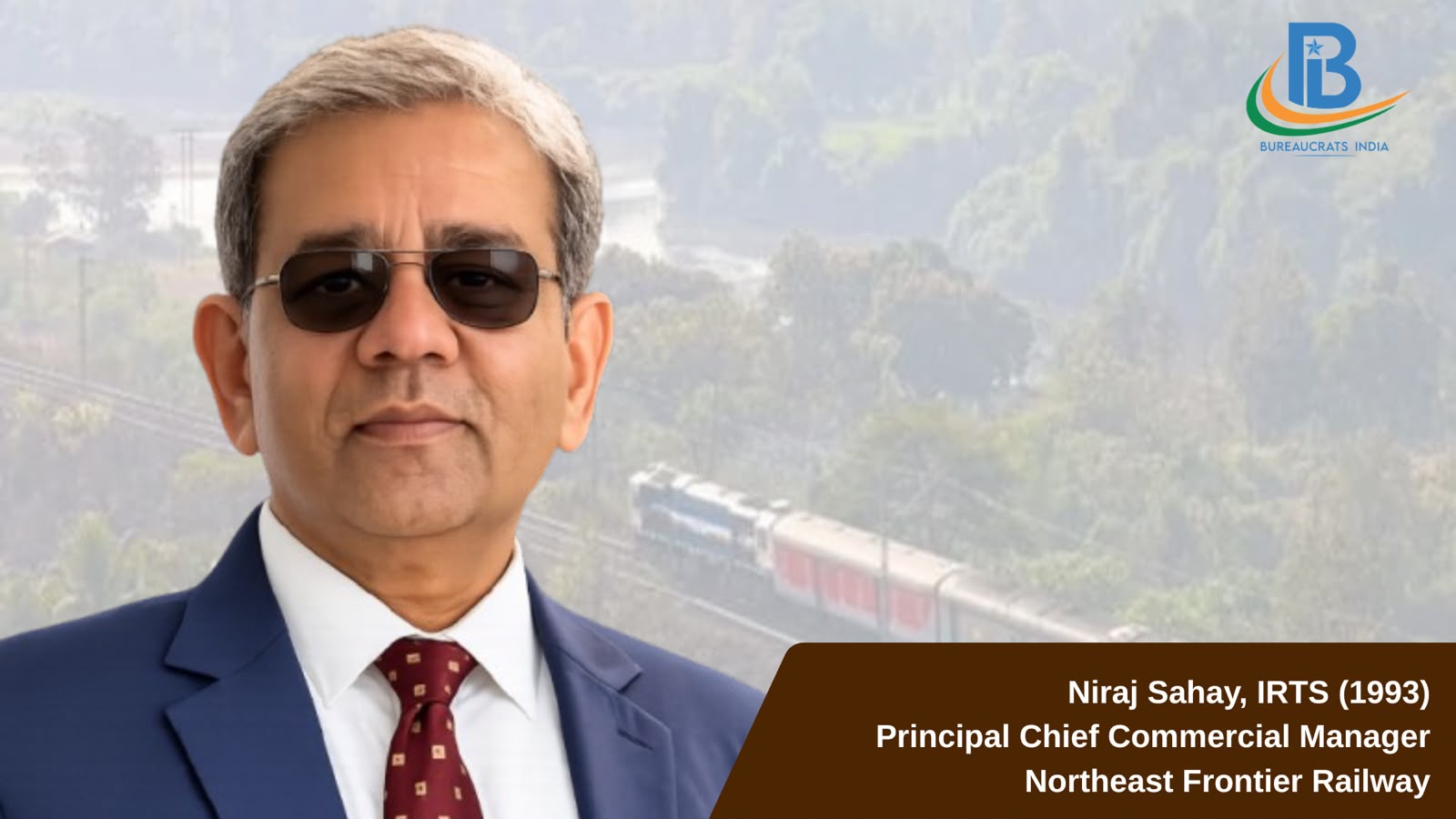
Guwahati: For most travellers, a railway station is much more than a transit point. It is the gateway to a city, the beginning of a journey, and often the first impression of a region. Across Northeast India, these gateways are undergoing a remarkable transformation under the leadership of Niraj Sahay, a 1993-batch Indian Railway Traffic Service (IRTS) officer and the Principal Chief Commercial Manager (PCCM) of Northeast Frontier Railway (NFR).
Headquartered in Maligaon, Guwahati, Northeast Frontier Railway is one of the 18 premier zones of Indian Railways and serves as the lifeline of connectivity for the Northeast. Its network extends across Assam, Arunachal Pradesh, Nagaland, Manipur, Meghalaya, Tripura, Mizoram and Sikkim, while also covering parts of West Bengal and Bihar. Operating through five divisions vis-à-vis, Alipurduar, Katihar, Lumding, Rangiya and Tinsukia; NFR manages more than 4,200 kms of railway routes and serves over 400 stations spread across some of the country's most challenging terrains.
The zone holds immense strategic significance. Its railway lines operate close to the international borders of Nepal, Bangladesh, Bhutan, China and Myanmar, making it crucial not only for economic development but also for national security. At the same time, NFR continues to push connectivity deeper into remote regions and works towards linking previously unconnected state capitals to the national rail network.
Against this backdrop, Niraj Sahay's efforts are helping redefine the passenger experience while creating new avenues for commercial growth.
Airport-Style Stations and Passenger Comfort
One of the most visible changes has been the modernization of station infrastructure. "Railway stations across the zone are being upgraded with airport-style amenities designed to improve convenience and navigation. Modern signages have been installed to help passengers easily locate platforms, exits, waiting halls, booking offices, food courts and other facilities. These seemingly simple interventions significantly improve passenger movement and reduce travel stress, especially at busy stations," says Sahay, whose passion for the tracks is unparalleled.
Passenger comfort has also received focused attention. "Executive Lounges at major stations along with airport-style seating arrangements at platforms are being introduced across stations, offering a more comfortable waiting experience. Given the long-distance nature of travel in the Northeast, such enhancements directly improve the quality of journeys for thousands of passengers every day," informs Sahay, with a glint of pride in his eyes.
Beyond aesthetics, NFR has invested in strengthening essential infrastructure. Improved drainage systems have been developed at stations to prevent waterlogging and enhance cleanliness, particularly during the region's intense monsoon season. The redevelopment of planned station circulating areas, entry-exit approach roads, provision of covered sheds for passengers, raising of platforms from low levels to standard high level, extension of platform length to accommodate newly introduced full-length trains, and improved lighting for better visibility at night are some of the areas where focussed attention through allocation of dedicated funds has gradually started showing results. "These improvements create stations that are not only attractive but also resilient and functional," the 1993-batch officer adds.
Going Cashless
Sahay has also championed the adoption of digital payments across railway premises. Commercial units, including catering stalls operating within stations, are increasingly shifting towards cashless transactions, making purchases faster, more transparent and more convenient for passengers. All reserved and unreserved ticketing counters at stations have been provided with UPI/QR-coded facilities for cashless payments, and parcel and luggage bookings too have been made cashless. The initiative aligns with India's broader digital transformation agenda and improves operational efficiency.
Guwahati's New Snooze Lounge and Sleeping Pods
Passenger amenities have expanded significantly under Sahay's leadership, taking rest and comfort facilities to the next level. "At Guwahati Railway Station, a modern snooze lounge featuring 54 air-conditioned sleeping pods with TV and Wi-Fi facilities offers day-trippers and religious tourists a safe and comfortable place to rest during long layovers or overnight journeys," informs Sahay, while acknowledging the support from the Assam Government for other modernisation works.
The facility has been developed on a plot of about 900 square metres near Guwahati Railway Station that had earlier been overrun with garbage and disused pump houses. Structured as a five-year contract commencing January 2026, the project carries a total contract value of ₹1.13 crore. Besides the 54 air-conditioned snooze lounges and Wi-Fi-enabled sleeping pods, the facility includes a dedicated ladies' powder room and a multi-cuisine restaurant reserved exclusively for users of the paid facilities.
Retiring rooms across the zone have also been upgraded with improved furnishings and modern facilities, providing accommodation options that cater to different budgets and requirements.
Branded Retail and the Rise of 'The Terminal'
The commercial landscape of railway stations is evolving as well. NFR is positioning stations as vibrant public spaces where passengers can access organised retail services. "The upcoming branded outlets such as Zudio/Westside reflect a broader vision of transforming stations into commercially active destinations while generating additional revenue for the railway," adds Sahay.
Among the most innovative projects in progress is "The Terminal," being developed at the old, non-operational PRS (Passenger Reservation System) building adjacent to Guwahati Railway Station — billed as Northeast India's first transit retail destination. Officially titled "Soft Play Area, Flea Market & Branded Food Kiosks at Old PRS Building, Guwahati," the project is spread over 25,000 square feet and is being developed on a revenue-sharing basis for a tenure of five years with effect from 09.05.2026 under the NINFRIS Scheme. It will bring together a soft-play area, a flea market and branded food kiosks with an "Artisan's Alley," alongside a gaming zone for passengers, with proposed outlets including Domino's, KFC, Baskin Robbins, Tao Bao, WOW! Momo, Belgian Waffle and Subway.
The project is expected to generate steady non-fare revenue for the railway through licence fees over its five-year tenure; starting at Rs 30 lakh in the first year (already paid) and Rs 30 lakh in the second year, rising to Rs 33 lakh in the third year, Rs 36.3 lakh in the fourth year and Rs 39.93 lakh in the fifth year, for a total of about ₹1.69 crore over the licence period.
Beyond retail and dining, the redevelopment has been backed by significant civic infrastructure upgrades: a dedicated Sewage Treatment Plant (STP) for scientific and environmentally compliant disposal of sewage generated from the food court; a modern Effluent Treatment Plant (ETP) for treatment of kitchen wastewater in line with pollution-control norms; integrated drainage and wastewater management connecting all existing pipelines to the central STP; and a comprehensive hygiene and sanitation overhaul of the building's rear service areas. Officials note that the transformation is stark ~ a once-derelict, overgrown compound with a dilapidated boundary wall is being reimagined into a landscaped, well-lit retail and dining precinct with a themed entrance, garden restaurants and an artisan's alley.
"Such projects seek to unlock the value of railway assets while creating community-oriented public spaces," adds the officer.
A Single-Brand Premium Store at the Station Circulating Area
In a parallel initiative, NFR is developing a Single Brand Premium Store within the circulating area of Guwahati Railway Station. The project has been awarded for a ten-year tenure, from 16 November 2026 to 15 November 2036, and is expected to earn the railway about Rs 1.05 crore over the contract period. The three-storeyed retail space, with a ground floor and first floor of about 2,910 square feet each, has been designed with a curved glass façade, and prospective brands under consideration include Zudio, Vishal Mega Mart, V2 Value & Variety, Max and V Mart.
The ground floor layout provides for male and female toilets, a staircase, a lift and a back office within the 2,910 sq. ft. footprint, while the first floor houses a store room alongside the staircase and lift lobby; designed to give the premium retail format a functional, modern back-of-house alongside its striking street-facing glass frontage.
Reviving Heritage: Rail Coach Restaurants and Amingaon
Similarly, Rail Coach Restaurants, which repurpose railway coaches into themed dining destinations, are being proliferated at various stations where demand exists. Another ambitious initiative is a proposed cultural and culinary hub at the old and abandoned Amingaon station on the banks of the Brahmaputra. Amingaon was the old station of the metre-gauge era, from before 1962, when there was no rail connectivity across the Brahmaputra, and it now stands abandoned. Envisaged features include theme parks, cultural venues, conference facilities, garden restaurants, playgrounds, museums, wellness centres and event spaces, a project with the potential to become a major attraction for Guwahati.
Last-Mile Connectivity and Tourism
Recognising the importance of seamless travel, NFR is strengthening last-mile connectivity as well. Automated systems are being planned to enable passengers to book taxis and app-based transport services directly from railway stations — particularly beneficial for travellers heading to destinations such as Shillong and other parts of the Northeast, where onward connectivity plays a critical role in the overall travel experience.
Tourism promotion has emerged as another important focus area. The Northeast is home to extraordinary natural beauty, cultural diversity and adventure tourism opportunities. By improving station infrastructure, enhancing passenger facilities and creating destination-oriented commercial spaces, "NFR is helping make the region more accessible and attractive to visitors from across India and abroad," adds Sahay.
Non-Fare Revenue and Electrification
A key component of Sahay's strategy has been revenue diversification through non-fare income. Retail outlets, food courts, advertisements, tourism services, parking facilities and themed developments are being leveraged to generate sustainable revenue streams. This approach enables NFR to improve passenger services while strengthening its financial sustainability.
Importantly, these initiatives are taking place alongside NFR's ambitious push towards complete railway electrification. The zone is rapidly progressing towards 100 percent electrification, supporting Indian Railways' larger goal of achieving net-zero carbon emissions. Electrification is also enabling seamless electric locomotive connectivity between Northeast cities and major destinations such as New Delhi, improving efficiency while reducing environmental impact.
New Jalpaiguri: A Gateway to the Hills
Beyond Guwahati, Sahay has also outlined plans for New Jalpaiguri (NJP) station, a key gateway for tourists heading to Darjeeling, Gangtok and Kalimpong. A Passenger Amenities Hub is coming up at NJP over an unused land parcel, with modern resting facilities and a lounge for transit tourists who de-board at the station before continuing on to the hills — a facility expected to also generate good non-fare revenue for the railway. Separately, a passenger experience zone has already been created at NJP on its newly developed platforms.
A wholly new building with modern facilities has also been sanctioned for narrow-gauge passengers who take joy rides in toy trains from NJP to Darjeeling via the Darjeeling Himalayan Railway (DHR), a UNESCO-declared World Heritage asset.
A New Vision for Railway Travel
The transformation underway at Northeast Frontier Railway reflects a larger shift in the role of Indian Railways under the vision of Prime Minister Narendra Modi: from a transportation provider to a modern, passenger-centric and commercially dynamic public service institution. Through infrastructure upgrades, digital innovation, commercial redevelopment, tourism promotion and enhanced passenger amenities, Sahay is helping shape a new vision for railway travel in one of India's most strategically important regions.
As NFR continues to expand connectivity and modernize its network, the railway stations of the Northeast are increasingly becoming symbols of progress, reflecting both the aspirations of the region and the transformative potential of Indian Railways.