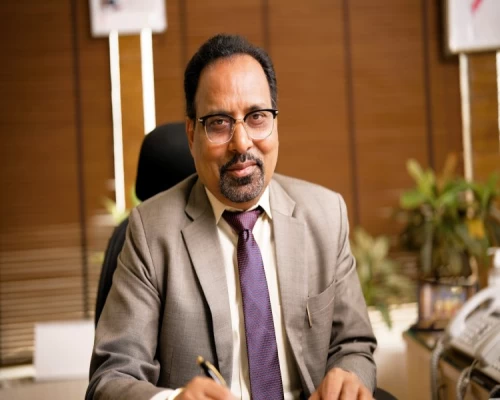
In an exclusive interview with Aparna Vats of Bureaucrats India, Shri Akash Tripathi, Managing Director of Solar Energy Corporation of India Ltd. (SECI), highlights the organisation’s expanding role as a key market maker in India’s clean energy transition. As the country advances towards its ambitious target of 500 GW of non-fossil fuel capacity by 2030, SECI is not only driving large-scale renewable deployment but also emerging as a leader in green hydrogen and green ammonia. Drawing on his extensive experience across governance, energy policy and technology-led institutions, Shri Tripathi explains how SECI’s globally competitive tariff discovery is attracting international investment, strengthening grid reliability, and positioning India at the forefront of the global clean energy economy.
1. Can you provide an overview of SECI’s current role in promoting renewable energy in India, and how its work aligns with the country’s larger clean energy goals?
Solar Energy Corporation of India Ltd. (SECI), a Central Public Sector Enterprise under the Ministry of New and Renewable Energy (MNRE), plays a significant role in advancing India’s renewable energy transition. As a key Renewable Energy Implementing Agency, SECI supports the development, deployment, and integration of renewable energy capacity across the country. SECI strengthens the renewable energy market through transparent competitive bidding and structured Power Purchase Agreements (PPAs) and Power Sale Agreements (PSAs). Acting as an intermediary procurer, it ensures long-term offtake for developers through back-to-back arrangements with DISCOMs and other buyers, enhancing investor confidence and market stability.
By translating national policies into on-ground implementation, SECI leverages India’s diverse solar and wind potential through data-driven planning and stakeholder collaboration. Beyond capacity addition, SECI supports emerging sectors such as hybrid projects, energy storage, green hydrogen, and offshore wind, which are essential for grid stability and higher renewable penetration. Overall, SECI’s work aligns closely with India’s clean energy goals of expanding non-fossil capacity, strengthening energy security, promoting self-reliance, and enabling long-term decarbonisation.
2. SECI has played a key role in implementing the National Solar Mission and other MNRE schemes. How do you see SECI’s responsibilities evolving as India moves towards more ambitious renewable targets?
As India moves toward more ambitious renewable and decarbonisation targets, SECI’s role is evolving from a scheme-implementing agency to a strategic, market-shaping institution. While it will continue to implement MNRE schemes through transparent tenders, PPAs, and PSAs, SECI’s focus is expanding toward system-level renewable integration. Greater emphasis will be placed on hybrid projects, round-the-clock renewable power, and energy storage to ensure grid reliability as renewable penetration rises. SECI’s role is also deepening in emerging sectors such as green hydrogen, green ammonia, offshore wind, and advanced storage, where its experience in structured procurement and risk mitigation is critical to creating bankable frameworks and enabling private participation.
In addition, SECI is expected to play a larger role in market design and innovation, including new procurement models, demand aggregation, and enabling renewable access for DISCOMs, industries, and emerging green value chains, while continuing to address offtaker risk through its intermediary role.
3. Before joining SECI, you served as Additional Secretary in the Ministry of Power and held leadership roles across technology, energy, and governance. How does this diverse administrative experience shape your approach as MD of SECI?
My administrative experience across district, state, and national levels has shaped a systems-oriented and execution-focused approach at SECI. Serving as Additional Secretary in the Ministry of Power provided deep exposure to the sector’s structural challenges, including grid reliability, distribution constraints, and the importance of long-term contracting frameworks. This experience reinforces the need for renewable energy to be not only clean but also dispatchable, dependable, and seamlessly integrated into the power system core to SECI’s evolving mandate. My work in digital governance and technology-driven institutions such as Digital India Corporation, MyGov, and the India Semiconductor Mission further strengthened my belief in process innovation, data-driven decision-making, and institutional agility. At SECI, this translates into emphasis on transparent tendering, scalable procurement, and risk-mitigated frameworks that balance policy alignment with operational discipline, innovation with stability, and ambition with execution certainty.
4. SECI has been actively involved in developing large solar projects and solar parks across the country. Could you highlight a few such initiatives and explain their impact on states and local economies?
SECI has played a significant role in developing large-scale solar and solar-plus-storage projects across diverse geographies, delivering both clean power and local economic benefits. A flagship example is the 100 MW Solar PV project with a 40 MW/120 MWh Battery Energy Storage System at Rajnandgaon, Chhattisgarh. This project enables reliable power supply beyond solar hours, enhances grid stability, and serves as a reference model for solar-plus-storage deployment, while supporting local employment and ancillary services.
Another key initiative is the 100 MW Floating Solar PV project at Getalsud Dam in Jharkhand, which optimises water bodies for clean energy generation and positions the state as an early adopter of innovative technologies. The 300 MW Solar PV project at Ramagiri, Andhra Pradesh, developed under the CPSU Scheme Phase-II using domestically manufactured modules, supports Make in India and demonstrates SECI’s ability to enable inter-state renewable power flows.
In addition, SECI supports large solar parks through joint ventures with states, providing plug-and-play infrastructure that attracts private investment, generates employment, and delivers long-term socio-economic benefits. CSR initiatives around project sites further strengthen community development and inclusive growth.
5. With a ‘AAA’ credit rating and a Category-I power trading licence, SECI enjoys strong financial credibility. How does this strength help de-risk renewable projects and attract private and global investment?
SECI’s ‘AAA’ credit rating and Category-I power trading licence significantly de-risk renewable energy projects. Through long-term PPAs with developers and back-to-back PSAs with DISCOMs, SECI mitigates counterparty and payment risks, improving bankability for capital-intensive projects. Its trading licence allows demand aggregation and inter-state power flows, creating scale and predictability. SECI’s strong balance sheet enables standardised contracts and innovative procurement models for hybrid, RTC, storage-linked, and emerging green energy projects. As a trusted public-sector counterparty, SECI lowers the cost of capital and attracts domestic and global investors to India’s renewable energy market.
6. Energy storage and hybrid renewable projects are becoming critical for grid stability. How is SECI preparing to scale up battery energy storage systems and round-the-clock renewable power solutions?
As India targets 500 GW of non-fossil capacity by 2030, the focus is shifting from capacity addition to grid reliability and assured power delivery. SECI is responding by scaling up Firm and Dispatchable Renewable Energy and Round-the-Clock renewable models that bundle generation with storage or complementary sources. Battery Energy Storage Systems are central to this strategy, supported by declining battery costs and innovative storage-integrated tenders. These solutions help manage intermittency and enable power supply beyond generation hours. SECI is also supporting Pumped Storage Projects as a long-duration, cost-effective storage solution that complements battery storage. By aligning storage deployment, hybrid renewables, transmission planning, and market mechanisms, SECI is ensuring renewable energy is dispatchable, reliable, and grid ready.
7. India has committed to achieving around 500 GW of non-fossil fuel capacity by 2030. What specific role will SECI play in helping the country reach this target, especially in the coming five years?
India’s 500 GW non-fossil capacity target is among the most ambitious globally. Of the approximately 250 GW already achieved, SECI has enabled about 15% (excluding large hydro) through its procurement and implementation mechanisms. In the next five years, SECI will increasingly act as a market maker aggregating demand, conducting transparent e-bidding, and offering long-term contracts with strong payment security. SECI will also play a leading role in green hydrogen and green ammonia, having already enabled globally competitive tariffs that attract international investment. By strengthening hybrid, RTC, and storage-integrated tenders, SECI will help bridge the remaining gap toward 500 GW while ensuring grid stability and value for DISCOMs and consumers.
8. Renewable energy expansion often requires close coordination with states, DISCOMs and PSUs. How does SECI work with these stakeholders to address challenges such as land, transmission and payment security?
SECI plays a central facilitative role between developers, states, DISCOMs, and PSUs. Through transparent tariff-based e-bidding, long-term PPAs, and back-to-back PSAs, SECI provides contractual clarity and supports bankability while enabling states to meet Renewable Purchase Obligations. Payment security is addressed through mechanisms such as letters of credit, delinquent payment surcharge rules, and tripartite arrangements, supported by SECI’s highest credit ratings. SECI also works closely with state agencies to ease land acquisition, right-of-way clearances, and transmission connectivity, reducing delays and improving grid integration.
9. Given the fast-changing nature of the renewable energy sector, how does SECI adapt to policy changes, new technologies and market dynamics while continuing to remain a trusted nodal agency?
SECI’s adaptability stems from close coordination with MNRE and regulators, allowing rapid incorporation of policy changes into procurement frameworks. By designing tenders that encourage innovation and efficiency, SECI enables adoption of advanced technologies while supporting affordability and grid stability. Transparent bidding, standardised contracts, and strong payment security mitigate market and investor risk. Continuous engagement with states, PSUs, and global stakeholders ensures SECI stays a trusted nodal agency delivering scalable and bankable renewable solutions.
10. Looking ahead to 2030 and beyond, what is your vision for SECI, not just as a project implementing agency, but as a long-term institution shaping India’s clean energy future?
SECI’s vision is to evolve into a long-term institution shaping India’s clean energy transition, aligned with the Panchamrit goals. Beyond implementation, SECI aims to lead planning, procurement innovation, and market development across the renewable ecosystem. A key focus will be leadership in green hydrogen and its derivatives, positioning India as a global hub for green molecules. SECI’s move toward a CAPEX-heavy asset ownership model will strengthen energy security, support net-zero goals, and catalyse private investment, domestic manufacturing, and job creation.
SECI aspires to be a catalyst for systemic change bridging policy and markets, innovation and stability, and ambition and execution to build resilient clean energy infrastructure for India’s low-carbon future.
Aparna Vats