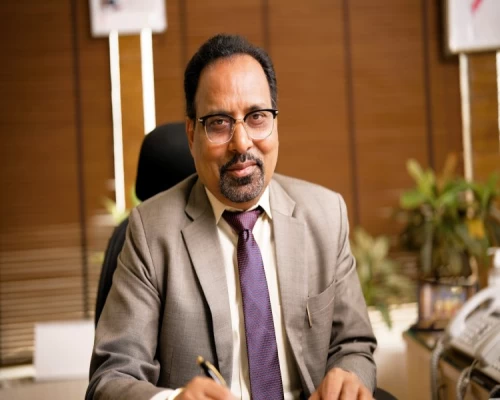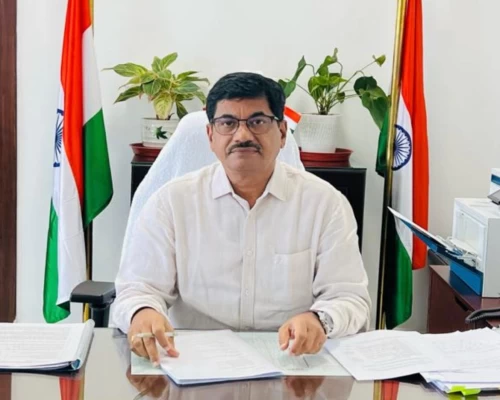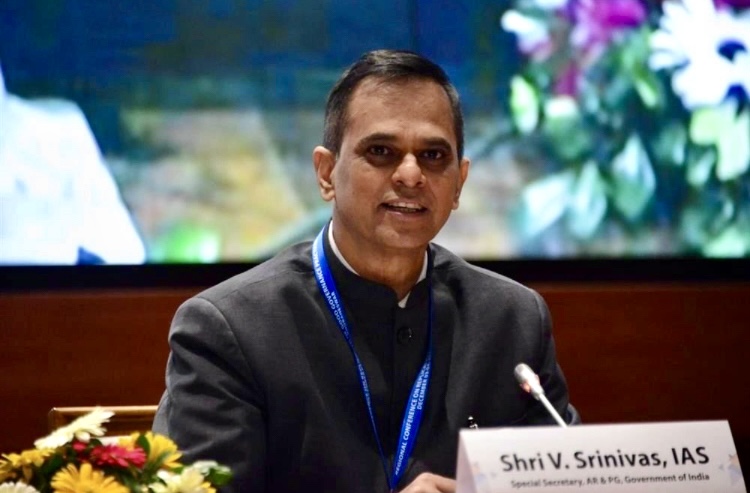
In a special edition of Bureaucrats India Dialogue, Editor-in-Chief Dr Navneet Anand speaks with Rajasthan Chief Secretary V. Srinivas on governance reforms, digital transformation, and India’s evolving administrative landscape. Here are the excerpts:
You have completed nearly four decades in service. What has fundamentally changed in governance, and what has remained constant?
Governance has undergone a significant transformation, especially with the shift to a digital state. Today, we operate in an ecosystem of smart cities, smart classrooms, digital hospitals, and technology-driven citizen interfaces. The philosophy of “minimum government, maximum governance” has expanded both scale and reach, enabling us to connect with the last citizen seamlessly.
However, the foundations of public service remain unchanged—leadership, fairness, adherence to the rule of law, ethics, and accountability. These values cannot be outsourced and continue to define the civil services.
Having worked in both the Union Government and a state like Rajasthan, how do the challenges differ?
At the Union level, governance involves policy formulation, international engagement, and coordination with states. Accountability is also more institutional, involving Parliament, judiciary, and oversight bodies.
In contrast, state governments focus on execution—delivering schemes on the ground within defined timelines. The institution of the District Collector, for example, remains one of the most resilient administrative systems globally, playing a critical role in grassroots governance.
You were the first Indian to head the International Institute of Administrative Sciences. What global governance lessons did you bring back?
India’s governance model stands strong globally due to its democratic depth and institutional strength. During my tenure, we worked towards making administrative sciences more inclusive, digitally connected, and knowledge-driven.
We enabled global collaboration, increased participation of scholars, and produced significant publications, including Viksit Bharat @2047: Governance Transformed. The idea was to ensure knowledge flows without boundaries and that every stakeholder contributes to global governance discourse.
How has your international exposure, especially with the IMF, shaped your approach to reforms?
My experience with the International Monetary Fund provided deep insights into macroeconomic stability, fiscal reforms, and global financial systems.
I witnessed India’s transformation—from a country facing a macroeconomic crisis in 1991 to becoming one of the fastest-growing economies and a creditor nation. This exposure strengthened my understanding of taxation, expenditure management, and policy frameworks.
How is the philosophy of ‘maximum governance, minimum government’ shaping Rajasthan’s vision of Viksit Rajasthan 2047?
The core is digital empowerment—both of citizens and institutions. Platforms like Jan Sampark have scaled grievance redressal dramatically through AI and automation.
We’ve replicated models like PRAGATI at the state level through Raj Unnati for project monitoring. Additionally, initiatives like Mission Rajivika are strengthening rural livelihoods through credit, skills, and market linkages. Technology is central to improving efficiency and service delivery.
Rajasthan aims to become a $4.3 trillion economy by 2047. What are the key drivers?
The roadmap, developed with NITI Aayog, focuses on sustained double-digit growth, capital expenditure, and inclusive development through the GYAN approach—Garib, Yuva, Annadata, and Nari.
Large infrastructure projects, digital governance, and social sector saturation are key pillars. Progress is continuously monitored through real-time dashboards and high-level reviews.
How are you ensuring a whole-of-government and whole-of-society approach?
Rajasthan has a strong legacy of participatory governance. Initiatives like Mukhyamantri Viksit Gram Abhiyan emphasize decentralized planning at the panchayat level.
We are also focusing on deregulation, reducing compliance burdens, improving ease of doing business, and enhancing institutional efficiency across sectors.
Industrial expansion through petrozones and infrastructure is gaining momentum. How does it fit into the growth blueprint?
Industrial growth is critical for macroeconomic expansion. Regions like Bhilwara, Pali, and Jaipur are being developed as industrial hubs.
The upcoming zones near the Hindustan Rajasthan Refinery will leverage petrochemical feedstock to boost downstream industries, creating jobs and strengthening value chains.
You’ve emphasized citizen-centric governance. How are systems being redesigned for accountability?
The citizen’s journey must be simplified. Technology has enabled this—from digital grievance systems to online FIRs and real-time monitoring of law enforcement processes.
We are also focusing on gender-sensitive policing, faster response systems, and improving safety, especially for women and tourists.
With such a demanding career, how do you view work-life balance?
The civil services demand resilience and continuous learning. There are steep learning curves and constant transitions.
I believe in commitment to national service. Hard work is non-negotiable. Staying physically fit and mentally focused is essential to sustain such responsibilities. The guiding principle remains—nation first, citizen first.
Your message to Bureaucrats India and its audience?
Bureaucrats India plays an important role in highlighting stories of governance and reform. I appreciate your efforts in showcasing the work of committed civil servants.
I look forward to continued collaboration in amplifying these voices as India progresses towards Viksit Bharat @2047.