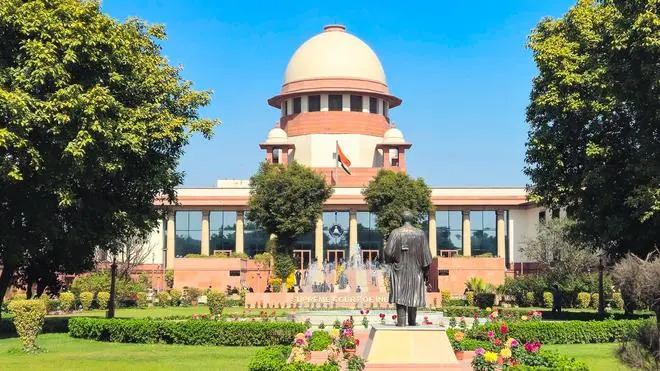
New Delhi: The Supreme Court has reignited one of India’s most sensitive debate - who should continue to benefit from reservation once a family has already achieved social and economic mobility through it.
Hearing a petition linked to the “creamy layer” principle in OBC reservation, the apex court questioned whether children of highly placed bureaucrats and affluent families should continue to claim quota benefits generation after generation.
A bench led by Justice B V Nagarathna made the pointed observation: 'If both parents are IAS officers, why should children have reservations?' The court further remarked that education and economic empowerment naturally lead to social mobility, raising concerns over the perpetual continuation of quota benefits within already empowered sections.
The remarks came during the hearing of a plea challenging the exclusion of a Karnataka-based candidate from OBC reservation benefits under creamy layer rules. Authorities had held that the candidate’s parents were government employees and their income exceeded the prescribed threshold.
The observations have once again brought the 'creamy layer' doctrine into national focus. The concept emerged from the landmark 1992 Indra Sawhney judgment, popularly known as the Mandal case, in which the Supreme Court upheld 27 per cent reservation for Other Backward Classes (OBCs) but ruled that the socially and economically advanced sections within OBCs must be excluded from reservation benefits.
At present, the creamy layer ceiling for OBCs is generally fixed at an annual family income of Rs 8 lakh, although exclusion is not determined by income alone. Children of senior constitutional authorities, top bureaucrats, and high-ranking officers can also fall outside reservation eligibility irrespective of earnings.
Interestingly, the Supreme Court had only recently clarified that parental income alone cannot determine creamy layer status, stressing that the nature and status of parents’ employment must also be taken into account.
The latest courtroom exchange, however, went beyond technical criteria and touched the larger philosophical question surrounding affirmative action - whether reservation is intended as a temporary ladder for upliftment or a continuing entitlement across generations.
Justice Nagarathna observed that if families continue availing reservation even after achieving educational and economic advancement, 'we will never get out of it.'
The remarks are likely to trigger fresh political and legal discussions, especially at a time when debates around sub-categorisation, creamy layer expansion, and reservation reforms are already intensifying across states and courts.
While the Supreme Court has not issued any ruling yet, its observations have reopened a difficult national conversation: at what point does social justice policy stop addressing disadvantage and start reproducing privilege within reserved categories themselves?
BI Bureau