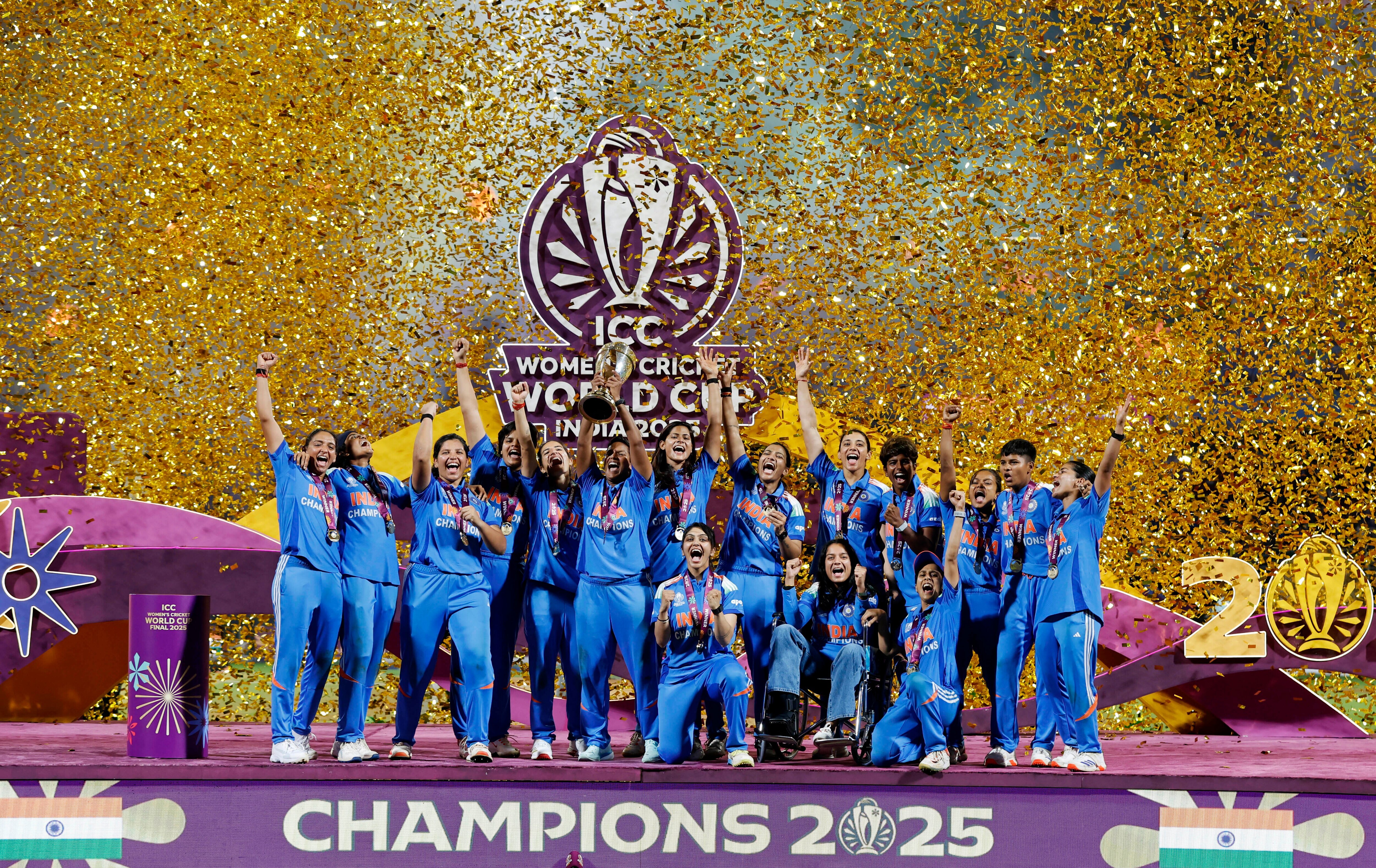
New Delhi: At the DY Patil Stadium in Navi Mumbai, history was made as India lifted the ICC Women’s Cricket World Cup for the very first time, defeating South Africa by 52 runs in a moment of immense pride for the nation. Batting first, India posted an impressive 298/7, powered by Shafali Verma’s 87, Deepti Sharma’s 58, Smriti Mandhana’s 45, and Richa Ghosh’s 34. In reply, South Africa managed 246 in 45.3 overs, with Laura Wolvaardt’s fighting 101 falling short against India’s disciplined bowling attack. Deepti Sharma shone with figures of 5/39, while Shafali added 2/36, and captain Harmanpreet Kaur sealed the historic victory with the final catch — marking a defining chapter in Indian cricket.
Women's cricket in India started small in the 1970s. Players like Shantha Rangaswamy, the first Test captain, traveled in unreserved train compartments and stayed in basic dorms. They often funded trips themselves or sought donations. The Women's Cricket Association of India formed in 1973 and held the first national tournament in Pune with just three teams. Kits were shared, and meals were simple home-packed food. Diana Edulji and her Railways team got jobs in 1984, allowing year-round training that gave them an edge domestically. India's first Test victory came in 1976 against West Indies, drawing 25,000 spectators in Patna.
Progress built slowly. Mithali Raj and Jhulan Goswami led India to the 2005 final, losing to Australia. Veterans remember being told the sport wasn't worth investing in; they raised money from NRIs or celebrities for tours. The 2017 final at Lord's was another close call—Harmanpreet's 171 in the semi-final against Australia got them there, but England won by nine runs after a late collapse. Harmanpreet later said of the 2025 team, "We lost three back-to-back games, but we knew this team had something special."
Around the world, other teams showed what was possible with early support. Australia has won seven titles, including 2022 when Alyssa Healy scored 170 in the final against England. Ellyse Perry has been a key all-rounder for them. England won the first World Cup in 1973, with Enid Bakewell scoring 118, and took three more titles, including 2017. New Zealand pulled off an upset in 2000 against Australia. These countries offered professional contracts and leagues sooner, giving players steady backing.
In India, things changed after the BCCI took over in 2006. The Women's Premier League launched in 2023, and pay parity followed. In the 2025 tournament, India recovered from three losses to chase 339 against Australia in the semi-final—the highest knockout chase in women's World Cups—with Jemimah Rodrigues unbeaten on 127 and Harmanpreet on 89. Deepti was the first player, men’s or women’s, to score 200 runs and take 20 wickets in one edition. The BCCI gave the team ₹51 crore, plus the ICC's $4.48 million prize. Coach Amol Mazumdar described it as a turning point.
Prime Minister Narendra Modi congratulated the team on X: "A spectacular win by the Indian team in the ICC Women’s Cricket World Cup 2025 Finals. Their performance in the final was marked by great skill and confidence. The team showed exceptional teamwork and tenacity throughout the tournament. Congratulations to our players. This historic win will motivate future champions to take up sports. #WomensWorldCup2025"
A spectacular win by the Indian team in the ICC Women’s Cricket World Cup 2025 Finals. Their performance in the final was marked by great skill and confidence. The team showed exceptional teamwork and tenacity throughout the tournament. Congratulations to our players. This…
— Narendra Modi (@narendramodi) November 2, 2025
The win connects past struggles to today's opportunities. From pioneers scraping by to players in a professional league, the team has come far. Sachin Tendulkar noted, "They’ve inspired countless young girls to pick up a bat and ball." It's a clear shift in how women's cricket is supported and seen in India.
1983 inspired an entire generation to dream big and chase those dreams. 🏏
— Sachin Tendulkar (@sachin_rt) November 2, 2025
Today, our Women’s Cricket Team has done something truly special. They have inspired countless young girls across the country to pick up a bat and ball, take the field and believe that they too can lift… pic.twitter.com/YiFeqpRipc
Yet this triumph is just the start. With growing infrastructure and global competition intensifying, the Women in Blue have a long way to go to defend the title, dominate bilaterals, and sustain the momentum for future generations.
BI Bureau