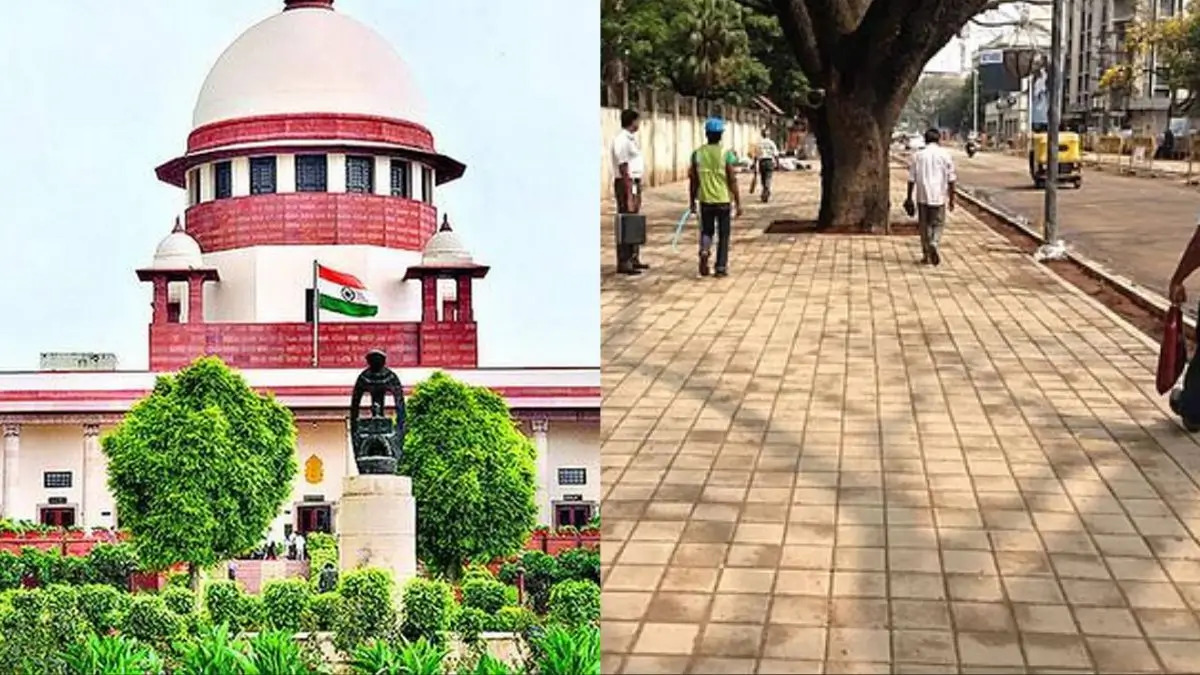
New Delhi: In a significant ruling on road safety and public spaces, the Supreme Court has declared that the right to walk on demarcated footpaths is a fundamental right and takes precedence over the privilege of motor vehicle use. The court also called upon the government to enact a dedicated law to safeguard pedestrian rights and ensure accountability for violations.
The judgment arose from a case involving the death of a five-year-old boy who was hit by a tanker while walking to school with his father. Reflecting on the tragedy, the bench of Justices P S Narasimha and Atul S Chandurkar observed, “Who could have ever imagined that it would be the last walk with his son?”
While examining the issue, the court noted that pedestrians remain among the most vulnerable road users in the country. It observed that footpaths are often encroached upon by vehicles, vendors and other obstructions, forcing people to walk in unsafe conditions despite dedicated pedestrian spaces being available.
Tracing the history of transportation, the court pointed out that walking existed long before wheeled transport, yet modern roads have largely been designed around motor vehicles. The bench said that over time, pedestrians have been pushed to the margins of urban planning and road infrastructure.
“It could also be elitism to start with, for machines with wheels were only for the rich, but as economies progressed and cheaper motor vehicles were introduced, the entire spectrum of motorised transportation dominated the roads, pushed aside the walkers to the extent that they are treated as a nuisance for the drivers who routinely run over the walkers and their footpaths. This should stop from now on as we declare the fundamental right to walk on demarcated footpaths alongside motorised roads,” said the court.
The bench described the lack of safe and accessible footpaths, and the tendency to subordinate pedestrian spaces to vehicular movement, as a “civilisational problem”. It also linked the act of walking to India’s freedom movement, highlighting its broader social and historical significance.
Commenting on the ruling, Piyush Tiwari, founder and CEO of SaveLIFE Foundation, said the judgment changes the way road users are prioritised.
“For decades the footpath has been the most expendable line on road building and maintenance plans. By recognising the right to walk as a fundamental right that takes priority over motorised traffic, the Supreme Court has reversed that hierarchy, and rightly so. For municipal bodies and road-owning agencies, a safe, unobstructed footpath is no longer discretionary, it is a constitutional duty wherever a road exists,” said Tiwari.
The court also examined the framework of the Motor Vehicles Act, 1988, stating that the legislation primarily focuses on vehicles and their regulation rather than on protecting the rights of pedestrians.
“The Motor Vehicles Act is built upon ‘vehicle’ as the subject of the legislation, while ‘human’ interests are incidental, which a motor vehicle must avoid violating, that’s all, and no further,” said the court.
Although the Motor Vehicles (Driving) Regulations, notified in 2017, require drivers to take special care of vulnerable road users such as pedestrians and cyclists, the court said these provisions remain advisory in nature and do not recognise a fundamental right to walk on footpaths.
“This Court has long been struggling to squeeze in pedestrian rights in the nooks and crannies of the Motor Vehicles Act and the attempt is still continuing with monitoring the implementation of its directions issued since 2012,” said the Supreme Court.
In the case before it, the court also restored and enhanced compensation awarded to the boy’s family. It set aside a High Court order that had reduced the amount granted by the Motor Accident Claims Tribunal. Recalculating the compensation, the Supreme Court increased it to Rs 11.44 lakh and directed that the amount be paid within two months.
The court further clarified that violations of the right to walk on demarcated footpaths would allow citizens to seek constitutional and legal remedies, in addition to those available under the Motor Vehicles Act, 1988.
BI Bureau