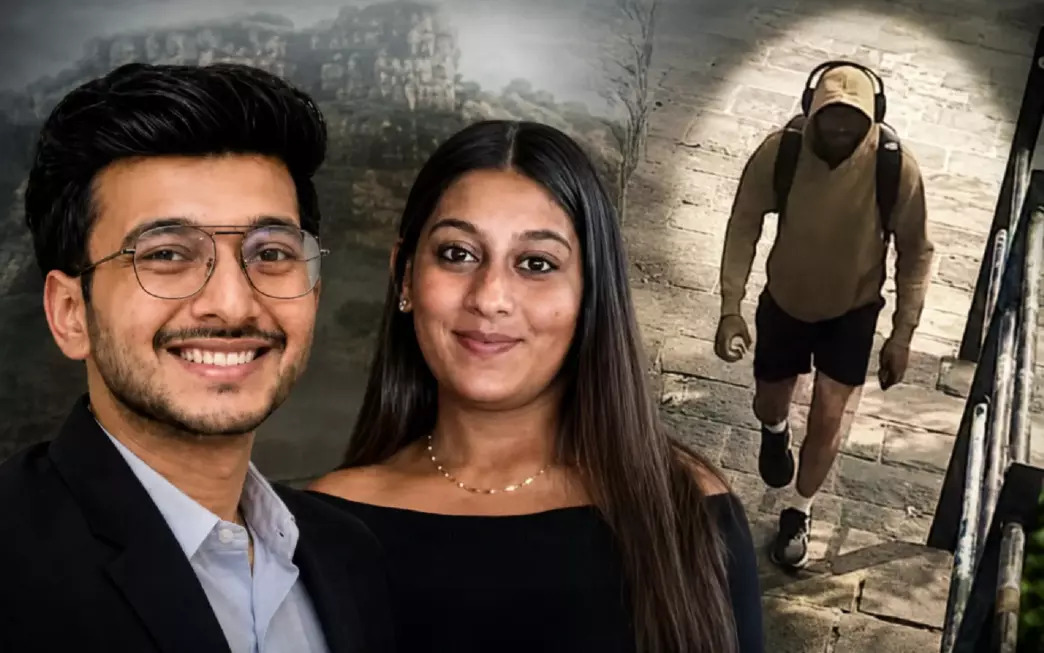
Pune: On June 14, what looked like a tragic trekking accident at Lohagad Fort soon became one of India’s most talked-about murder investigations. Within days, Pune Rural Police had dismantled the accident theory, reconstructed the sequence of events and arrested the victim's fiancée, Siya Goyal, and her alleged boyfriend, Chetan Chaudhary, for the murder of 26-year-old realtor Ketan Agarwal.
The investigation was led by Pune Rural Superintendent of Police Sandeep Singh Gill, who personally visited the crime scene soon after the incident and supervised every stage of the probe. A 2016-batch IPS officer, Gill took charge as Pune Rural SP in 2025 after serving as Deputy Commissioner of Police in Pune City. Hailing from a farming family in Punjab, he was a college professor before clearing the Civil Services Examination and joining the IPS.
One of the first clues that caught investigators' attention was a black hoodie. Despite the summer heat, CCTV cameras captured Chetan wearing the hoodie while heading towards Lohagad Fort with Ketan and Siya. Hours later, after Ketan's death, he was seen returning without it. Police searched the area and recovered the discarded hoodie from bushes near the fort. The recovery became one of the earliest physical clues that prompted investigators to question whether the death was really an accident.
Instead of accepting the version that Ketan had slipped while taking photographs, investigators began examining every detail. The crime scene was secured immediately, witnesses and fellow trekkers were questioned, and CCTV footage from multiple locations was collected to reconstruct the movements of the trio before and after the incident. Mobile tower locations and call detail records were analysed to establish a precise timeline.
The investigation soon shifted to digital evidence. Police found that WhatsApp chats, Instagram conversations, photographs and other data had allegedly been deleted from the accused's mobile phones. Even the recycle bins had been emptied. Rather than treating the missing data as lost, investigators sent the phones for forensic examination to recover the erased material, which they believe could establish the planning behind the alleged murder as well as communication after the incident.
Investigators also recreated the incident at Lohagad Fort using a dummy to determine whether Ketan could have accidentally fallen from the spot. The reconstruction, combined with forensic findings and physical evidence collected at the scene, reportedly strengthened the suspicion that the fall was not accidental.
As investigators dug deeper, they pieced together what they believe was the motive. According to police, Siya and Chetan had remained in a relationship despite Siya's engagement to Ketan. Investigators are examining whether family preference for a financially secure marriage, coupled with the couple's continuing relationship, led to the alleged conspiracy. Call detail records reportedly showed that Siya and Chetan had exchanged more than 2,000 phone calls over several months. During questioning, the two allegedly began giving conflicting statements, while investigators continued matching their claims with CCTV footage, forensic evidence and digital records.
The speed with which the case unfolded reflected a coordinated, evidence-driven investigation. Under SP Gill's supervision, investigators combined traditional detective work with modern forensic techniques, recovering physical evidence, analysing CCTV footage, examining mobile phone data, retrieving deleted digital records and reconstructing the crime scene. Within days, what had initially been reported as an accidental death had been converted into a murder case supported by multiple strands of evidence.
The Ketan murder case also highlights the changing face of policing in India. Increasingly, investigations are being driven by scientific evidence rather than solely by witness accounts or confessions. CCTV networks, digital forensics, call data analysis, cyber investigation, crime scene reconstruction and forensic science are becoming central to criminal investigations across the country. The Pune Rural Police investigation demonstrates how prompt intervention, careful preservation of evidence and technology-led policing can rapidly unravel even the most carefully planned crimes.
The case is now before the court, where the evidence collected by the investigating team will be tested during trial. Whatever the outcome of the judicial process, the investigation has already emerged as a notable example of the growing professionalism, technological capability and scientific approach being adopted by police forces across India.
BI Bureau