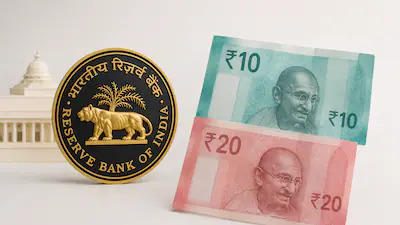
New Delhi: The Reserve Bank of India (RBI) is set to introduce polymer banknotes from the beginning of the next financial year, with Rs 10 and Rs 20 notes expected to be the first to enter circulation. The move is aimed at increasing the lifespan of frequently used currency notes while also strengthening the country’s currency printing capacity.
Announcing the plan after the monetary policy meeting, RBI Governor Sanjay Malhotra said the central bank has chosen lower denomination notes because they change hands more often and wear out faster than higher-value notes.
“Polymer notes have two purposes. One, it enhances the durability. This is relevant especially for the lower denominated notes with higher velocity. These notes have been in circulation for more than 30 years in various countries, and one finds that the life is much more, around 2-4 times the life of the paper currency,” Malhotra said at the central bank’s post monetary policy press conference.
“The second purpose is to expand our capacity as the needs of the economy increase,” he said.
Before introducing the new notes nationwide, the RBI will conduct field trials to evaluate how polymer currency performs under Indian climatic conditions and within the country’s existing cash-handling infrastructure.
“We will test and check on how they perform in the Indian climate, conditions, and other infrastructure that we have put in place,” Malhotra said. “We are targeting that circulation, if everything goes to plan, starts from the beginning of the next financial year,” he said.
As part of the pilot, the RBI will introduce 100 crore pieces each of Rs 10 and Rs 20 polymer notes, amounting to a total value of Rs 3,000 crore. To support the exercise, the RBI’s subsidiary, Bharatiya Reserve Bank Note Mudran Private Limited, recently issued a global tender for 3.4 crore polymer sheets, describing them as an “immediate requirement.”
According to the tender document, if the field trials are successful, the central bank plans to procure larger quantities of polymer substrate for multiple denominations in the future.
This is the RBI’s second attempt to introduce polymer currency in India. An earlier trial involving 100 crore Rs 10 polymer notes was conducted across cities with different climatic conditions, including Kochi, Shimla and Bhubaneswar. However, that initiative did not move forward after the notes encountered certain technical infirmities during testing.
BI Bureau