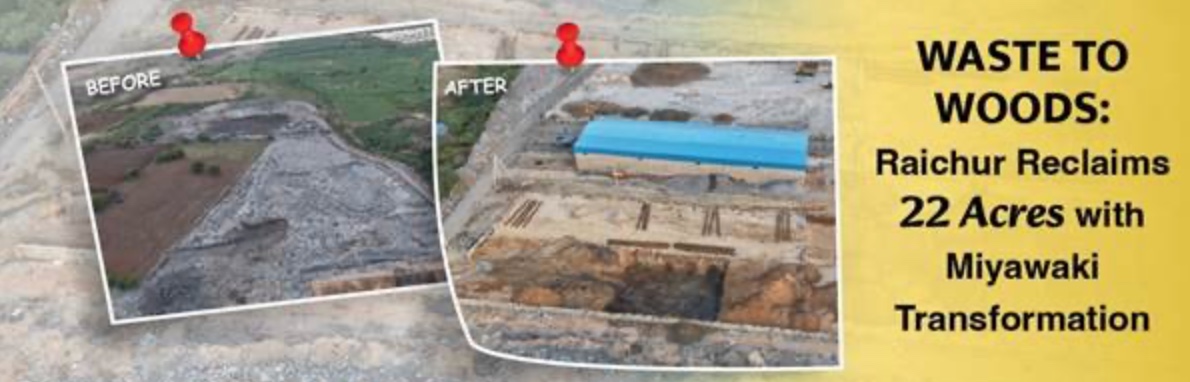
Raichur in Karnataka has transformed the 35-acre Yakalaspura dumpsite into a green urban asset through scientific remediation of legacy waste under the Swachh Bharat Mission-Urban 2.0 (SBM-U 2.0).
The project has so far processed around 62,252 metric tonnes of legacy waste and reclaimed nearly 22 acres of urban land. Part of the reclaimed land is now being developed into a Miyawaki forest, creating a new green space out of what was once a major waste-management challenge.
What is Legacy Waste?
Legacy waste refers to old, accumulated municipal solid waste lying at dumpsites for several years.
Such dumpsites can create multiple environmental and public health problems, including:
- Leachate, or polluted liquid generated from waste
- Foul odour
- Air and soil pollution
- Methane and other harmful emissions
- Occupation of valuable urban land
- Risks to nearby communities
Under SBM-U 2.0, one of the major objectives is to address such legacy dumpsites and create garbage-free cities.
What Happened in Raichur?
The Raichur City Corporation undertook scientific remediation of the Yakalaspura dumpsite.
The intervention has resulted in:
- 62,252 MT of legacy waste processed and remediated
- Nearly 22 acres of urban land reclaimed
- Plantation activities started on 5 June 2026, World Environment Day
- Around 60,000 saplings planted on the reclaimed land
The city has adopted the approach of "Toxic Waste to Ecological Wealth", seeking to convert a former dumpsite into an ecological asset.
What is a Miyawaki Forest?
The Miyawaki method is a technique of creating dense forests using native plant species in a relatively small area.
It was developed by Japanese botanist Akira Miyawaki.
The approach generally focuses on:
- Planting native species
- Creating dense vegetation
- Improving biodiversity
- Supporting soil restoration
- Increasing green cover
- Enhancing carbon sequestration
In Raichur, a Miyawaki forest is being developed across approximately 5–7 acres of the reclaimed land.
The plantation includes bamboo and other native species, with around 60,000 saplings planted. The site is expected to develop into a green cover within about a year.
Organisations Involved
The initiative is being implemented by the Raichur City Corporation in collaboration with Security Printing and Minting Corporation of India Limited (SPMCIL) and New India Space Limited.
The transformed site was inaugurated on World Environment Day, 5 June 2026, by Union Finance and Corporate Affairs Minister Nirmala Sitharaman.
Why is this Important for UPSC?
The Raichur initiative connects several important areas of the UPSC syllabus:
Environment: Waste management, pollution control, biodiversity and ecological restoration.
Urban Governance Sustainable management of urban land and municipal solid waste.
Government Schemes: Implementation of Swachh Bharat Mission-Urban 2.0.
Climate Change: Carbon sequestration and expansion of urban green cover.
Sustainable Development: Converting an environmental liability into a productive ecological asset.
UPSC Prelims Facts
Swachh Bharat Mission-Urban 2.0
- Focuses on making cities garbage-free.
- Includes remediation of legacy dumpsites.
- Promotes scientific management of municipal solid waste.
Miyawaki Method
- Developed by Japanese botanist Akira Miyawaki.
- Uses predominantly native plant species.
- Aims to create dense forests in relatively small areas.
Legacy Waste
- Old accumulated waste at existing dumpsites.
- Requires scientific remediation before the land can be safely reused.
Possible UPSC Mains Question
Q. Urban India faces the dual challenge of managing municipal solid waste and ensuring sustainable use of land. Discuss how legacy waste remediation and ecological restoration can help address these challenges.
Key points for an answer
- Legacy dumpsites occupy valuable urban land and create environmental risks.
- Scientific remediation can reduce pollution and public health hazards.
- Reclaimed land can be used for green spaces and other sustainable purposes.
- Miyawaki forests can contribute to biodiversity, carbon sequestration and urban greening.
- Such initiatives demonstrate how urban governance can combine sanitation, environmental protection and sustainable land use
- The Raichur model under SBM-U 2.0 shows the potential for converting waste-management challenges into ecological assets.
Main information source: PIB