New Delhi: Union Home Minister Amit Shah on Friday called for a coordinated international campaign against narcotics trafficking and narco-terrorism, warning that the world could face irreversible consequences if countries fail to act collectively within the next decade.
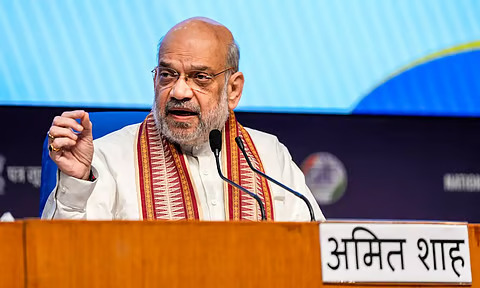
Speaking at the R. N. Kao Memorial Lecture 2026 organised by Research and Analysis Wing in New Delhi, Shah said global drug cartels were exploiting loopholes created by fragmented national laws and weak coordination between countries.
“If joint efforts are not initiated now, after 10 years the world will realise that it was too late to reverse the harm,” Shah said while addressing diplomats, former intelligence chiefs and senior members of India’s security establishment.
The lecture, themed “Narcotics: A Borderless Threat, A Collective Responsibility”, was attended by ambassadors and high commissioners from over 40 countries. The annual lecture series was instituted in 2007 in memory of Rameshwar Nath Kao.
Linking narcotics trafficking to terrorism and organised crime, Shah warned that drug syndicates were increasingly financing terror activities and parallel economies across regions. He also cautioned against the rise of “narco-states” emerging as alternative centres of power.
Shah said India was pursuing Prime Minister Narendra Modi’s vision of a “Drug-Free India by 2047” and that security agencies had prepared a roadmap to dismantle trafficking networks under a strict “Zero Tolerance” policy.
“Not one gram of narcotics will be allowed to enter India or use the country as a transit route,” he said.
The Home Minister argued that differing definitions of banned substances and varying punishments across countries had weakened global enforcement efforts and allowed traffickers to shift operations across borders.
“Unless there is a high degree of global alignment on what is designated as controlled substances, as well as common standard penalties for drug trafficking, drug cartels will continue to take advantage of the inconsistencies in policy,” he said.
Shah proposed a four-point international framework that included uniform definitions of prohibited narcotics, standardised punishments for trafficking offences, faster extradition of drug kingpins and real-time intelligence sharing between countries.
Highlighting India’s recent efforts, he said more than 40 transnational criminals had been brought back to the country over the past two years with the support of partner nations, while adding that further cooperation was needed.
Addressing diplomats directly, Shah urged governments to view the narcotics crisis as more than a law-and-order challenge and called for joint political, intelligence and security responses.
“A world of 8 billion people, 195 nations, and 250,000 kilometres of international borders cannot tackle the problem of drugs through fragmented approaches,” he said.
He concluded by urging nations to rise above geopolitical differences and strengthen coordinated operations against global narcotics networks and narco-terror groups.
BI Bureau