New Delhi: One year after Operation Sindoor emerged as one of India’s most decisive responses to cross-border terrorism, the Narendra Modi government on Thursday used the anniversary to underline a larger message — that India’s security doctrine has fundamentally shifted towards rapid retaliation, integrated warfare and institutional preparedness.
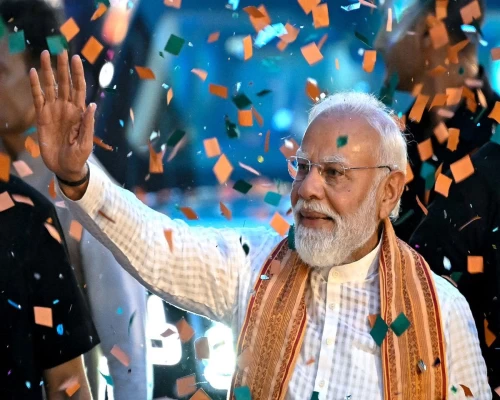
Prime Minister Narendra Modi led tributes to the armed forces, describing Operation Sindoor as a “fitting response” to those who attacked innocent civilians in Pahalgam, and said the operation reflected India’s “courage, precision and resolve” in combating terrorism.
Defence Minister Rajnath Singh said the operation demonstrated “unmatched precision, seamless jointness and deep synergy across services”, calling it a defining example of India’s preparedness against emerging security threats.
Operation Sindoor was launched in May 2025 following the deadly Pahalgam terror attack that killed 26 people. Indian forces carried out precision strikes on multiple terror-linked targets across the border in what officials described as a calibrated but decisive response aimed at dismantling terror infrastructure while avoiding wider escalation.
Beyond the military action, Operation Sindoor is increasingly being viewed within strategic circles as a benchmark in governance coordination and bureaucratic efficiency during conflict management. Senior officials across the defence, intelligence, diplomatic and home affairs establishments worked through an integrated command structure that ensured rapid decision-making, coordinated messaging and real-time operational support.
Officials say the operation reflected a new model of “whole-of-government” response, where military preparedness was backed by seamless inter-ministerial coordination, intelligence integration and diplomatic outreach. Crisis communication, airspace management, cyber preparedness and international engagement were executed simultaneously, minimising uncertainty while projecting strategic clarity.
The operation also accelerated conversations around integrated theatre commands, indigenous defence manufacturing and technology-led warfare. Security planners increasingly view Operation Sindoor as a case study in multi-domain operations involving precision strikes, electronic warfare, surveillance systems and coordinated command-and-control mechanisms.
The anniversary was marked by coordinated messaging across the government, with Prime Minister Modi, External Affairs Minister S. Jaishankar and several Union ministers changing their social media display pictures to Operation Sindoor insignia, underscoring the operation’s continuing strategic and political significance.
Military analysts say the operation marked a transition from reactive security responses to a doctrine centred on deterrence, speed and visible state capacity.
Unlike earlier limited retaliatory actions, Operation Sindoor projected India’s willingness to undertake swift, technology-driven and coordinated action against terror infrastructure.
Even a year later, the operation continues to shape discussions around national security, governance preparedness and civil-military coordination. The message from New Delhi on the anniversary remained clear: Operation Sindoor was not merely a military mission, but a template for India’s evolving security and governance architecture.
BI Bureau