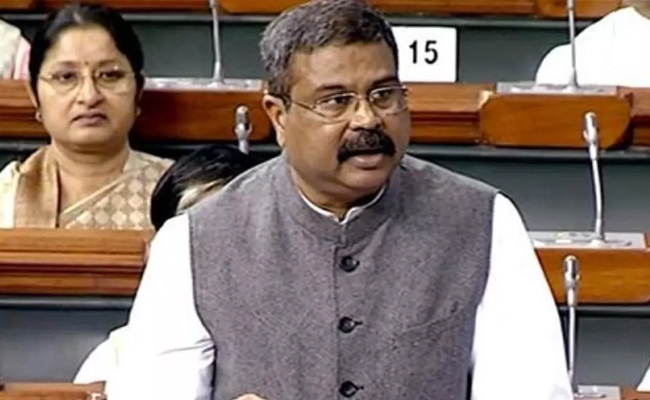
New Delhi: Education minister Dharmendra Pradhan on Monday introduced the Viksit Bharat Shiksha Adhishthan Bill, 2025 in the Lok Sabha, proposing a structural overhaul of higher education regulation aimed at improving quality, autonomy and global alignment of Indian institutions.
The Bill seeks to empower higher educational institutions through coordinated standard setting and simplified regulation, in line with the National Education Policy 2020. It proposes the creation of the Viksit Bharat Shiksha Adhishthan as an apex body, supported by three independent councils for standards, regulation and accreditation.
If enacted, the law will repeal the University Grants Commission Act, the All India Council for Technical Education Act and the National Council for Teacher Education Act. Their roles will be subsumed under the new Adhishthan, bringing all higher educational institutions under a single regulatory framework while retaining the existing autonomy of Institutions of National Importance. The Council of Architecture will continue as a professional standard setting body.
The Bill follows Cabinet approval granted on 12 December, 2025 and is introduced under Entry 66 of the Union List, which deals with coordination and determination of standards in higher education and research institutions.
A central feature of the proposed system is a technology-driven, faceless single-window mechanism. Institutions will disclose governance, financial, academic and performance-related information on a public digital portal. This disclosure will also serve as the basis for accreditation, reducing multiple inspections and approvals.
The proposed framework separates standard setting, regulation and accreditation to avoid overlap. The Standards Council will specify minimum academic benchmarks, the Regulatory Council will ensure compliance and coordination, and the Accreditation Council will function as an independent accrediting authority.
The Bill also focuses on student-centric reforms, including a strengthened grievance redressal mechanism, structured student feedback in institutional evaluation and wider access to holistic and interdisciplinary education. It aims to raise the gross enrolment ratio, promote research and innovation, and prepare students for emerging areas critical to national development.
By simplifying regulation and aligning academic standards with global practices, the proposed law seeks to support innovation in higher education and contribute to long-term goals such as Atmanirbhar Bharat.
BI Bureau