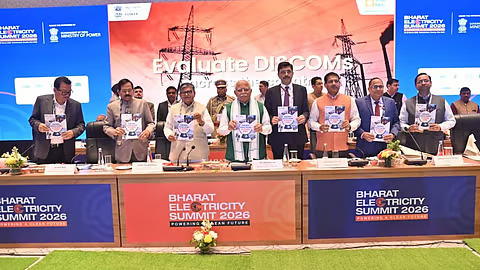
New Delhi: Power sector leaders have called for accelerated and sustained reforms in the distribution segment to secure the financial health of DISCOMs and support India’s long-term energy transition goals. The discussion took place during a CEO roundtable on power distribution under the draft National Electricity Policy, 2026 (NEP 2026) at the Bharat Electricity Summit 2026 on Friday.
The meeting, chaired by Pankaj Agarwal, Secretary, Ministry of Power, brought together top executives from leading power sector organizations to deliberate on strengthening the distribution ecosystem.
Participants welcomed the draft policy, describing it as “comprehensive and forward-looking” in addressing emerging challenges. They noted that it offers “a clear strategic direction for strengthening the power sector in the context of India’s transition towards sustained high economic growth.”
Industry leaders highlighted that the proposed reforms, especially in distribution, would play “a critical role in enhancing financial viability, improving service quality, and enabling the integration of new and evolving technologies.”
Discussions also focused on aligning electricity supply with the ambitions of Viksit Bharat @ 2047, which envisions a USD 30 trillion economy and energy independence. The draft NEP 2026 aims to “increasing per capita electricity consumption to 2,000 kWh by 2030 and over 4,000 kWh by 2047.”
These targets are in line with India’s climate commitments to reduce emissions intensity by 45 percent from 2005 levels by 2030 and achieve net-zero emissions by 2070, requiring “a decisive shift towards low-carbon energy sources.”
Improving financial sustainability of DISCOMs emerged as a key priority. The policy proposes measures such as “optimisation of power procurement through advance planning, reduction of Aggregate Technical & Commercial (AT&C) losses, and strengthening of corporate governance mechanisms.”
It also outlines plans to achieve “single-digit AT&C losses through phased rollout of smart meters with prepayment functionality,” beginning with government, commercial and industrial users, along with “regular energy audits and improved accounting practices.”
To improve efficiency and accountability, the policy recommends “shared distribution networks” to avoid duplication of infrastructure. It further stresses “GIS-based asset mapping, consumer indexing, and system automation” to enhance operations and service delivery.
Recognising the increasing role of distributed energy, the draft proposes setting up a Distribution System Operator to facilitate integration of “distributed renewables, energy storage systems, and Vehicle-to-Grid (V2G) technologies,” ensuring “optimal utilisation of resources through local energy markets.”
The policy also focuses on improving reliability and resilience of power supply through “optimal network redundancy at specified voltage levels” and stricter enforcement of service standards. It suggests redundancy at the distribution transformer level in cities with populations above 10 lakh by 2032, along with underground cabling in congested urban areas.
Ensuring universal electricity access, particularly in border regions, remains a key objective under the draft framework.
BI Bureau