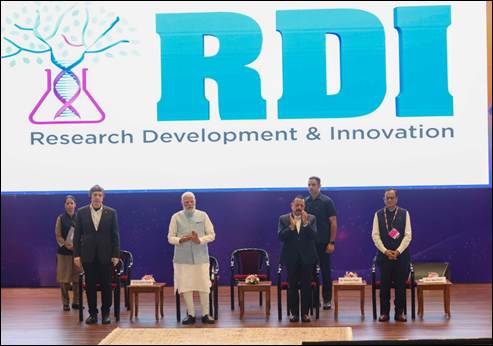
New Delhi: India has launched a major push to strengthen its research and development ecosystem with the introduction of the ₹1 lakh crore Research, Development and Innovation (RDI) Scheme. Announced on 3 November 2025 during the Emerging Science, Technology and Innovation Conclave (ESTIC) 2025 at Bharat Mandapam, New Delhi, the initiative aims to accelerate scientific progress and promote private sector participation in the country’s innovation landscape.
The RDI Scheme seeks to create a private sector–driven innovation environment by offering long-term financing and refinancing support for high-impact research projects at low or nil interest rates. It is designed to encourage greater investment in sunrise and strategic sectors while addressing challenges in private research funding through growth and risk capital.
The key objectives of the scheme include encouraging private sector participation in critical domains, financing transformative projects, supporting access to strategic technologies, and facilitating a Deep-Tech Fund of Funds to strengthen the financing ecosystem for innovation-led enterprises.
The launch coincided with ESTIC 2025, envisioned as India’s flagship platform for advancing scientific collaboration and technological development. The three-day conclave brings together more than 3,000 participants from academia, industry, and government, alongside Nobel Laureates, innovators, and policymakers. The event features plenary sessions, panel discussions, technical sessions, exhibitions of over 35 deep-tech start-ups, and poster presentations by young scientists.
Centred on the theme “Viksit Bharat 2047 – Pioneering Sustainable Innovation, Technological Advancement and Empowerment,” ESTIC 2025 reflects India’s growing ambition to build a knowledge-based, self-reliant economy driven by science and innovation.
Over the past decade, India’s commitment to research and innovation has grown steadily. The country’s Gross Expenditure on Research and Development (GERD) has more than doubled, rising from ₹60,196.75 crore in 2010–11 to ₹1,27,380.96 crore in 2020–21. Patent filings have also surged, increasing from 24,326 in 2020–21 to 68,176 in 2024–25, marking a major rise in domestic innovation.
As per Science and Engineering Indicators 2022 by the National Science Foundation, USA, India awarded 40,813 doctorates in 2018–19, including 24,474 in Science and Technology, ranking third globally in science and engineering PhDs after the United States and China.
The government’s efforts to promote research and innovation are supported by institutional and policy frameworks such as the Anusandhan National Research Foundation (ANRF), the National Geospatial Policy, the Indian Space Policy, and the BioE3 Policy.
The ANRF, established in February 2024, aims to mobilise ₹50,000 crore between 2023 and 2028 to strengthen academia–industry collaboration and fund high-impact research aligned with national priorities. Similarly, the National Geospatial Policy 2022 and Indian Space Policy 2023 are opening new avenues for data-driven innovation, while the BioE3 Policy 2024 promotes biomanufacturing and bio-based entrepreneurship for a sustainable economy.
The Atal Innovation Mission 2.0 continues to nurture innovation at the grassroots level through Atal Tinkering Labs and incubation centres, with an approved budget of ₹2,750 crore till 2028.
Several national missions are driving India’s presence in frontier technologies. These include the National Quantum Mission, the National Mission on Interdisciplinary Cyber-Physical Systems, the National Supercomputing Mission, the India Semiconductor Mission, the Deep Ocean Mission, and the IndiaAI Mission. Each focuses on strengthening indigenous R&D, building advanced infrastructure, and promoting collaboration between academia and industry.
India’s Digital Public Infrastructure (DPI) has further enhanced its R&D vision by enabling efficient, inclusive, and transparent governance systems. Platforms such as UPI, Co-WIN, DigiLocker, Aadhaar, and Direct Benefit Transfer have demonstrated how digital innovation can transform service delivery and strengthen the foundation for research and entrepreneurship.
India’s growing focus on research, innovation, and technology reflects a unified vision for Viksit Bharat@2047. With the launch of the RDI Scheme and complementary national initiatives, the country is laying the groundwork for a future where science and technology drive sustainable, inclusive, and globally competitive growth.
BI Bureau