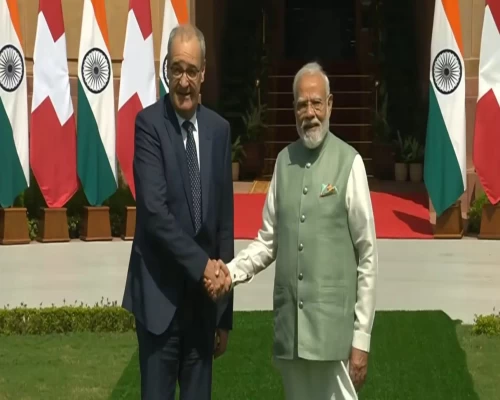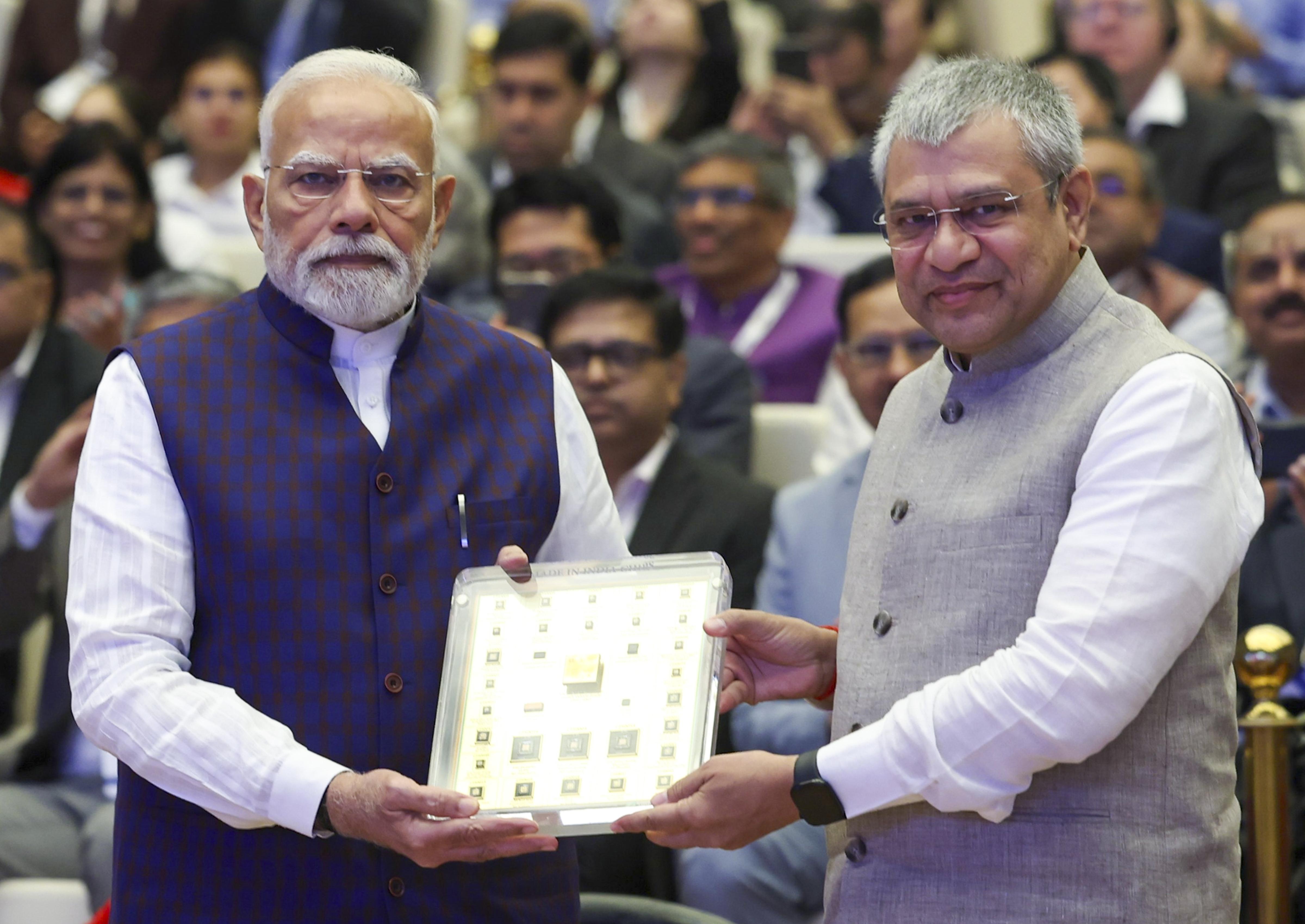
New Delhi: India took a major step in semiconductor self-reliance on Tuesday with the unveiling of Vikram 3201, the country’s first fully indigenous 32-bit microprocessor certified for use in launch vehicles. Electronics and IT Minister Ashwini Vaishnaw presented the processor to Prime Minister Narendra Modi at the Semicon India 2025 conference in New Delhi.
Developed by the Indian Space Research Organisation’s Semiconductor Laboratory in Chandigarh, the chip is designed to withstand extreme space conditions, including temperatures ranging from –55 to +125 degrees Celsius. It will power navigation, control, and mission management systems in rockets, handling the rapid calculations required to keep them on course.
The Vikram 3201 is an upgrade to Isro’s earlier Vikram 1601, a 16-bit processor used since 2009. Unlike its predecessor, the new chip supports 64-bit floating-point operations, Ada programming language compatibility, and includes on-chip 1553B bus interfaces for reliable avionics communication. Fabricated using 180-nanometre CMOS technology, it has already been validated in orbit aboard the PSLV-C60 mission, where it powered the Mission Management Computer on the PSLV Orbital Experimental Module.
“Just a few years ago, we met for the first time to make a new beginning driven by our Prime Minister's farsighted vision, and we launched the India Semiconductor Mission. In a short span of 3.5 years, we have the world looking at India with confidence. Today, the construction of five semiconductor units is going on at a rapid pace. We just presented the first ‘Made-in-India’ chip to PM Modi,” Vaishnaw said. Addressing global companies, he added, “We are living in unprecedented times, and global policy turmoil has created huge uncertainty. In these turbulent times, India stands as a lighthouse of stability and growth. In these uncertain times, you should come to India because our policies are stable.”
Alongside Vikram 3201, Isro also showcased Kalpana 3201, a 32-bit SPARC V8 RISC processor, and four other devices aimed at miniaturising avionics: two Reconfigurable Data Acquisition Systems, a Relay Driver IC, and a Multi-Channel Low Drop-out Regulator IC. Officials said these advances would significantly cut dependence on imported electronics for launch vehicles.
To support the ecosystem, Isro has built its own software tools for Vikram, including Ada compilers, assemblers, simulators, and development environments, with a C compiler under development. This ensures India controls both hardware and programming resources for space missions.
The launch was part of Semicon India 2025, a three-day event that brings together more than 20,750 participants, including 2,500 delegates from 48 countries, 150 speakers, and over 350 exhibitors. The conference covers semiconductor fabrication, advanced packaging, artificial intelligence, manufacturing, state policy, and international collaborations.
This year’s edition marks the fourth in the series, following earlier events in Bengaluru, Gandhinagar, and Greater Noida.
BI Bureau