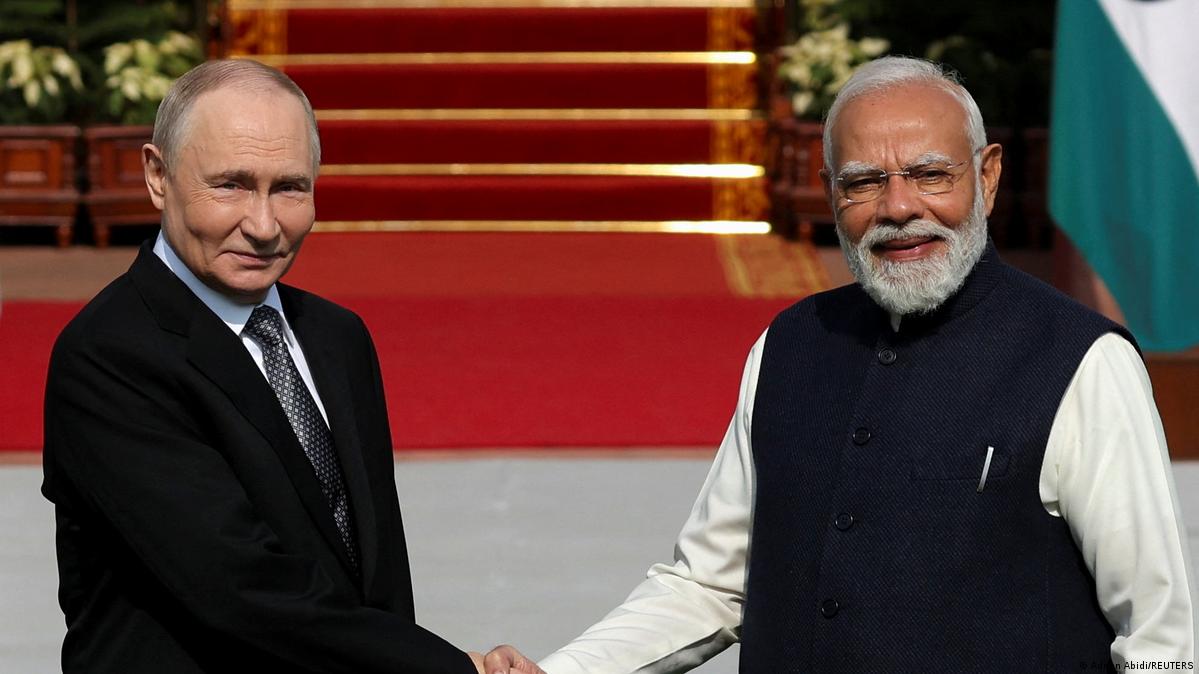
New Delhi: Russian President Vladimir Putin concluded his two-day visit to India on Friday after attending a banquet at Rashtrapati Bhavan hosted by President Droupadi Murmu. This was Putin’s first trip to India in four years, marked by detailed discussions with Prime Minister Narendra Modi on trade, defence cooperation and future economic frameworks. Foreign Secretary Vikram Misri said the leaders also reviewed the proposed free trade agreement currently being negotiated between India and the Eurasian Economic Union.
During the visit, both sides explored expanding nuclear energy cooperation. According to Bloomberg, India agreed to allocate a site for a second nuclear power plant with Russian-designed reactors. Defence cooperation also featured prominently, with Reuters reporting that Russia has proposed localising production of the fifth-generation Sukhoi Su-57 fighter aircraft in India.
Putin praised Modi’s leadership, saying India is becoming technologically sovereign. He said India is pursuing an independent and sovereign policy under the leadership of PM Modi and achieving very good results, noting that the Indian economy is one of the fastest-growing in the world.
Modi and Putin addressed the India-Russia Business Forum following their talks at Hyderabad House, where Modi said the two countries are exploring joint ventures in electric vehicle manufacturing. He added that discussions have begun on a free trade agreement between India and the Eurasian Economic Union.
The leaders later delivered a joint press statement, where Putin assured India of “uninterrupted fuel” supplies, describing Russia as a reliable supplier of oil, gas and coal. His remark came amid continued pressure from the United States on India to scale down oil imports from Russia.
Both sides announced the finalisation of an economic cooperation programme until 2030 aimed at diversifying business ties and raising bilateral trade to 100 billion dollars by the end of the decade. Putin said work is progressing on an agreement for India to establish a free trade zone with the Eurasian Economic Union, adding that it could help increase trade further.
Reflecting on decades of bilateral ties, Modi said, “Over the past eight decades, the world has witnessed numerous ups and downs. Humanity has had to pass through many challenges and crises. And amidst all this, the India-Russia friendship has remained steadfast like a pole star.”
He also raised concerns over recent terror attacks, saying, “Whether it is the terrorist attack in Pahalgam or the cowardly assault on the Crocus City Hall , the root of all these incidents is the same.” Modi added, “India’s unwavering belief is that terrorism is a direct assault on the values of humanity and that global unity against it is our greatest strength.”
Modi highlighted the importance of cooperation in critical minerals to support secure and diversified global supply chains. He also announced that India will soon issue free electronic visas for Russian tourists and tour groups.
Before departing, Putin received a set of gifts from Modi, including Kashmiri saffron, Assam tea, an ornate silver tea set, a silver horse, a marble chess set and a Russian-language edition of the Bhagvad Gita.
BI Bureau