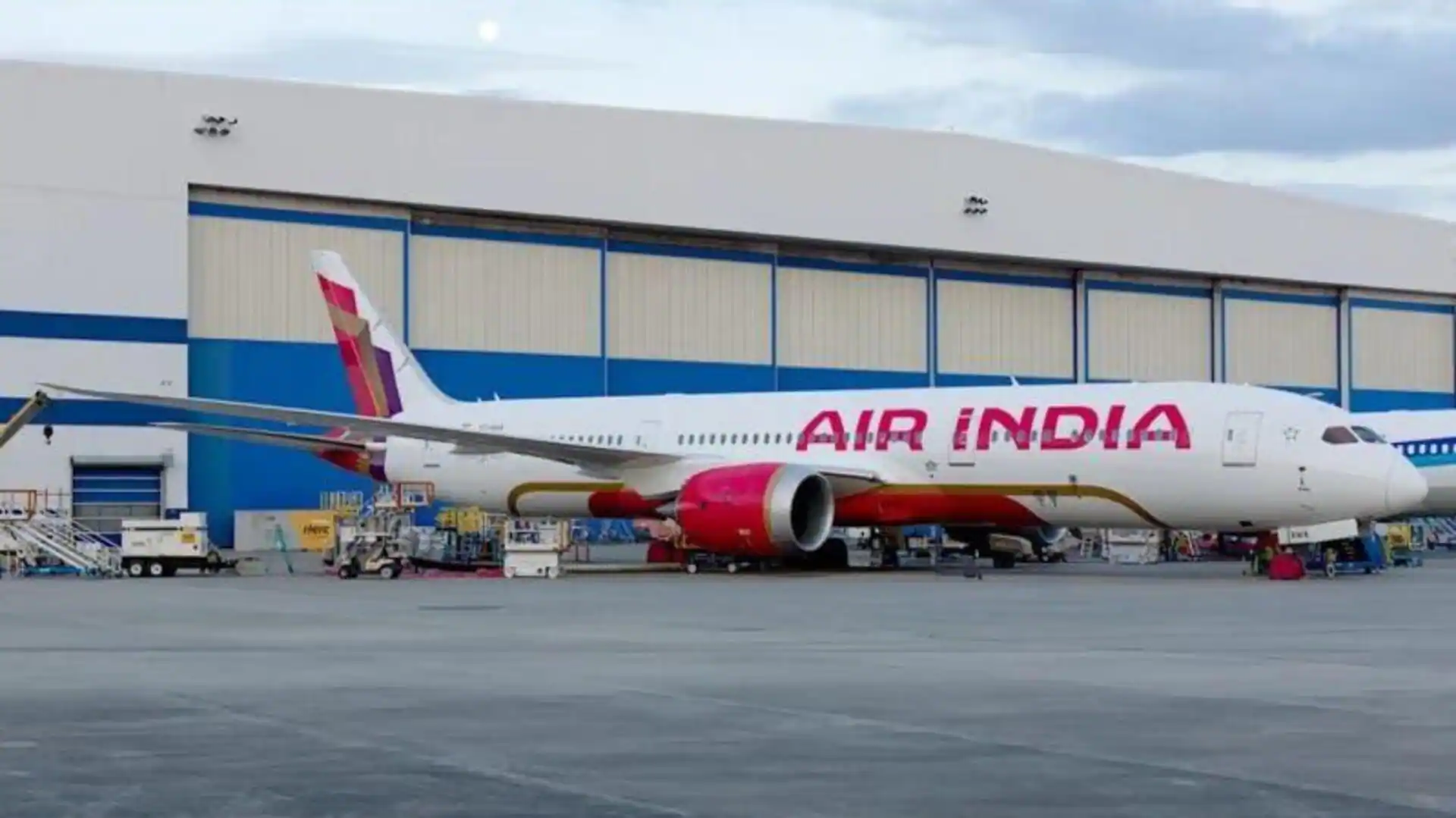
New Delhi: Air India is preparing to induct its first Boeing 787-9 Dreamliner in the first quarter of 2026, marking a key step in the airline’s ongoing wide-body fleet renewal and expansion of long-haul capacity.
Boeing has confirmed that delivery of the first aircraft is expected before the end of the current quarter, with production already underway on subsequent units. The 787-9s are part of Air India’s large aircraft order placed in 2023, aimed at reshaping its international network with newer, more efficient aircraft.
The 787-9 Dreamliner sits between the 787-8 and the larger 787-10 in Boeing’s wide-body family. Compared to the 787-8s already in Air India’s fleet, the 787-9 features a longer fuselage, higher payload capability, and extended range, allowing the airline to operate longer nonstop services with greater efficiency.
The aircraft generally accommodates between 250 and 290 passengers in a three-class layout. Air India’s version is expected to reflect the carrier’s updated brand identity, with a redesigned cabin, an expanded premium economy section, and an upgraded business class, subject to final configuration details.
Built largely using advanced composite materials, the 787-9 delivers around 20 percent better fuel efficiency than older wide-body aircraft. Its next-generation engines contribute to lower fuel consumption, reduced emissions, and quieter operations. With a range of about 7,565 nautical miles, the aircraft enables nonstop connectivity from India to destinations across Europe, East Asia, and North America.
Initial deployments are expected from Delhi and Mumbai, where international demand continues to grow faster than available capacity. Passenger comfort is enhanced through larger windows, improved cabin pressurisation, advanced air filtration systems, and higher humidity levels, features designed to reduce fatigue on flights lasting more than ten hours.
The first 787-9 will be the initial aircraft from Air India’s order of 20 of the type, included within its purchase of over 200 Boeing aircraft. Deliveries will follow a phased schedule, with multiple aircraft joining the fleet over the next two years. The aircraft is currently undergoing final acceptance checks, with approvals from the Directorate General of Civil Aviation expected before it enters commercial service. It will carry an Indian registration, in line with Air India’s existing wide-body fleet.
In parallel, Air India has outlined plans to induct six new wide-body aircraft in 2026, including Boeing 787-9s and Airbus A350-1000s. Older leased aircraft will be returned during this period, keeping the overall fleet size broadly steady while bringing down the average age of the fleet.
The airline is seeking to narrow the gap between international travel demand and available capacity, particularly on high-yield long-haul routes. Boeing, meanwhile, has noted that aircraft deliveries are only one part of the capacity equation in India. Airport infrastructure, slot availability, regulatory processes, maintenance capacity, and pilot availability continue to influence how quickly airlines can scale up operations.
The manufacturer said it has introduced system-wide production changes over the past 18 months to improve safety, quality oversight, and delivery reliability, as part of efforts to strengthen confidence among airline customers and support long-term fleet growth.
BI Bureau