New Delhi: With Bombay Creamery, Reliance is entering a market where mass pricing, premiumisation, regional brands and quick commerce are reshaping the way Indians buy an everyday indulgence.
Ice cream may look like an unusual category for a conglomerate whose consumer ambitions have already taken it into beverages, packaged foods, personal care and household products. But Reliance Consumer Products Limited’s latest move suggests that the company sees considerably more in the humble ice cream than an opportunity to sell another frozen dessert.
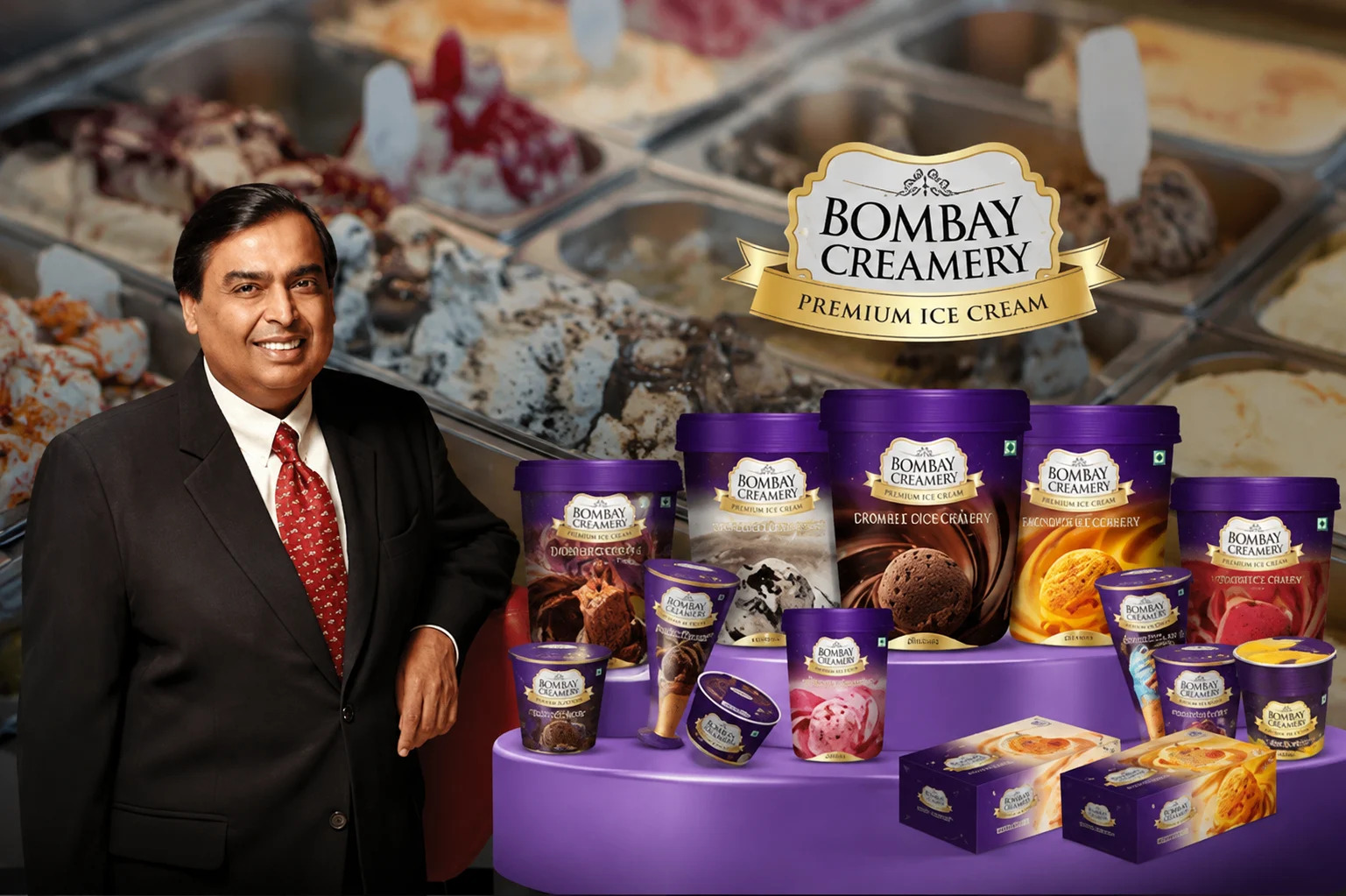
On September 1, Reliance Consumer Products, the FMCG arm of Reliance Industries, entered the ice-cream market with Bombay Creamery. The brand is being positioned as an accessible premium dairy ice cream, made with real dairy cream, with prices starting at just Rs.10. The initial rollout is focused on western India, with a pan-India expansion planned subsequently. The range spans cups, cones, tubs, bars and sticks.
The Rs.10 starting price is perhaps the clearest indication that this is not simply a portfolio extension. It points towards a familiar Reliance strategy: enter a large consumer market with an aggressive price proposition, use scale and distribution to build reach, and then expand the relationship with the consumer across a wider portfolio.
A market that is bigger than it looks
India’s ice-cream market has traditionally been treated as a seasonal indulgence, but that description is becoming increasingly outdated. Rising disposable incomes, urbanisation, expanding cold-chain infrastructure and changing consumption habits are turning ice cream into a more frequent, year-round purchase. One estimate puts the Indian ice-cream industry at about Rs.27,166 crore in 2026 and projects it to reach nearly Rs.63,941 crore by 2034. Different market studies use different definitions of the category, but they agree on the broader direction: the market is expanding rapidly.
That growth is particularly attractive because India still has considerable room for greater per-capita consumption. Ice cream is also benefiting from the growing culture of individual indulgence, with consumers increasingly buying single-serve products for themselves rather than only larger packs for family consumption.
This is where the category becomes strategically relevant to Reliance. A company looking to build a large FMCG business needs categories that offer frequent consumption, multiple price points and opportunities for both mass-market penetration and premium products. Ice cream offers all three.
The market is fragmented, and that matters
Reliance is not walking into a market controlled by a single national player. Instead, India’s ice-cream industry has developed around a mix of national brands, strong regional companies and newer premium and digital-first players.
Amul remains one of the most powerful names in the category, while Kwality Wall’s has a significant presence across the organised market. Vadilal and Havmor have built particularly strong positions through their Gujarat and western India roots before expanding beyond the region. Mother Dairy is an important player in the north, while Arun has a strong southern presence. Naturals has created a differentiated premium proposition around fruit-based ice creams, while Hocco has emerged as an ambitious challenger with roots in western India.
Alongside these established brands, newer companies such as Go Zero are targeting consumers looking for differentiated, health-oriented and premium products. International brands such as Baskin-Robbins also occupy the higher end of the market.
The result is an unusually diverse competitive landscape. Consumers are not choosing between two or three brands. They are choosing between mass-market dairy ice creams, regional favourites, premium products, impulse formats, fruit-based offerings and newer health-conscious alternatives.
That fragmentation could give Reliance an opening.
Why the ₹10 price point is important
Reliance’s decision to start Bombay Creamery at Rs.10 deserves more attention than it might initially receive. In a category built heavily around impulse consumption, the entry price can determine whether a consumer simply notices a product or actually tries it.
The strategy also echoes Reliance’s recent consumer-business expansion. Campa’s revival in beverages demonstrated how an established brand could be repositioned and scaled through aggressive pricing, marketing and distribution. Campa crossed Rs.4,700 crore in gross sales in FY26, according to Reliance’s investor communication, while its Independence brand recorded Rs.2,600 crore in sales. RCPL itself has been targeting a dramatic expansion of its consumer-products business, with revenue reaching Rs.22,000 crore in FY26.
Ice cream provides another category where that approach could be tested.
The Rs.10 product can act as an entry point, but the larger opportunity lies beyond it. Once consumers become familiar with the brand, Reliance can potentially move them towards cones, premium flavours, bars, tubs and family packs. In other words, the first battle may be about price, but the longer-term battle is about building consumption and brand loyalty.
Reliance’s biggest advantage may not be the ice cream
Making good ice cream is not particularly difficult. Making it available at scale, consistently and at the right temperature across thousands of outlets is much harder.
This is where Reliance’s existing ecosystem becomes important.
The company has an extensive physical retail presence, access to modern trade, an expanding FMCG distribution network and its own digital commerce ecosystem. Ice cream is also particularly suited to impulse-led retail and fast delivery. Reuters has reported that Reliance has already used freezer placements in retail stores for its consumer products, a strategy that could become even more relevant for Bombay Creamery. (Reuters)
Quick commerce adds another layer to this opportunity. Consumers can now order an ice cream when the craving strikes and receive it within minutes. That changes the category from something bought during a supermarket visit to something that can become part of an immediate consumption occasion.
For Reliance, the combination of retail outlets, distribution infrastructure and digital channels could therefore be as important as the product itself.
The incumbents have plenty of strengths
Reliance’s entry does not mean the existing players are vulnerable by default. In fact, its biggest competitors possess something that cannot be built overnight: decades of consumer familiarity.
Amul has enormous brand trust and distribution reach. Vadilal and Havmor have strong regional loyalties and established manufacturing capabilities. Kwality Wall’s brings a powerful portfolio of well-known impulse brands, while Mother Dairy benefits from its strong presence in northern India. Naturals has created a premium identity that is difficult to replicate simply through pricing.
Hocco is another brand worth watching. It has been expanding beyond its western India base and investing in manufacturing and distribution, demonstrating that regional challengers are themselves becoming increasingly national in their ambitions.
This makes the coming competition more interesting. Reliance will have to compete not only on price, but also on taste, availability, product innovation and the ability to create an emotional connection with consumers.
The bigger Reliance consumer strategy
Bombay Creamery therefore makes sense when viewed alongside Reliance’s broader consumer ambitions.
The company has been steadily assembling a portfolio that spans beverages, staples, packaged foods, personal care and home-care products. The stated ambition is not to build a collection of isolated brands, but to create a large consumer business with the scale to compete across everyday categories.
Ice cream fits into that ambition because it combines high visibility with multiple consumption occasions and a wide price ladder. It also gives Reliance another product that can travel through the same increasingly integrated ecosystem of retail, distribution and digital commerce.
The significance of Bombay Creamery, therefore, may not lie in whether Reliance can immediately displace Amul or any other incumbent. The more important question is whether Reliance can repeat its consumer playbook in a category where regional loyalty is strong, cold-chain economics are demanding and consumers care deeply about taste.
If it can, India’s ice-cream market could become another testing ground for the company’s larger FMCG ambition.
For consumers, that could mean more choices and sharper competition. For established brands, it could mean a new kind of challenger has entered the freezer.
And this time, Reliance is not selling data or telecom services. It is selling a ₹10 scoop of India’s next big consumer battle.
BI Bureau