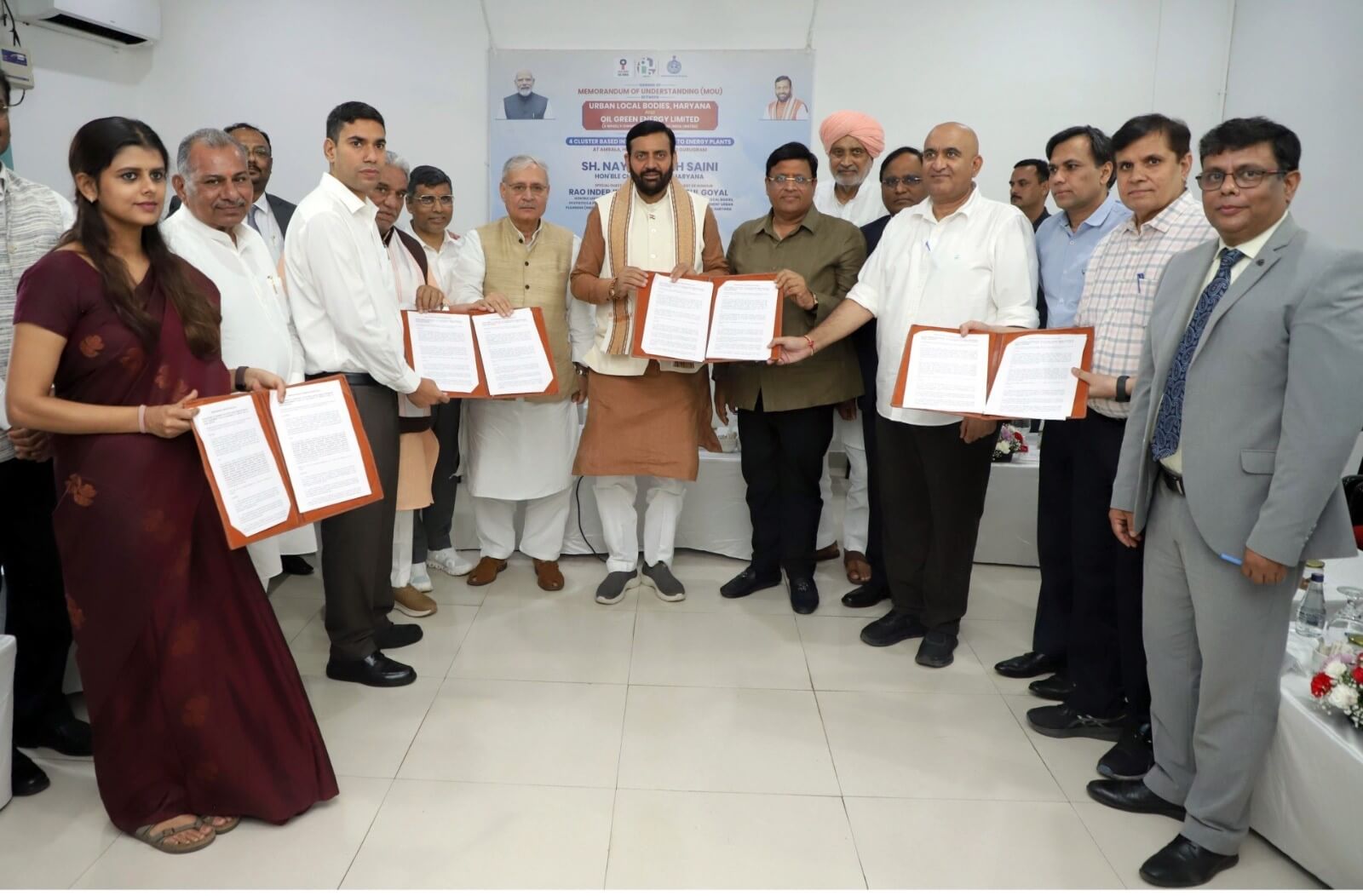
New Delhi: OIL Green Energy Limited (OGEL), a wholly owned subsidiary of Oil India Limited, has signed Memoranda of Understanding with four municipalities in Haryana to develop integrated Compressed Biogas (CBG) and Waste-to-Energy projects with a combined capacity to process around 5,000 tonnes of municipal solid waste per day.
The MoUs have been signed with the municipalities of Gurugram, Faridabad, Hisar and Ambala in the presence of Haryana Chief Minister Nayab Singh Saini, senior ministers, Members of Parliament and officials from the state government, Oil India Limited and OGEL.
The proposed projects will be developed across four clusters, with waste processing capacities of 500 tonnes per day in Hisar, 900 TPD in Ambala, 1,600 TPD in Faridabad and 2,000 TPD in Gurugram.
Together, the facilities are expected to produce around 70 to 75 TPD of CBG and generate 50 MW of green power.
The projects will follow an integrated waste processing and resource recovery model. Municipal solid waste will first undergo scientific pre-processing and segregation, after which different waste streams will be directed towards their respective uses.
Recyclable materials will be recovered for further use, while the wet and biodegradable fraction will be converted into CBG. The non-recyclable dry fraction will be used in Waste-to-Energy facilities to generate electricity.
The approach is designed to recover maximum value from municipal waste, improve energy recovery and reduce dependence on landfills. It will also enable waste to be converted into two forms of clean energy, CBG and green electricity.
The projects are expected to support Haryana’s efforts to strengthen municipal waste management while advancing the broader objectives of Waste-to-Wealth, circular economy and clean energy transition.
The initiative is aligned with the Government of India’s GOBARdhan, National Circular Bioenergy Scheme 2026, which promotes scientific waste management and the conversion of organic waste into CBG and other forms of clean energy.
With OGEL bringing four major urban clusters under an integrated waste processing model, the projects will create a system in which municipal waste can be channelled towards recycling, clean fuel production and electricity generation.
BI Bureau