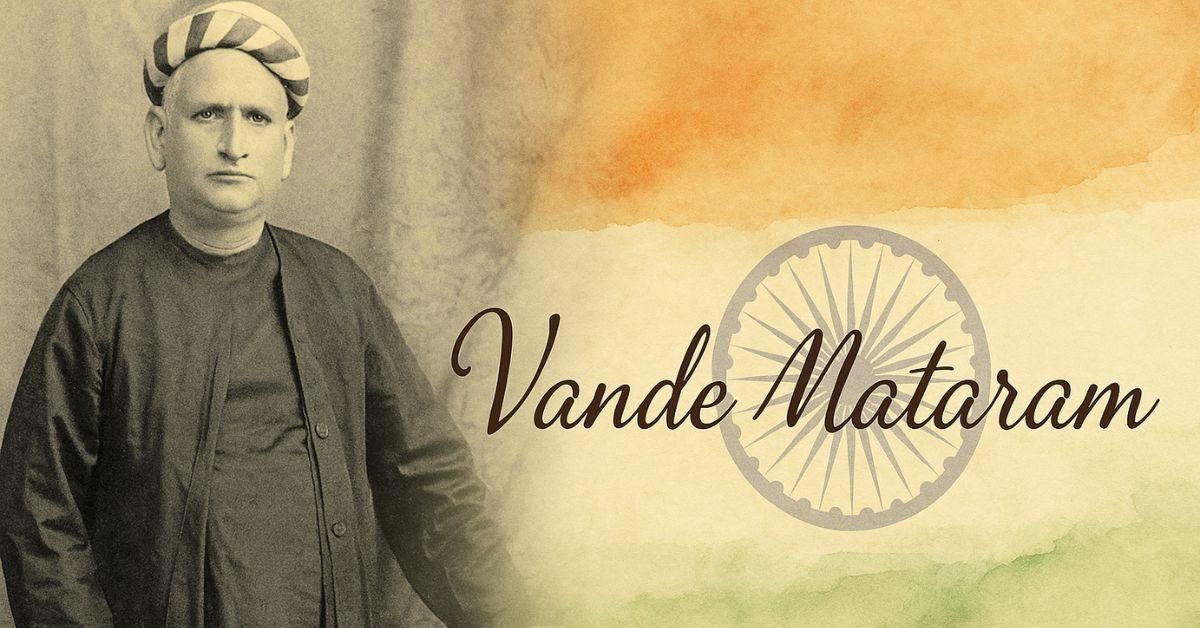
New Delhi: It has been 150 years of India’s National Song, Vande Mataram, which translates to “Mother, I Bow to Thee.” The hymn, composed by Bankim Chandra Chatterjee, became an anthem of courage and devotion that inspired generations of freedom fighters and continues to evoke India’s spirit of unity. First published in Bangadarshan on November 7, 1875, and later included in Anandamath (1882), the song was set to music by Rabindranath Tagore.
Over the decades, Vande Mataram has evolved from a literary creation into a rallying cry of nationalism, uniting Indians in their struggle for independence and beyond. The phrase continues to represent the soul of the nation resilient, diverse, and deeply rooted in love for the motherland.
The birth of a national song
The origins of Vande Mataram are deeply intertwined with India’s awakening against colonial rule. According to an article by Sri Aurobindo published in Bande Mataram on April 16, 1907, “it was thirty-two years ago that Bankim composed his renowned song. Few listened at that time, but during a moment of awakening from long delusions, the people of Bengal looked around for truth, and in a fated moment, someone sang ‘Bande Mataram.’”
Prior to its inclusion in book form, Anandamath was serialized in the Bengali magazine Bangadarshan, founded and edited by Bankim himself. The song appeared in the very first installment of the serialization in the March-April 1881 issue.
In 1907, when Madam Bhikaji Cama raised the tricolour for the first time outside India at Stuttgart, the words Vande Mataram were emblazoned on it a moment that symbolized the song’s power beyond borders.
The religion of patriotism
In Anandamath, Vande Mataram becomes the anthem of the Santanas ascetics who dedicate their lives to their motherland. They worship the motherland as the goddess herself, representing three forms: the glorious mother that was, the suffering mother that is, and the rejuvenated mother that will be. Sri Aurobindo described this vision saying, “The Mother of his vision held trenchant steel in her twice seventy million hands and not the bowl of the mendicant.”
Through this symbolism, Bankim Chandra redefined devotion as patriotism. His portrayal of the motherland as divine gave spiritual depth to nationalism.
Bankim Chandra Chatterjee: The visionary behind the verse
Born in 1838, Bankim Chandra Chatterjee was one of Bengal’s most influential literary figures of the 19th century. His novels Durgeshnandini (1865), Kapalkundala (1866), Anandamath (1882), and Devi Chaudhurani (1884) explored themes of morality, cultural pride, and self-determination in a colonized India.
Through Vande Mataram, he merged spiritual reverence with political consciousness, creating a lyrical vision of the motherland that would later ignite a national awakening.
From hymn to resistance
By the early 1900s, Vande Mataram had transformed into the heartbeat of India’s freedom struggle. In October 1905, the Bande Mataram Sampradaya was established in North Calcutta to promote the idea of the motherland as a sacred mission. Members would walk through the streets every Sunday singing Vande Mataram, often joined by Rabindranath Tagore.
That same year, processions in Barisal drew more than ten thousand participants chanting Vande Mataram. When the British tried to suppress the slogan, it only deepened its meaning. Students in Bengal were fined and threatened, yet continued to chant it defiantly.
In August 1906, Bipin Chandra Pal launched the English daily Bande Mataram, later joined by Sri Aurobindo as joint editor. Through its fearless editorials, the paper spread the message of self-reliance, unity, and political awakening.
Across the country, cries of Vande Mataram became the anthem of defiance in Tuticorin, Lahore, Barisal, and Bombay, it was sung at rallies, protests, and trials.
When Lokmanya Tilak was arrested in 1908, crowds outside the Bombay police court sang Vande Mataram in solidarity. On his release in 1914, the same chant echoed through Pune’s streets.
A call that crossed oceans
Outside India too, Vande Mataram became a rallying symbol. In 1909, when Madan Lal Dhingra faced the gallows in London, his final words were “Bande Mataram.” That same year, Indian patriots in Paris began publishing a magazine under the same name from Geneva. In 1912, when Gopal Krishna Gokhale arrived in Cape Town, he was welcomed by chants of Vande Mataram.
Recognition as a national song
After independence, Vande Mataram retained its position as one of India’s most revered compositions. On January 24, 1950, Dr Rajendra Prasad addressed the Constituent Assembly, clarifying the dual status of the National Anthem and National Song.
He stated, “The composition consisting of the words and music known as Jana Gana Mana is the National Anthem of India, subject to such alterations in the words as the Government may authorise as occasion arises; and the song Vande Mataram, which has played a historic part in the struggle for Indian freedom, shall be honoured equally with Jana Gana Mana and shall have equal status with it.”
Celebrating 150 years
The Government of India will commemorate the 150th anniversary of Vande Mataram with nationwide celebrations. The inaugural event will be held at Delhi’s Indira Gandhi Stadium on November 7, 2025, accompanied by public events across the country down to the tehsil level. A commemorative stamp and coin will be released, and a national exhibition and short film will showcase the song’s history.
Over the year, All India Radio, Doordarshan, and FM stations will host special programmes. Panel discussions, exhibitions, and musical renditions will take place in educational and cultural institutions. A global music festival and tree plantation drives under the theme Vande Mataram: Salute to Mother Earth are also planned. Short films, murals, and LED displays at airports and railway stations will further bring the story of Vande Mataram to life.
A song that still unites
The 150-year commemoration is not just an act of remembrance but a reminder of how Vande Mataram continues to define India’s spirit. From its literary beginnings to its role in freedom movements, from whispered defiance to national reverence, the song remains an anthem of unity and love for the motherland.
Its melody still echoes through every generation reminding India to bow, once again, to its eternal mother.
BI Bureau