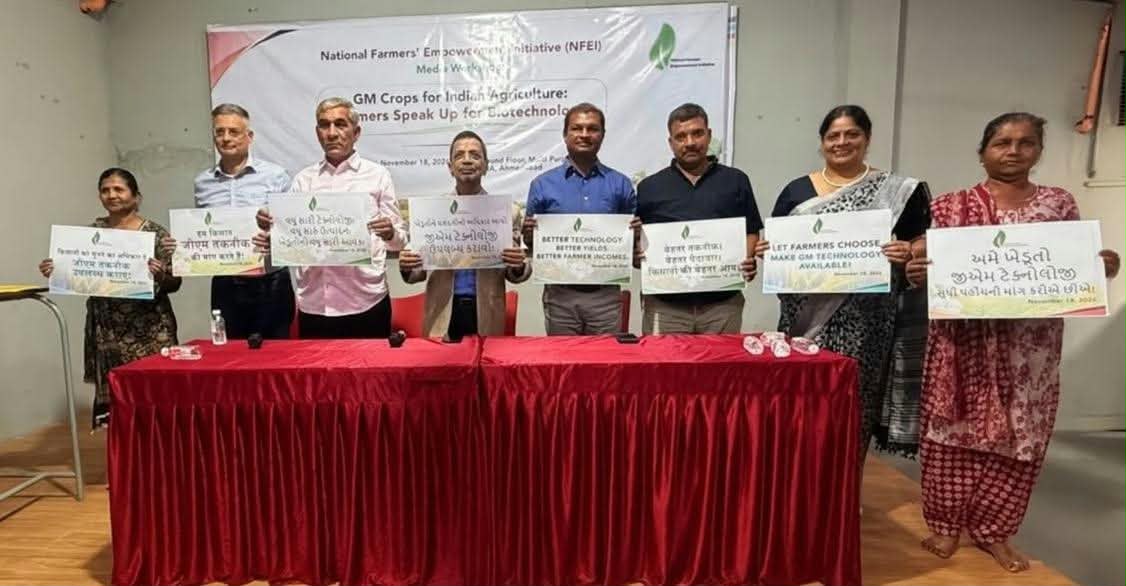
Ahmedabad: Gujarat farmers on Wednesday sought access to the next generation of genetically modified (GM) crops and urged science-led decisions on farm technology. At a media workshop organised by the National Farmers Empowerment Initiative (NFEI), they said new pests, erratic weather and rising costs demand better traits.
Gujarat was among the first states to grow Bt cotton after its approval in 2002. According to Ministry of Agriculture data, national cotton yield rose from 186 kg per hectare in 2001–02 to 510 kg in 2013–14, and India, a net importer of raw cotton until 2002, emerged as a leading exporter.
Bt cotton remains India’s only commercially approved GM crop, and Bollgard II, introduced in 2006, is still the latest trait available to farmers. Pink bollworm first broke through single-gene Bt cotton in Gujarat in 2009 and has since developed resistance to Bollgard II. Globally, next-generation cotton traits now combine protection against bollworms and sucking pests with tolerance to five herbicides.
“Bt cotton made a difference to cotton cultivation in India. Today, farmers face new pests, unpredictable weather and rising costs. We need access to improved technologies and better crop traits,” said Prakash Punambhai Patel, a farmer from Simri village.
According to ISAAA’s report on biotech crops in 2024, 218.71 million hectares were planted with GM crops that year, and since 1996, 73 countries have adopted them, 44 through cultivation and 29 through imports. The World Health Organization states that GM foods on international markets have passed safety assessments and are not likely to present risks to human health.
“The key question is not whether technology should be used, but how it can be assessed responsibly and deployed to meet the needs of Indian agriculture,” said Dr Vijay Kumar, Former Research Scientist and Head Cotton at Navsari Agricultural University.
Speakers said regulatory uncertainty is the main bottleneck. Bt brinjal, cleared in 2009, has been under a moratorium since February 2010. GM mustard DMH-11, recommended for environmental release in October 2022, awaits a decision after a split Supreme Court verdict in July 2024. Field trials also need a no-objection certificate from each state; in 2023, Gujarat and Telangana declined trials of GE cotton hybrids developed against pink bollworm.
“Farmers will adopt technologies that improve productivity and protect crops if they receive the right information and guidance. Agricultural policies must keep pace with science,” said Mukesh Kantilal Patel, a farmer from Chanasma in Patan district.
Participants said GM technology and genome editing, already used in two rice varieties India released in 2025, could deliver crops that are more productive, climate-resilient and nutritious. They called for a predictable, science-based framework that evaluates such technologies rigorously and, where they meet safety standards, makes them available to farmers without delay.
“Farmers deserve a choice of the best technologies available anywhere in the world. Field trials must continue across agro-climatic zones so that Indian science is ready to deliver proven, safe traits the moment policy allows,” said Bharat Char, Chief Science Officer, Mahyco and Head of Alliance for Agri Innovation.
Farmers reiterated that they must have a meaningful voice in decisions on the technologies that shape their livelihoods.
BI Bureau


_500_x_400.webp "Seed industry welcomes proposed single-window system, seeks unified approach to make India a global seed hub")