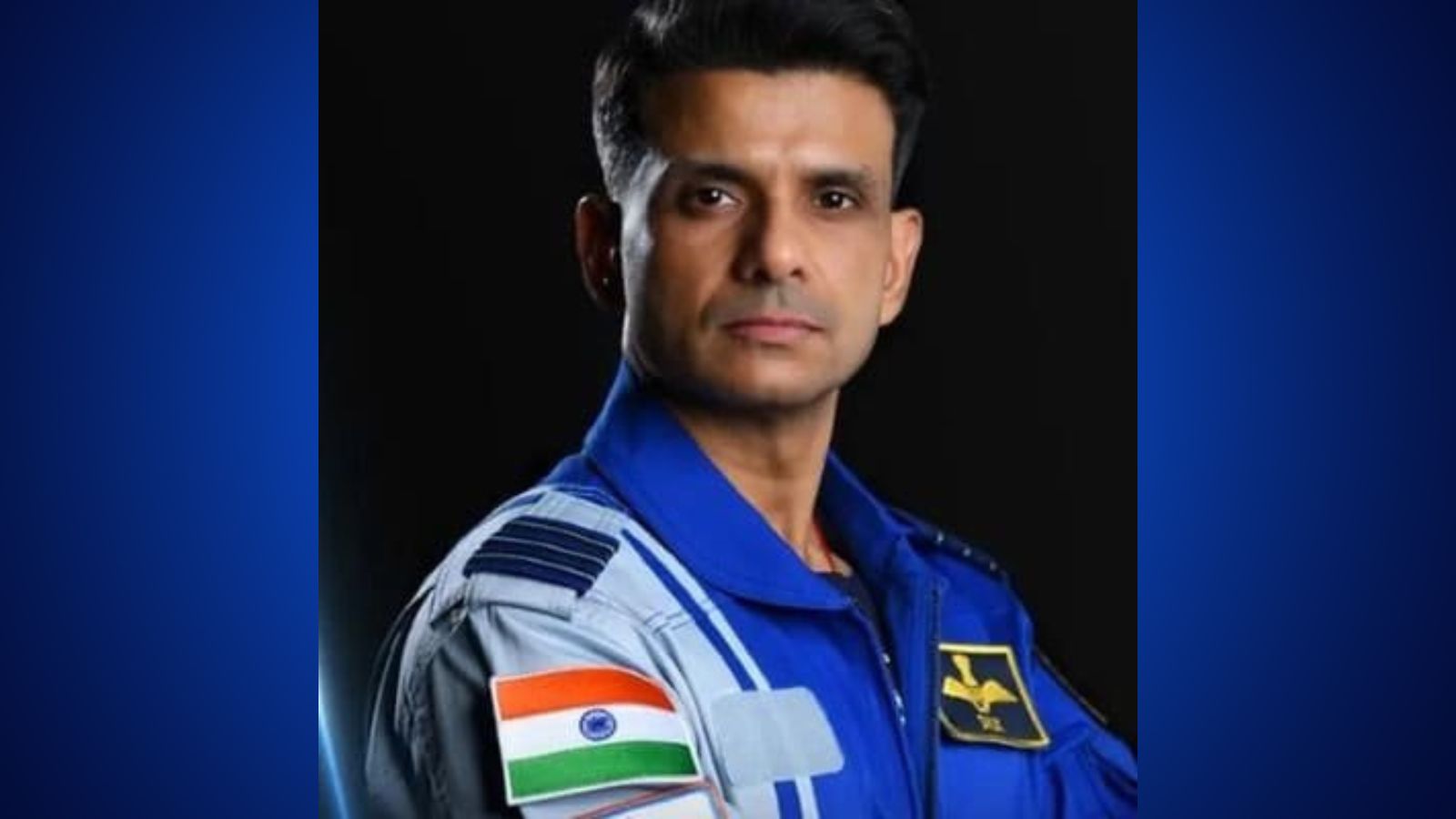
New Delhi: India has made a dramatic return to human spaceflight after more than four decades, as Group Captain Shubhanshu Shukla launched into space aboard the Axiom-4 (Ax-4) mission on Wednesday. Piloting the international crew mission, Shukla has become the second Indian to travel to space, following Rakesh Sharma’s historic 1984 flight, and the first to reach the International Space Station (ISS).
The Ax-4 mission lifted off from NASA’s Kennedy Space Center in Florida at 12:01 IST, led by veteran astronaut Peggy Whitson, who has spent over 675 days in space. The crew includes representatives from Hungary and Poland, marking a return to space for those countries after more than 40 years. The mission, a commercial collaboration between NASA, ISRO, the European Space Agency (ESA), and SpaceX, is operated by Axiom Space.
Group Captain Shukla’s 26-hour journey to the ISS is not just a personal milestone but also a landmark in India’s human spaceflight ambitions. Once docked, he will be the first Indian ever to set foot on NASA’s orbiting laboratory. "We're back in space after 41 years and what an amazing ride it's been," he said shortly after launch. "On my shoulder, I carry the Indian flag. This is not the start of my journey to the ISS, this is the beginning of India's human spaceflight. I welcome all my fellow Indians to be a part of this journey and feel proud and excited."
The 39-year-old fighter pilot from Lucknow joined the Indian Air Force in 2006 and has logged over 2,000 hours flying aircraft such as MiGs, Sukhois, Dorniers, Jaguars, and Hawks. He was one of four officers shortlisted for India's own human space mission, Gaganyaan, expected in 2027. ISRO secured Shukla’s seat on Ax-4 for ₹500 crore, a move expected to greatly benefit India’s space research and readiness.
During the 14-day mission aboard the ISS, Shukla and his crew will carry out 60 scientific experiments, including seven from India. These range from testing crop seed resilience in microgravity to studying algae strains that could be used as food or fuel in space. Other experiments will explore muscle degeneration, the behaviour of tardigrades in space, and the effects of digital screens on cognitive function in microgravity.
ISRO has said that Shukla will also interact with Indian students from space and may engage in a conversation with Prime Minister Narendra Modi during his stay. The Prime Minister welcomed the launch, stating that the astronaut "carries with him the wishes, hopes and aspirations of 1.4 billion Indians."
In Lucknow, his family joined students in watching the live broadcast, greeted with applause and music as the rocket lifted off. Reflecting on the journey ahead, Shukla had said, "As I go into space, I carry not just instruments and equipment, I carry hopes and dreams of a billion hearts."
With plans to build a space station by 2035 and land an astronaut on the Moon by 2040, India’s space ambitions are growing steadily. The Ax-4 mission marks not just a return to space but the start of a more sustained Indian presence in the final frontier.
BI Bureau