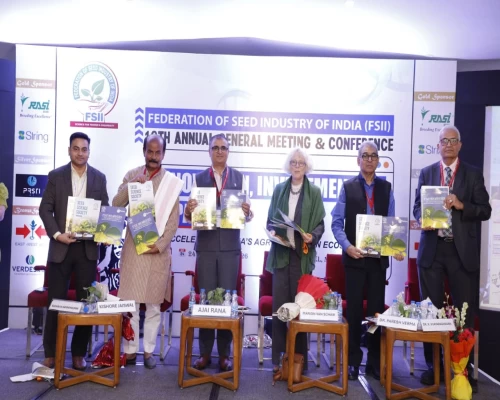
New Delhi: NITI Aayog on Monday released a detailed policy report titled Internationalisation of higher education in India, opportunities, challenges and policy recommendations, outlining a long-term roadmap to position India as a global destination for higher education and research.
The report was released by vice-chairperson Suman Bery, member (education) V.K. Paul, member Arvind Virmani and chief executive officer B.V.R. Subrahmanyam, in the presence of higher education secretary Vineet Joshi and AICTE chairperson Sitaram.
Prepared in collaboration with a consortium of knowledge partners led by IIT Madras, the report is positioned as a first-of-its-kind publication from the Global South. It focuses on the idea of “internationalisation at home” envisioned under the National Education Policy 2020 and examines how global engagement can be embedded within India’s higher education system.
The study analyses internationalisation at global, national and institutional levels, while also reviewing trends in academic mobility over the past two decades. It explores opportunities linked to greater movement of students and faculty, stronger international academic and research collaborations, and the establishment of international branch campuses in India as well as Indian university campuses abroad.
The findings are based on extensive qualitative and quantitative research. Inputs include responses to a detailed survey of more than 100 questions from 160 higher education institutions across 24 states, discussions at a national workshop held at IIT Madras earlier this year with 140 national and international participants, and key informant interviews with experts from 30 institutions across 16 countries.
Speaking at the release, Suman Bery said that promoting the internationalisation of higher education in India had both a commercial and a diplomatic rationale, particularly when viewed as an effective instrument of soft power.
V.K. Paul placed the report in the context of NEP implementation and India’s vision for Viksit Bharat 2047. He said India should aim to host one lakh international students in central and state universities by 2030.
Arvind Virmani said international students who benefit from the Indian education system could contribute to progress in India and globally. He stressed the need to strengthen India’s doctoral programmes through greater international collaboration.
B.V.R. Subrahmanyam highlighted the multiple benefits of internationalising the higher education system of the world’s fourth-largest economy. These include improvements in curriculum and pedagogy, reduced outflow of foreign exchange, and expanded opportunities for research partnerships. He also emphasised the role of private universities, the potential of India’s 3.5 crore-strong diaspora, and the need for the government to act as an effective enabler through simpler regulation.
Vineet Joshi said public and private universities would need to work together if India is to emerge as a global higher education hub. He noted that initiatives under NEP had created a strong foundation and that UGC regulations had already helped attract nearly 13 international universities to India. Praising the report, he said the 76 action pathways outlined in it offered a clear roadmap to achieve internationalisation goals by 2047.
AICTE chairperson Sitaram said India should position itself as a talent magnet and attract more students from the Global South to high-quality programmes in engineering, technology and management.
The report puts forward 22 policy recommendations, 76 action pathways and 125 performance indicators, along with nearly 30 ongoing Indian and global practices. These recommendations are structured around five thematic areas, strategy, regulation, finance, branding, communication and outreach, and curriculum and culture, with the aim of building India into a global centre for higher education and research by 2047.
BI Bureau