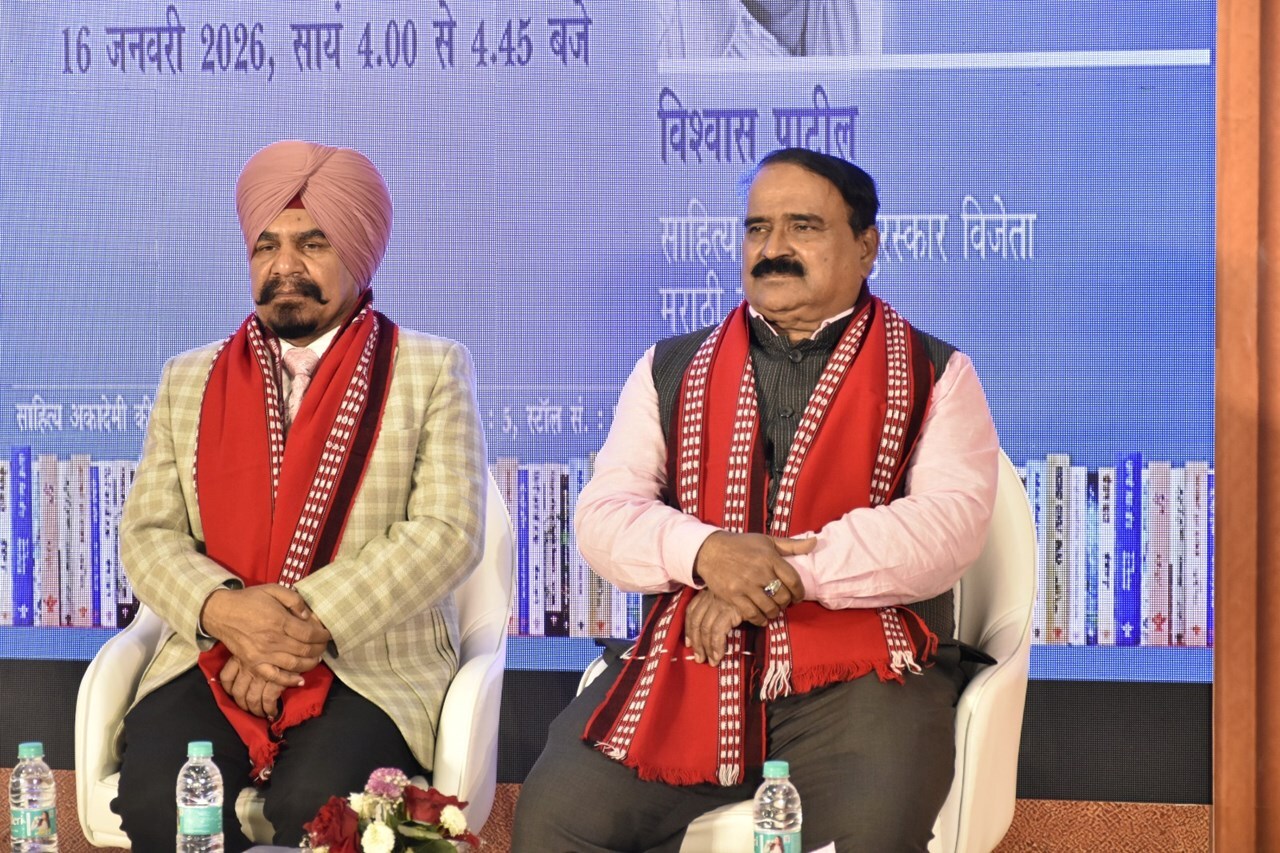
New Delhi: Sahitya Akademi hosted a Face-to-Face interaction and a panel discussion on India’s intellectual traditions at the New Delhi World Book Fair 2026 on January 15 at Bharat Mandapam.
The Face-to-Face session featured K. P. Ramanunni, noted Malayalam writer and Sahitya Akademi Award recipient, who reflected on his literary life and creative journey. He spoke about his roots in Kozhikode, recognised by UNESCO as India’s first City of Literature, and shared how personal experiences have shaped his writing. During the programme, he read excerpts from his Malayalam short story ‘MTP’, translated into English by Abu Bakar Kaba. Written as a play in seven segments, the story examines the emotional and human complexities surrounding a medical termination of pregnancy, drawing from lived realities. Ramanunni also spoke about his early years, recalling how reading spiritual and communist literature as a teenager led to inner conflict and eventually pushed him towards writing as a form of expression.
The session was followed by a panel discussion on India’s intellectual traditions, with Rawail Singh, Harekrishna Satapathy, and Basavaraj Kalgudi sharing their perspectives. Rawail Singh traced Punjab’s intellectual heritage from Takshashila to the traditions of Nath Yogis, Sufism, and Sikhism. Harekrishna Satapathy spoke on links between ancient and present-day education systems, referring to Brahma, Vishnu, and Mahesh as the Aadigurus, and recited a Vedic shloka. Basavaraj Kalgudi focused on knowledge systems outside the mainstream, discussing oral and written traditions and the role of tribal and agrarian wisdom in ancient India.
The programmes drew active participation from students, teachers, writers, and literature enthusiasts, leading to engaging discussions and audience interaction. The event concluded with a vote of thanks by Sandeep Kaur on behalf of Sahitya Akademi.
BI Bureau