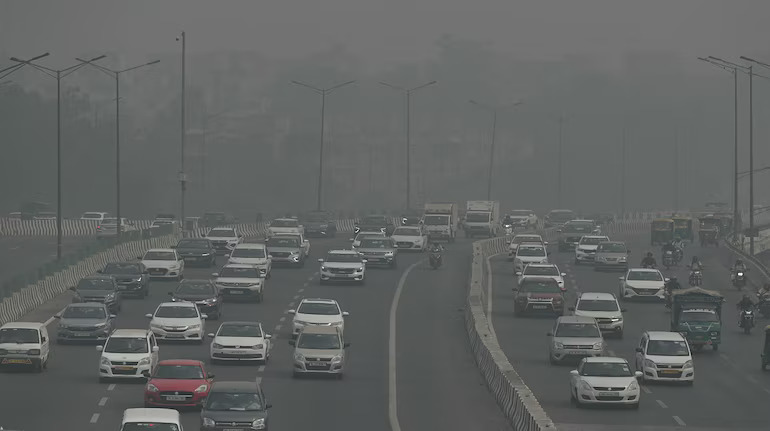
New Delhi: Two days after the festive lights dimmed, Delhi woke up under a grey blanket of smog on Wednesday morning. The familiar post-Diwali haze settled over the city, pushing air pollution levels deep into the ‘very poor’ zone, a stark reminder that the capital’s annual tryst with toxic air is far from over.
According to the Central Pollution Control Board (CPCB), Delhi’s overall Air Quality Index (AQI) stood at 345, compared to Sunday’s 326. Several parts of the city recorded even higher levels, with Ashok Vihar, Bawana and Dilshad Garden touching AQI readings near 380 early in the morning, just short of the ‘severe’ category.
Neighbourhoods such as RK Puram (380), Nehru Nagar (394), and Dwarka Sector 8 (353) remained in the ‘very poor’ range, while Anand Vihar (355) and Bawana (376) flirted with ‘severe’ levels. A few areas, including Lodhi Road (334) and IGI Airport (295), saw slightly better air quality but still fell within the ‘poor’ to ‘very poor’ bracket.
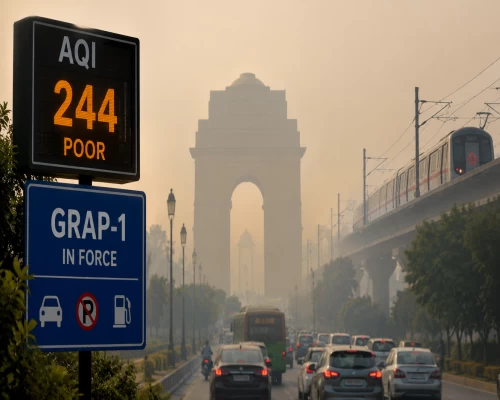
The Commission for Air Quality Management (CAQM) has already implemented Stage II of the Graded Response Action Plan (GRAP) across Delhi-NCR in an effort to prevent further deterioration. The decision followed forecasts from the India Meteorological Department (IMD) and the Indian Institute of Tropical Meteorology (IITM), which warned that calm winds and low temperatures could trap pollutants closer to the surface in the coming days.
Authorities estimate that transport contributed around 15.6% of Delhi’s pollution on Monday, while industries and other sources added 23.3%, as per the Decision Support System (DSS).
While residents complained of breathing discomfort and irritation, Delhi Environment Minister Manjinder Singh Sirsa struck a note of cautious optimism. “Despite a 21% rise in construction and an 8% increase in new vehicle registrations, pollution levels have remained stable,” he said on Tuesday.
Sirsa compared the data from previous years to highlight progress. “Post-Diwali AQI in Delhi was 462 in 2020, 360 in 2024, and 351 this year. This clearly proves that crackers are not the main cause of pollution. Delhiites celebrated responsibly, and our measures ensured stability in air quality,” he said.
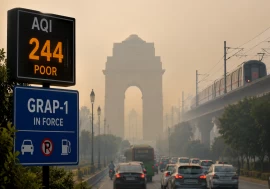
Visuals from across the city, however, told a more sobering story, iconic landmarks like Akshardham and India Gate shrouded in haze, their outlines barely visible through the smog.
The CPCB classifies air quality as ‘good’ (0–50), ‘satisfactory’ (51–100), ‘moderate’ (101–200), ‘poor’ (201–300), ‘very poor’ (301–400) and ‘severe’ (401–500). With Delhi hovering in the higher end of the ‘very poor’ category, officials warn that unless weather conditions improve, the capital could once again tip into the ‘severe’ zone, just as it has done every winter in recent years.
BI Bureau