Raipur: A government can launch a hundred schemes. But for the citizen, governance is ultimately judged by a much simpler question: Did my problem get solved?
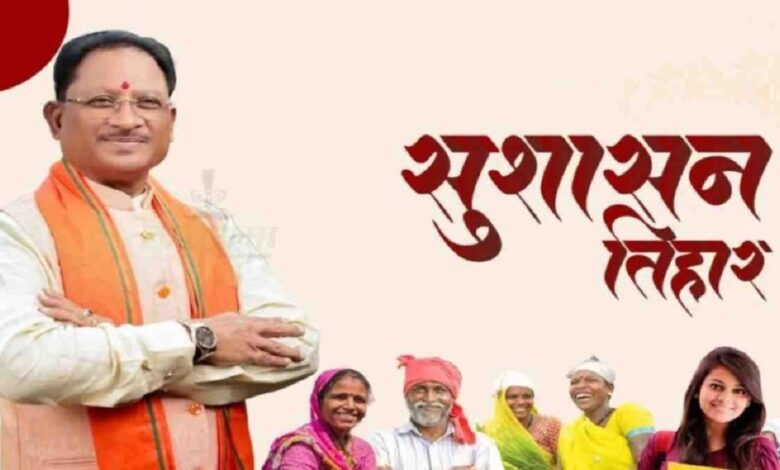
That question sits at the heart of Chhattisgarh’s evolving governance approach. The state’s Sushasan Tihar 2026 offered a powerful demonstration of it—not as a ceremonial exercise, but as an administrative effort to take grievance redressal closer to citizens and turn pending cases into measurable outcomes.
Across rural and urban areas, public grievance camps brought officials face-to-face with citizens. In rural areas, camps covered clusters of 15–20 gram panchayats, while urban camps were organised ward-wise. The focus extended from land mutation, partition and demarcation to delayed MGNREGA wages, welfare payments, certificates, electricity, drinking water and other everyday administrative concerns.
The distinction is important. A grievance camp can easily become another forum for receiving applications. The more meaningful measure is what happens after the application is received.
In Korba’s Mudapar, for example, 1,065 applications were received at one camp, with 238 resolved on the spot. At a camp in Baloda Bazar’s Chichirda, 1,145 applications were received and 450 were addressed immediately. Such interventions bring a useful metric into the governance conversation: not merely how many citizens were heard, but how many problems were actually resolved.
One such last-mile impact is visible in the districts Sukma. The district administration has brought services including Ayushman cards, ration cards, Aadhaar updates, driving licences and caste, income and residence certificates under a single-window system, sparing residents - particularly those travelling from remote and formerly Naxal-affected areas - the need to visit multiple offices. According to Sukma Collector Amit Kumar, around 100 citizens use the facility every day, with more than 4,000 beneficiaries served within its first two-and-a-half months. He sees the initiative as an important step towards translating the Chief Minister’s vision of good governance and e-governance into easier, more accessible services on the ground.
Chhattisgarh’s upgraded Seva Setu platform brings 441 government services onto a single interface, integrating more than 30 departments. According to the state government, the digital service ecosystem has recorded more than 3.2 crore transactions and certificates issued. The platform also integrates Aadhaar-based e-KYC, DigiLocker, e-Pramaan, WhatsApp, AI and Bhashini, including support for 22 Indian languages.
For a state with a large rural population and challenging last-mile delivery requirements, the significance is not simply technological. It is about reducing the number of doors a citizen has to knock on.
That same emphasis on solving problems through innovation is visible within the bureaucracy. The Chief Minister’s Excellence Awards 2025–26 received 312 innovation proposals - 275 from districts and 37 from state-level departments. Ten were eventually selected following a multi-stage assessment that considered measurable outcomes, citizen-centricity and scalability.
Among the initiatives recognised was blockchain-based land-record digitisation in Dantewada, aimed at improving the security and accessibility of land records. Another initiative created a single-window system integrating 136 services across 16 departments, simplifying interactions between government and businesses.
These examples point to an important shift in administrative thinking. Innovation is increasingly being judged not by how sophisticated the technology sounds, but by whether it removes friction from governance.
The state’s grievance-redressal architecture adds another layer. Its CM Helpline 1076 allows citizens to register complaints, track their status and seek information on government schemes. The platform reports more than 1.81 lakh registered complaints, with over 70,800 marked resolved.
Taken together, these initiatives suggest a governance model built around three complementary ideas: reach the citizen, simplify access and measure delivery.
That is particularly relevant for Chhattisgarh, where the effectiveness of government depends heavily on what happens beyond Raipur—in districts, blocks, gram panchayats and remote communities.
The state’s performance in the Panchayat Advancement Index 2.0 also points to the importance being placed on grassroots institutions. Chhattisgarh recorded 100% participation, with all 11,643 Gram Panchayats and Traditional Local Bodies submitting validated data across 33 districts and 145 blocks.
Special campaigns can create urgency and visibility. Digital platforms can make access easier. Innovation awards can identify promising ideas. But good governance becomes durable only when these practices become part of everyday administration - when grievance resolution is routinely time-bound, when officials proactively identify beneficiaries, when technology reduces rather than adds to bureaucratic complexity, and when performance is measured by outcomes on the ground.
That is where Chhattisgarh’s current governance push could become more than a collection of initiatives.
BI Bureau