New Delhi: In a first-of-its-kind experiment in over five decades, Delhi skies witnessed a cloud-seeding operation on Tuesday, as part of the government’s desperate bid to induce artificial rain and wash away the thick blanket of smog choking the capital.
The trial, conducted jointly by the Delhi government and IIT-Kanpur, saw a Cessna aircraft take off from Kanpur and disperse eight fire flares containing silver iodide and sodium chloride over areas including Burari, Karol Bagh, and Mayur Vihar. The half-hour operation, which officials said could trigger rainfall within 15 minutes to four hours, marked the beginning of a series of nine such exercises planned in the coming days.
“We are exploring every scientific option to combat Delhi’s severe air pollution. If successful, artificial rain could offer temporary relief,” Environment Minister Manjinder Singh Sirsa said.
This was the third such experiment in Delhi’s history and the first since the early 1970s. The last attempt, conducted by the National Physical Laboratory, used ground-based silver iodide generators to seed clouds over a 25-km radius in central Delhi.
While results from Tuesday’s trial are awaited, officials said low atmospheric moisture could affect outcomes. “The test flight last week could not induce rainfall due to humidity levels below 20%, while at least 50% is needed,” an IIT-Kanpur scientist explained.
Experts say cloud seeding, used in over 50 countries including China, the US, and Australia, can enhance rainfall by up to 46% under suitable conditions. India’s most comprehensive study under the CAIPEEX programme in Maharashtra (2017–2019) demonstrated promising results, leading to renewed interest in the technology.
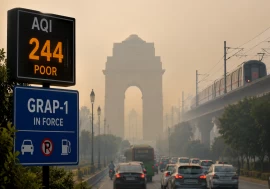
Cleared by the DGCA and multiple departments, the Delhi project was approved by the Cabinet in May with a budget of ₹3.21 crore for five trials. The initiative forms part of the city’s broader winter pollution mitigation plan, as air quality remains in the ‘very poor’ category despite curbs under the Graded Response Action Plan (GRAP).
BI Bureau