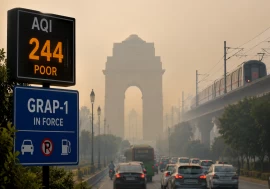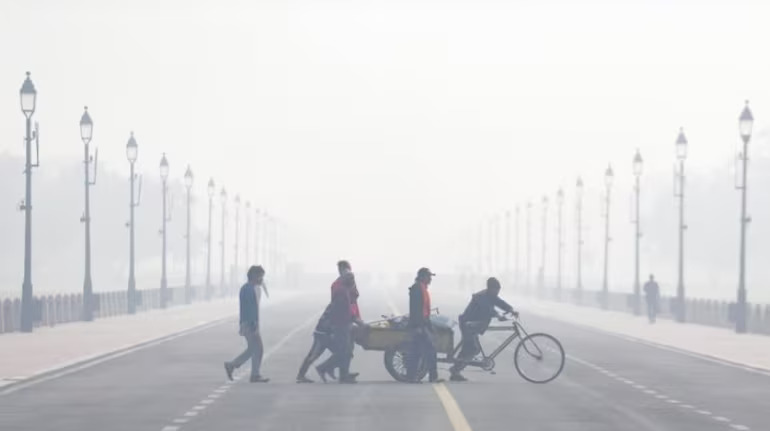
New Delhi: A new satellite-based assessment by the Centre for Research on Energy and Clean Air (CREA) has identified Delhi as the most polluted state in the country, with air quality levels far above national and global safety limits. The study measured Delhi’s annual mean PM2.5 concentration at 101 micrograms per cubic metre, which is 2.5 times higher than the Indian standard and 20 times the World Health Organisation guideline.
The assessment, covering March 2024 to February 2025, shows that pollution is not limited to a few regions. Chandigarh recorded the second-highest annual PM2.5 level at 70 micrograms per cubic metre, followed by Haryana at 63 and Tripura at 62. States including Assam, Bihar, West Bengal, Punjab, Meghalaya, and Nagaland also crossed the national annual limit of 40 micrograms per cubic metre.
CREA’s district-level analysis shows the scale of the problem. Of 749 districts examined, 447, or roughly 60%, breached the National Ambient Air Quality Standard for PM2.5. Delhi and Assam each accounted for 11 of the 50 most polluted districts, while Bihar and Haryana contributed seven districts each. Uttar Pradesh had four districts on the list, Tripura three, and Rajasthan and West Bengal two each.
In several regions, every district monitored exceeded national clean-air norms. This was the case for Delhi, Assam, Punjab, Haryana, Chandigarh, Himachal Pradesh, Meghalaya, Tripura, and Jammu and Kashmir. States with widespread violations included Bihar, where 37 of 38 districts crossed the limit, and Gujarat, where 32 of 33 districts did the same. West Bengal, Nagaland, Rajasthan, and Jharkhand also saw most districts breaching standards.
Ladakh, Andaman and Nicobar Islands, and Lakshadweep were not included in the assessment due to limited ground monitoring data.
CREA’s findings point to growing health risks and highlight the need for stronger, region-specific measures to bring down pollution levels across India.
BI Bureau