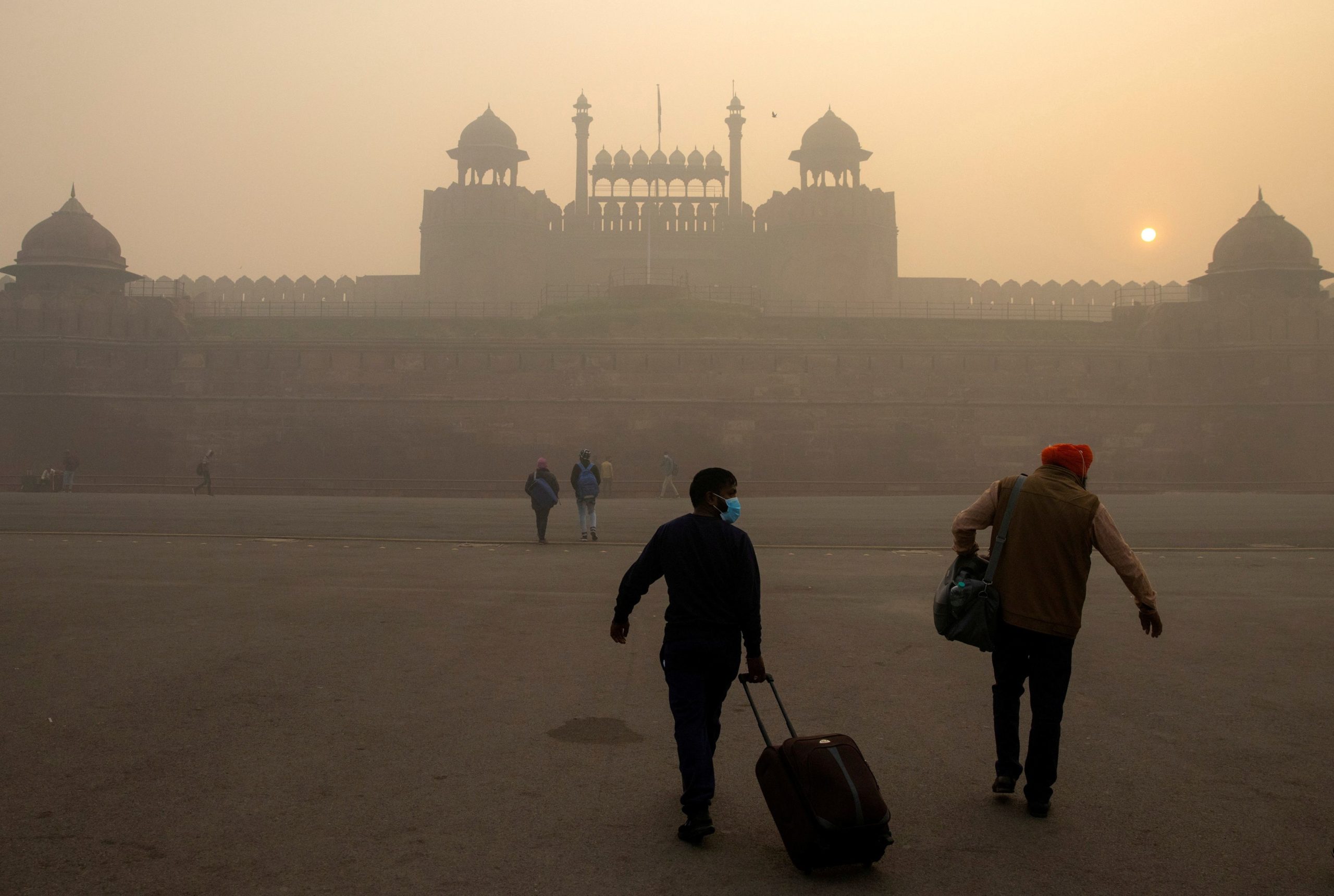
New Delhi: Delhi’s deadly air pollution is not just choking its residents - it is silently corroding history. A new Indo-Italian study titled “Characterisation of red sandstone and black crust to analyse air pollution impacts on a cultural heritage building: Red Fort, Delhi, India” has revealed that the iconic Red Fort is suffering accelerated damage as layers of toxic “black crusts” form on its sandstone walls, threatening its centuries-old beauty and structural strength.
Published in June this year in the MDPI journal, the research is the first comprehensive scientific analysis of how urban air pollution is degrading the 17th-century fort, built by Mughal emperor Shah Jahan. Conducted jointly by IIT Roorkee, IIT Kanpur, Ca’ Foscari University of Venice, and the Archaeological Survey of India under a collaboration between India’s Department of Science and Technology and Italy’s Ministry of Foreign Affairs, the study paints a grim picture.
Samples collected from across the complex—including Zafar Mahal, Moti Masjid, and Delhi Gate—showed black crusts ranging from ultra-thin 0.05 mm films in sheltered corners to thick 0.5 mm layers in areas exposed to heavy traffic. These stubborn layers, composed of gypsum, bassanite, weddellite, and toxic heavy metals like lead, zinc, and chromium, are tightly bonded to the stone surface, raising the risk of flaking, cracks, and loss of intricate carvings.
Researchers noted that pollutants such as sulphur dioxide and nitrogen oxides are reacting chemically with the sandstone to form gypsum layers that erode during rains. Meanwhile, nitrates and oxalates seep deep into the stone, weakening it from within and encouraging biological growth. The team also documented blistering, salt crystallisation, and moisture-related crumbling, particularly near the entrances.
Air quality data from the Central Pollution Control Board (2021–23) revealed that Delhi’s fine particulate matter levels were consistently more than 2.5 times the national limit, while coarse particles exceeded the threshold by over three times. Nitrogen dioxide levels were also above safe limits, accelerating the sandstone’s decay, though ammonia and sulphur dioxide remained within permissible levels.
“This is a wake-up call,” the study stressed, adding that urgent interventions—such as regular cleaning, protective coatings, and stricter pollution control—are essential to save the monument and other heritage sites from irreversible damage.
The Red Fort, constructed between 1639 and 1648 and recognised as a UNESCO World Heritage Site since 2007, today stands pressed against Delhi’s busy Inner Ring Road, directly exposed to the city’s toxic emissions.
Covering one square kilometre with walls up to 23 metres high and 14 metres thick at the base, the fort is a masterpiece of Mughal architecture and a symbol of India’s independence - yet now it finds itself under siege from pollution, not invaders.
BI Bureau