Bengaluru: Drone Federation India (DFI) recently inaugurated the Bharat Drone Stack Conference 2026 in Bengaluru, billed as India's largest conference on drone components. The event brought together more than 80 Indian component exhibitors and around 3,000 delegates, along with senior representatives from the armed forces, government and research institutions.
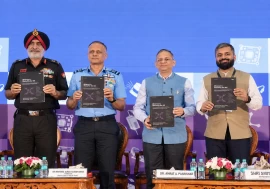
The conference was attended by Lieutenant General Shamsher Singh Virk, AVSM, SM, Deputy Chief of the Army Staff (CD&S); Air Marshal Samir Jayasinha Pendse, VM, VSM, Senior Air Staff Officer, Training Command, Indian Air Force; and Dr Abhay A. Pashilkar, Director, CSIR-NAL. It also featured 10 thematic sessions involving industry leaders and senior officials from the armed forces, paramilitary forces, DRDO and national laboratories.
During the inaugural session, the dignitaries released DFI's whitepaper, Making the Swadeshi Switch, which outlines 22 policy recommendations to strengthen domestic manufacturing of drone components. These include introducing Indian content norms for defence and civil drones, providing targeted support to component manufacturers, and establishing testing and certification facilities for components within the country. DFI will take these recommendations to the concerned ministries and agencies and review progress at the next edition of the conference in 2027.
According to DFI estimates, the Indian drone industry could grow from Rs 5,720 crore in 2025-26 to around Rs 97,300 crore by 2030-31, with the component market targeted at USD 3.08 billion. However, the sector continues to depend on imports for several critical parts and materials, including magnets, cells and chips. China's export controls on drone components, rare earth magnets and autopilots since September 2024 have further highlighted the need to strengthen domestic supply chains.
Smit Shah, President, Drone Federation India, said, “India has done the first half of the job. More than 160 drone models now hold type certificates, and more than 200 manufacturers are building defence drones of various categories. But a drone is only as Indian as the parts inside it, and any single source for a flight-critical part is a risk, because supply can be cut overnight.”
The conference is part of Bharat Drone Stack, DFI's initiative to promote self-reliance in drone components, launched in August 2025. From around 100 suppliers identified at its launch, the Bharat Drone Stack Platform now lists 208 suppliers, including 83 startups. Its component breakdown maps a drone across 11 categories, 62 subsystems, 243 parts and 52 raw materials, identifying areas where domestic manufacturing capabilities can be developed.
The first day featured discussions on import dependence and policy interventions, chaired by Maj Gen Roopesh Mehta, SM, VSM, Additional Director General, Capability Development, Indian Army. Another session examined the requirements of modern warfare from India's drone industry, with participation from the Indian Army, Indian Air Force, CISF, BSF and SSB. A separate discussion focused on the proposed “Trusted Indian Component” mark, with representatives from DRDO and DGAQA. The day also featured a fireside chat with Major General V.K. Nambiar, YSM, SM, VSM, GOC, Armed Forces Special Operations Division.
On 13 November, the Indian Army conducted an exclusive workshop titled Inside AASHVAST. The workshop explained how its AASHVAST lab screens drones and electronic systems for hidden hardware and firmware vulnerabilities, and how manufacturers can prepare their products for evaluation.
BI Bureau