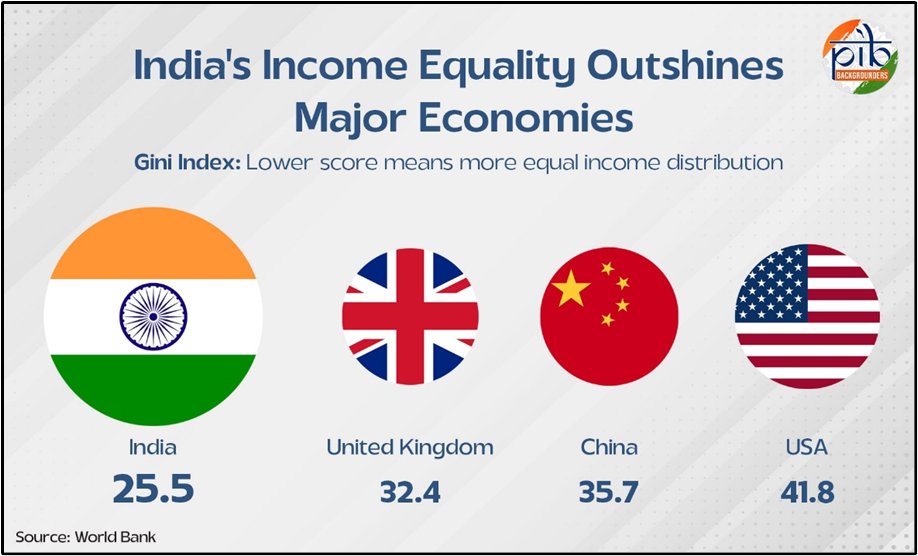
New Delhi: India has emerged as one of the most equal countries in the world in terms of income distribution, according to new data released by the World Bank. With a Gini Index score of 25.5, India now ranks fourth globally, behind only the Slovak Republic, Slovenia, and Belarus. The country’s performance places it ahead of major economies including the United States, which has a Gini score of 41.8, and China at 35.7. All G7 and G20 economies lag behind India on this indicator.
The Gini Index, where a lower score indicates more equal income distribution, reflects a significant transformation in India’s economic landscape. Once associated with high levels of poverty and inequality, the country is now seen as a model for equitable growth. This shift is largely credited to wide-reaching policy interventions aimed at poverty alleviation, financial inclusion, and technology-driven welfare delivery.
According to the World Bank’s Spring 2025 Poverty and Equity Brief, India has lifted 171 million people out of extreme poverty between 2011 and 2023. The proportion of people living below the international poverty line of $2.15 per day has fallen dramatically from 16.2 percent to just 2.3 percent during this period. India’s Gini score in 2011 was 28.8, already lower than many global peers, but the past decade has seen sustained improvement that now places the country among the world’s most equal societies.
Government efforts to extend the reach of welfare schemes through digital platforms appear to be central to this transformation. The Ministry of Social Welfare points to flagship programs such as the PM Jan Dhan Yojana, which has brought over 55 crore citizens into the formal banking system, and the Aadhaar digital ID, covering more than 142 crore people. Together with the Direct Benefit Transfer mechanism, these tools have ensured that subsidies and support reach intended beneficiaries efficiently, reducing leakages and improving outcomes. The DBT system alone has reportedly saved the exchequer Rs 3.48 lakh crore by March 2023.
Other major interventions include the Ayushman Bharat scheme, which has issued more than 41 crore health cards, and entrepreneurship support through the Stand-Up India initiative and the PM Vishwakarma Yojana. The PM Garib Kalyan Anna Yojana, which provides free food grains to over 80 crore people, has played a critical role in securing food access for vulnerable populations.
Officials say that behind this progress is a deliberate and consistent policy approach that combines grassroots outreach with technological infrastructure. As many developed nations continue to struggle with widening income gaps, India’s ability to reduce inequality at scale offers a compelling model. The World Bank’s findings underline how inclusive governance and digital public infrastructure can reshape a nation’s socio-economic landscape.
BI Bureau