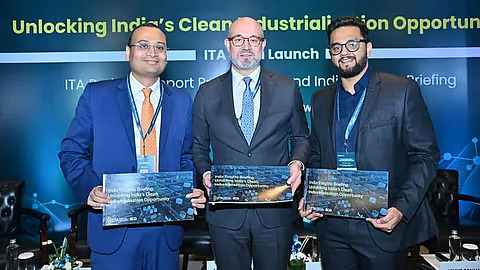
New Delhi: The Industrial Transition Accelerator (ITA), a global initiative formed at COP28, has launched its India Project Support Programme to accelerate 65 clean industrial projects towards the investment stage. The initiative, announced in New Delhi, aims to unlock around USD 150 billion in potential investments and generate over 200,000 direct and indirect jobs in India’s clean sector.
According to ITA’s India Insights Briefing, the programme is designed to catalyse large-scale decarbonisation across heavy-emitting sectors such as chemicals, steel, cement, aluminium, aviation, and shipping. ITA identifies India as having the third-largest clean industrial project pipeline in the world, after China and the United States, marking a key moment in the country’s push towards sustainable industrial growth.
The briefing maps strong clean industry potential across major states including Odisha, Andhra Pradesh, Karnataka, Gujarat, Rajasthan, Maharashtra, and Tamil Nadu. These states, with their renewable energy capacity, industrial infrastructure, and enabling policy frameworks, are expected to emerge as hubs for clean ammonia, methanol, steel, and other low-carbon commodities.
Sector-wise, the chemicals industry leads the way, accounting for nearly 80 per cent of projects focused on clean ammonia and methanol, surpassing the National Green Hydrogen Mission’s targets. The steel, cement, aluminium, and aviation sectors follow, each holding significant potential for emissions reduction and new market creation.
Despite the scale of opportunity, the report notes that progress towards Final Investment Decision (FID) has been limited, with only six projects having reached that stage so far. It highlights five key barriers slowing project execution: limited demand for green products, lack of long-term premium contracts, high capital costs, regulatory complexities, and infrastructure constraints such as port and grid access.
James Schofield, Managing Director, Industrial Transition Accelerator, said, “India’s industrial transition is central to both its growth objectives and the wider global decarbonisation effort. With one of the largest project pipelines worldwide, the challenge is no longer vision; it is execution. The India Project Support Programme will focus on unlocking demand, de-risking finance, and fast-tracking projects that can define India’s leadership in clean manufacturing. India’s commitment to build clean now would not only benefit the country domestically but also assist global momentum and present a strong supply of financed clean industrial projects to COP31 in November 2026.”
The programme will run through 2026, focusing on coordinated stakeholder action to align policy, stimulate demand, unlock financing, and build shared infrastructure. Structural measures will include new market-creation initiatives, voluntary buyer alliances, public procurement standards, and improved regulatory alignment with international frameworks such as the EU’s Carbon Border Adjustment Mechanism (CBAM).
A key goal of the programme is to position India as a major exporter of clean commodities to Europe and Asia, helping domestic industries adapt to global carbon compliance requirements. Green steel, sustainable aviation fuel, and green ammonia have been identified as sectors with strong export potential, capable of meeting a growing share of global demand by 2030.
Sumit Gupta, APAC Leader (Climate & Sustainability Practice), Boston Consulting Group (BCG), said, “India stands at a defining moment in the global clean industrial transformation. With a strong foundation of projects and growing private-sector momentum, the country is well placed to lead in scaling new low-carbon technologies. The opportunity spans clean fuels, green materials, and emerging manufacturing value chains. The ITA India Project Support Programme can help mobilise stakeholders and accelerate the next wave of investment-ready projects.”
Yash Kashyap, India Lead, Industrial Transition Accelerator, said, “The next 24 months will be decisive in determining which of India’s clean industry projects move from plans to plants. The pipeline is strong, the private sector is ambitious, and the policy base is taking shape. Our focus is to integrate these elements, aggregate demand, standardise bankable contracts, and build shared infrastructure to get projects investment-ready.”
ITA estimates that the initiative could create more than 200,000 jobs and contribute significantly to India’s long-term industrial decarbonisation. The programme aligns with the country’s Viksit Bharat 2047 vision and Net Zero 2070 goals, aiming to reduce industrial emissions while strengthening India’s position in global clean manufacturing.
BI Bureau