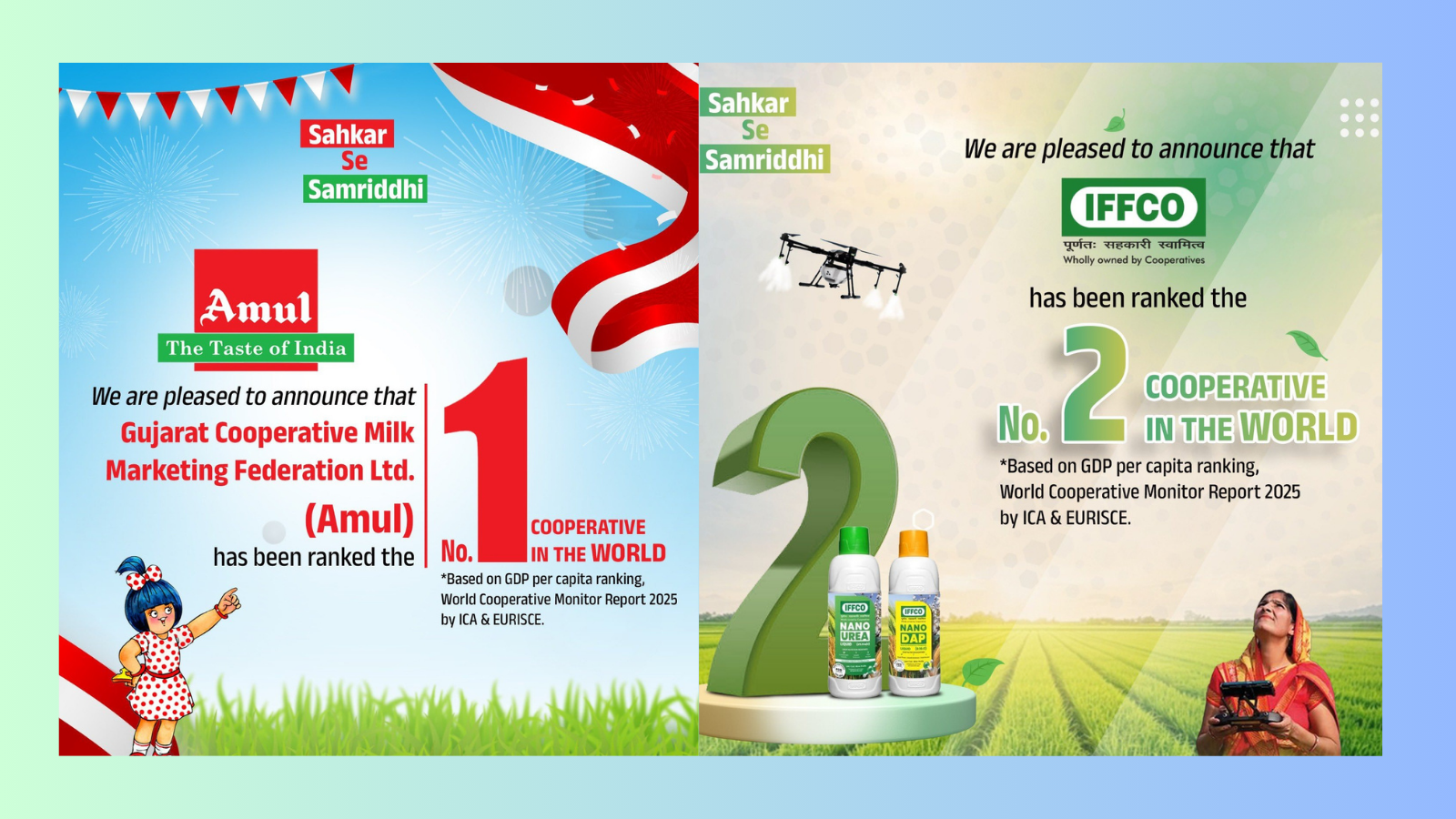
New Delhi: India’s cooperative movement has scripted history on the global stage. Two of its flagship institutions, Gujarat Cooperative Milk Marketing Federation (GCMMF), better known as Amul, and Indian Farmers Fertiliser Cooperative Limited (IFFCO), have emerged as the world’s top two cooperatives in the latest World Cooperative Monitor 2025, published by the International Cooperative Alliance (ICA) and the European Research Institute on Cooperative and Social Enterprises (EURICSE).
The feat positions India as a powerhouse in the global cooperative ecosystem, underscoring how member-owned enterprises rooted in rural communities are now setting international benchmarks for success and sustainability.
The 13th edition of the World Cooperative Monitor, released in Doha, revealed that the world’s top 300 cooperatives and mutual enterprises posted a combined turnover of USD 2.79 trillion in 2023. Among these, India’s cooperative champions stood out prominently. Amul (GCMMF) ranked first globally in terms of turnover relative to GDP per capita, while IFFCO followed closely at second place.
This double podium finish reflects not only financial strength but also the growing recognition of cooperative models that blend profitability with purpose, driven by farmers and for farmers.
Amul, through its vast dairy network, procures nearly 35 million litres of milk daily from around 18,600 village-level milk cooperatives spread across 33 districts, supporting over 3.6 million milk producers. IFFCO, founded in 1967, reaches more than 50 million farmers through a federation of about 35,000 cooperative societies, supplying essential agri-inputs and promoting sustainable farming practices.
The Monitor noted that cooperatives from emerging economies, particularly India, are rapidly closing the gap with traditional powerhouses by embracing digital transformation, local empowerment and social innovation.
Union Home and Cooperation Minister Amit Shah hailed the recognition, calling it a proud moment for the country. “A proud moment for Bharat! Heartiest congratulations to Amul and IFFCO for occupying the first two ranks among the top ten cooperatives in the world,” he wrote on social media.
He said the accomplishment was a tribute to millions of women dairy farmers and the farmer-members who have made these cooperatives models of self-reliance, embodying the vision of ‘Sahkar Se Samriddhi’ (prosperity through cooperation). The Ministry of Cooperation also described the recognition as a landmark milestone in India’s cooperative journey.
The achievement reinforces that cooperative models based on collective ownership and democratic participation can drive both economic growth and social inclusion. For India, it validates decades of policy and grassroots work to build strong cooperative federations across sectors like dairy, fertiliser and banking. Globally, it highlights that cooperatives from emerging economies can compete and lead in terms of scale, innovation and impact. It also strengthens India’s voice in international dialogues on food security, rural livelihoods and inclusive enterprise.
With the ICA’s 2026–2030 cooperative strategy focusing on Practice, Promote and Protect, India’s twin success offers valuable momentum. The key question now is how Amul and IFFCO will sustain their global lead while deepening benefits for their members. There is also hope that other Indian cooperatives in sectors like insurance, retail and housing will follow suit, and that the Ministry of Cooperation will help scale this model across the rural economy.
India’s rise in the cooperative rankings is more than a statistical win. It is a story of grassroots strength, collective enterprise and the enduring spirit of cooperation that continues to redefine how business and community can grow together.
BI Bureau