India and the Philippines have significantly deepened their bilateral relationship in recent years, elevating ties to a strategic partnership and expanding cooperation across defence, trade, agriculture, tourism, technology and the maritime domain.
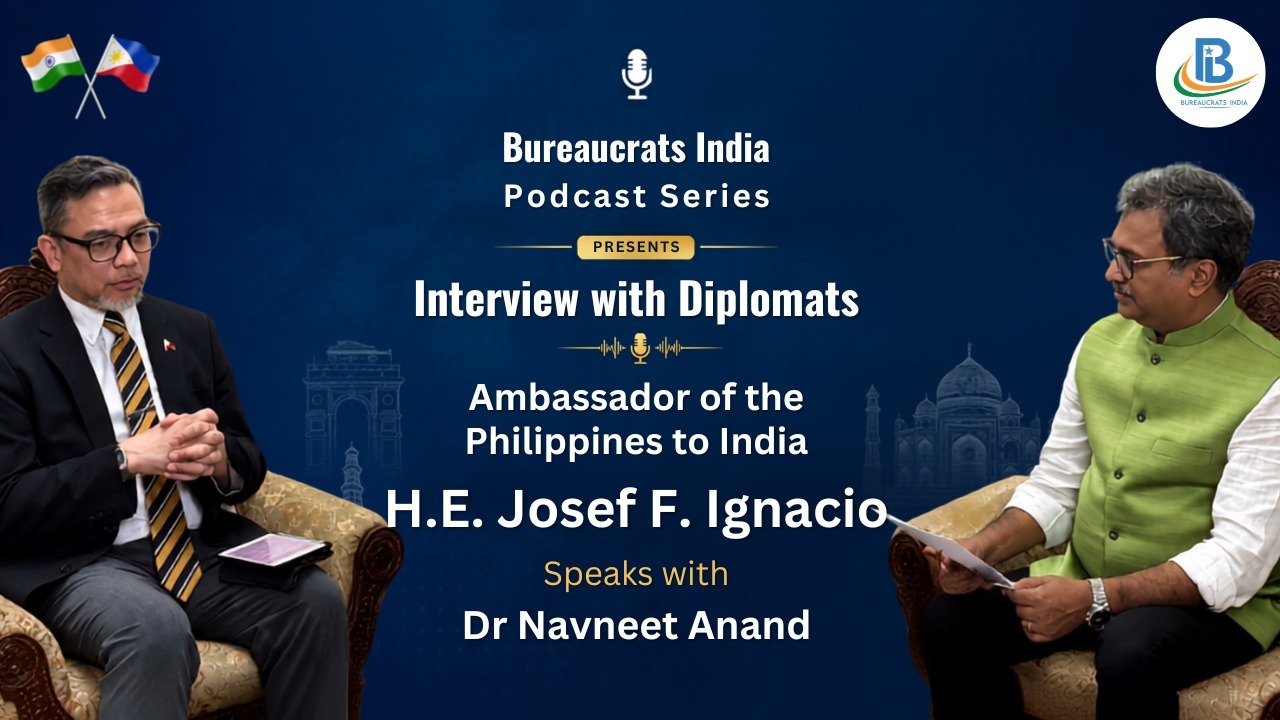
In this edition of Bureaucrats India Diplomats series, our Editor-in-Chief, Dr. Navneet Anand, speaks with H.E. Josef F. Ignacio, Ambassador of the Philippines to India, about his experience of India, the evolution of bilateral ties, the BrahMos partnership, agricultural and defence cooperation, ASEAN, tourism, investment opportunities, artificial intelligence and the future of the strategic partnership.
You have been in India for more than two years. How has your experience been?
It’s more than just liking India. I love India. In the Philippines, we learn about India early and there has always been curiosity about its culture and our historical links. Being able to live here and experience those connections firsthand has been wonderful.
I love the food, culture, music, literature and, of course, the brain power of the people. There is also tremendous dynamism in a society heading towards Viksit Bharat. It’s a good time to be in India.
India and the Philippines have elevated their ties to a strategic partnership. What tangible outcomes have you seen?
The relationship was already gaining momentum before the formal elevation. In 2023, our bilateral trade crossed $3 billion for the first time, and it has continued to grow. The BrahMos partnership has been an important driver, but defence cooperation goes beyond that to education, training and other equipment.
Another major achievement has been the growth in people-to-people ties. The Philippines introduced an e-visa and subsequently a 14-day visa-free facility for Indians, while India reciprocated with the gratis e-visa. Direct flights have also resumed. There are many high points in the relationship.
What has driven the acceleration in ties over the past year?
We have formal structures, bilateral agreements and joint working groups that have existed for years. What has changed is the alignment of our views, perspectives and interests. That like-mindedness has brought our countries closer and intensified the relationship to levels we had not seen before.
The BrahMos deal marked a milestone. How do you see defence cooperation evolving?
BrahMos is certainly a high point. It has given the Philippines a real deterrent capability, and the implementation of the contract is proceeding smoothly.
But our defence relationship extends beyond BrahMos. India has supplied military vehicles and tactical equipment, and the Philippines is increasingly looking at India as a regular source of defence equipment as we modernise our armed forces.
India’s defence industry has grown tremendously, particularly in indigenous production. Our military missions regularly visit India to explore opportunities, and we hope these efforts will bear fruit in the coming years.
Agriculture is another important area. How can bilateral agricultural trade be strengthened?
Agricultural trade is significant, with both countries having complementary strengths. The Philippines imports rice from India, including from West Bengal and Telangana, as well as buffalo meat. At the same time, we would like to expand opportunities for Philippine agricultural products in India.
Our Joint Working Group on Agriculture provides a formal platform to discuss products, standards, regulatory requirements and capacity building. The Joint Working Group on Trade and Investment also looks at ways to expand the basket of goods we trade.
We are also working towards negotiating a preferential trade agreement.
Where does that process stand?
We have completed the terms of reference, essentially the ground rules for the negotiations. Both sides are now working on identifying the products, sectors and goods that will be covered. Hopefully, we will be able to sit down and hammer out the details in the near term.
What can India and the Philippines learn from each other in agriculture and food security?
We have much to learn from each other, particularly in developing crops with better yields and greater resilience. Geography and climate change create challenges for both countries.
India has also been generous in capacity building, including scholarships in agriculture and allied sciences. We encourage our agricultural scientists and students to come to India and learn from the Indian experience. Given India’s population of more than 1.4 billion, its ability to feed such a large population is an amazing story.
How can India and the Philippines work together through ASEAN and the Indo-Pacific?
There are multiple mechanisms, from the ASEAN-India Summit and Foreign Ministers’ meetings to BIMSTEC and the Mekong-Ganga Cooperation framework.
The Philippines is currently the coordinator for ASEAN-India relations, giving us an opportunity to help strengthen the agenda. This year is the ASEAN Year of ASEAN-India Maritime Cooperation, following last year’s focus on tourism.
Ultimately, beyond the mechanisms, what binds us is a shared vision. ASEAN and India both want a stable, secure and prosperous Indo-Pacific. For the Philippines and India, maritime security, the global commons and the rule of law are particularly important areas of common interest.
Tourism has also gained momentum, particularly after the visa-free facility for Indians. How do you see this developing?
We realised that although our countries have historical and cultural connections, we had not known or visited each other as much as we should have.
The 14-day visa-free policy has worked wonders. Last year, Indian arrivals crossed 100,000, and we are confident of reaching the pre-pandemic level this year. We need to continue facilitating travel, improve direct connectivity between major cities and destinations, and encourage our private sectors to work together on tourism promotion.
Beyond beaches, what should Indian travellers explore in the Philippines?
We certainly have the beaches, and Indians will not be disappointed. But we also have mountains, heritage destinations, modern cities and unique diving experiences. The Philippines is part of the Coral Triangle, making it a special destination for scuba diving.
There are also agricultural landscapes, including vast banana and pineapple plantations in the southern Philippines and the spectacular rice terraces in the north. Once you are done with the beaches, go inland and experience these for yourself.
Where do you see the strategic partnership heading over the next decade?
The elevation to a strategic partnership was a deliberate decision for the Philippines. We do not enter into such partnerships casually. India has now joined that limited roster, which reflects the affinities between our two countries.
For now, we want to cultivate this strategic partnership and see its impact on trade, investment, education, tourism and security. Bilateral trade reached about $3.9 billion last year, and we hope to reach $10 billion within the next decade, perhaps sooner, aided by the PTA and other mechanisms. We also hope to expand educational exchanges, increase tourism and strengthen cooperation between our navies and coast guards. There is simply so much promise that bears realising, and we are confident we will get there.
What opportunities do you see for Indian investors in the Philippines?
Technology and high-tech sectors will play a key role. I would particularly like to see greater Indian involvement in the Philippines’ nickel sector. We are trying to move higher up the value chain, including processing nickel to support industries such as electric vehicles.
The Philippines has also been part of the semiconductor industry for a long time, particularly downstream. India is developing its own capabilities, so there are opportunities for collaboration. IT, semiconductors and EV-related sectors are areas where I see considerable potential.
AI is transforming diplomacy and economic life. What do you see as its biggest challenge?
AI has enormous advantages, but I do not subscribe to the view that it should replace what humans bring to their professions.
In diplomacy, information is now widely available and AI can produce reports almost instantly. The value added by diplomats lies increasingly in the insights, analysis and synthesis that come from engagement with governments, media and fellow diplomats. AI should be an enabling tool, but we must not lose sight of the human element. Countries also need to develop safeguards and standards so that AI remains a tool that serves humanity.
What is your view of Prime Minister Narendra Modi’s leadership?
PM Modi is a greatly admired leader. As ambassadors, we value every opportunity to interact with him and observe him at work.
It is inspiring how he is able to move people and the government as an organisation to meet the needs of the people. I think he has a heart, he listens, and then marshals the whole of government to address what he hears. There is a lesson there for government leaders around the world.
Finally, what message would you like to leave with the Bureaucrats India audience?
There is a lot of promise between our two countries, and our peoples have an important role in strengthening this growing relationship.
We invite Indians to visit the Philippines, enjoy our destinations and discover how our two nations, although separated by continental Southeast Asia, are actually not that dissimilar. The Indian influence reached the Philippines centuries ago. We have our version of the Ramayana and Sanskrit-derived words in our language. There are many cultural connections waiting to be rediscovered. We also want to share the good stories we have about India with our people so they can get to know India better and enjoy Incredible India.
BI Bureau