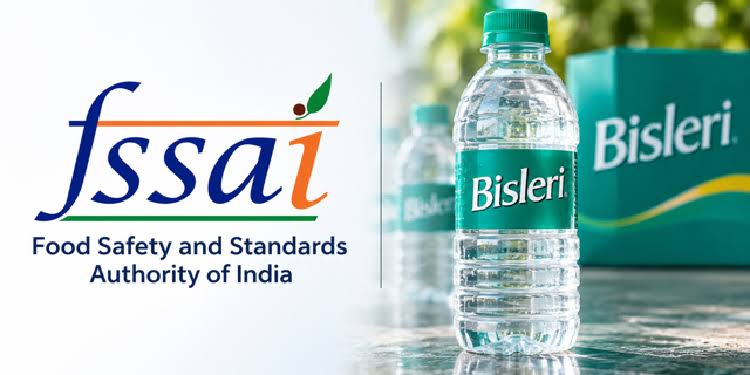
New Delhi: The Food Safety and Standards Authority of India (FSSAI) has sanctioned prosecution against Bisleri International Pvt Ltd after a regulatory sample of its packaged drinking water was declared unsafe following laboratory tests that flagged chemical non-compliance. The development has brought the spotlight on quality control and regulatory oversight in India's packaged drinking water industry, even as the company has maintained that its products are safe for consumption.
In a statement issued on November 23, Bisleri said the matter relates to a specific batch manufactured at its Goa facility in September 2025 and asserted that the findings do not reflect the quality of its overall production. The company also said it had not received any formal notice from FSSAI regarding the latest action.
According to FSSAI, a regulatory sample of 'Packaged Drinking Water (other than Mineral Water)' was collected from Bisleri International's premises for analysis. The initial laboratory examination found that the sample did not comply with the prescribed limits for bromate, following which it was declared unsafe under the Food Safety and Standards Act, 2006.
The company subsequently challenged the initial findings, and the sample was referred to a referral food laboratory for further examination. However, the referral laboratory also declared the sample unsafe, citing the detection of polynuclear aromatic hydrocarbons (PAHs).
Based on the findings of both laboratory examinations, FSSAI said violations relating to unsafe food had been established under the law. It has, therefore, sanctioned the launch of prosecution against Bisleri International Pvt Ltd under the Food Safety and Standards Act, 2006.
The two chemical parameters flagged in the investigation have significant public health implications. Bromate is a chemical compound that can form during water treatment, particularly when ozone is used for disinfection. The prescribed limit for bromate in drinking water is 10 micrograms per litre. Prolonged exposure to elevated levels is a potential health concern, with bromate classified by the International Agency for Research on Cancer (IARC) as possibly carcinogenic to humans.
PAHs, meanwhile, comprise a group of organic compounds that can enter the environment through industrial emissions, incomplete combustion and other sources of contamination. Certain compounds within this group are known carcinogens. Their detection in a drinking water sample warrants scrutiny of the source water, treatment processes and possible contamination during storage or packaging.
Responding to the regulatory action, Bisleri International maintained that its packaged drinking water is safe for consumption and reiterated its commitment to quality and consumer safety.
In its statement, the company said the matter dates back approximately 14 months and concerns a batch manufactured at its Goa facility in September 2025. It clarified that the facility is one of 143 plants in its manufacturing network.
According to Bisleri, FSSAI collected six samples from the Goa facility on September 30, 2025. The initial testing found that five samples complied with all applicable standards, while the sixth recorded a bromate level of 12 micrograms per litre, against the prescribed limit of 10 micrograms per litre.
Following an appeal filed by the company on November 22, 2025, the sample was sent to a referral laboratory for retesting. Bisleri said the referral laboratory found bromate within the prescribed limit but separately flagged the presence of PAHs.
The company said the difference between the two sets of findings raised questions that required clarification. It subsequently arranged independent testing of the sample at an FSSAI-approved laboratory, which, according to Bisleri, also found bromate levels to be within the prescribed limit.
Bisleri further stated that it submitted these independent test results to FSSAI's Western Regional Office through a formal communication dated February 2, 2026. The company claimed that it received no further communication from the regulator thereafter and understood the matter to have been closed.
It also said that, as of November 23, it had not received any notice from FSSAI either by email or in hard copy and had been unable to locate the reported notice on the regulator's website.
Emphasising its quality assurance processes, the company stated: "Drinking water safety is a priority for Bisleri. We maintain stringent quality controls of over 90 tests across our 10-step manufacturing process and will continue to cooperate with FSSAI to address the matter through the appropriate regulatory process."
Bisleri also reiterated that its packaged drinking water remains safe for consumption.
The development underscores the role of FSSAI in enforcing food safety standards and holding food business operators accountable for compliance. The regulator's decision to sanction prosecution indicates that it considers the laboratory findings sufficient to initiate legal proceedings. However, the sanction itself is not a judicial conviction, and the matter will be subject to the applicable legal process.
The case also draws attention to the broader regulatory framework governing packaged drinking water in India. In October 2024, the government removed the mandatory BIS certification requirement for packaged drinking water and mineral water. However, this did not dilute manufacturers' obligations to meet prescribed food safety and quality standards.
FSSAI subsequently introduced a testing scheme for packaged drinking water and mineral water, effective January 1, 2026, to strengthen quality monitoring and compliance.
The need for effective enforcement is also reflected in the industry's wider compliance record. Government data presented in Parliament showed that 333 out of 1,300 enforcement samples of packaged drinking water analysed in 2023-24 were non-conforming. In 2022-23, 650 of 1,776 samples failed to meet prescribed standards.
FSSAI has also stepped up enforcement action against food business operators in other categories. Its recent actions include sanctioning prosecution against certain other companies, suspending licences for regulatory non-compliance and ordering product recalls where food items were found unsafe.
The Bisleri case raises important questions about transparency, testing protocols and the communication of food safety findings. While the regulatory findings warrant serious attention, it is equally important to distinguish between a specific sample found unsafe and a blanket assessment of all products manufactured by a company.
The reported findings relate to a sample associated with a particular batch from the Goa facility. They do not, by themselves, establish that every Bisleri bottle currently available in the market is contaminated. Similarly, the company's independent test results and its assertion of product safety need to be considered alongside the findings of the regulator and the referral laboratory.
Clarity on the exact nature and concentration of the detected PAHs, the laboratory findings, the status of the affected batch and the subsequent regulatory process would help address concerns and provide consumers with a clearer understanding of the issue.
For consumers, the episode is a reminder to check the FSSAI licence details, manufacturing and packaging dates, batch numbers and the integrity of bottle seals when purchasing packaged drinking water. However, chemical contaminants such as bromate and PAHs cannot be reliably identified through appearance, smell or taste; laboratory testing remains essential.
Ultimately, the issue goes beyond one brand. Packaged drinking water is an important source of safe drinking water for millions of people, particularly in places where access to reliable public water supplies remains a challenge. Ensuring its safety requires consistent testing, transparent disclosure of findings, robust manufacturing controls and timely regulatory action.
The coming days will be important in establishing how the matter progresses through the regulatory and legal process. For both the regulator and the company, clear communication and verifiable evidence will be essential to safeguarding public confidence in packaged drinking water.
BI Bureau

_500_x_400.webp "Seed industry welcomes proposed single-window system, seeks unified approach to make India a global seed hub")