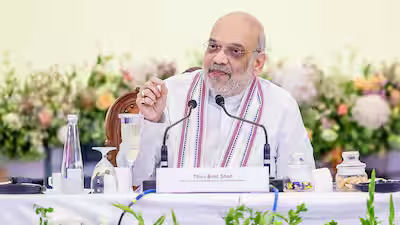
Itanagar: When Union Home Minister Amit Shah visited Kibithoo, one of India's northernmost villages in Arunachal Pradesh, in April 2023, the focus was on changing the development landscape of settlements along the country's international borders. He launched the Vibrant Villages Programme (VVP), aimed at improving infrastructure, connectivity and livelihood opportunities in remote border areas.
Nearly three years later, his latest visit to Arunachal Pradesh brought the focus to a larger question: how can these border villages become economically viable, retain their populations and contribute to the country's security?
Shah's two-day visit, which concluded on November 22, 2026, was significant in this context. Apart from reviewing internal security and border management, he assessed the progress of development programmes and outlined fresh priorities covering agriculture, tourism, healthcare, connectivity and cooperative institutions.
The sequence of high-level engagements with the state also reflects the Centre's continued attention to its strategic and developmental priorities. After Shah's visit to Kibithoo in 2023, he attended the swearing-in ceremony of Chief Minister Pema Khandu in June 2024. Prime Minister Narendra Modi subsequently visited Itanagar in September 2025, laying the foundation stone for and inaugurating projects worth more than Rs 5,100 crore, including major hydropower, connectivity and other development initiatives.
Shah's November 2026 visit added another dimension to this engagement, with a greater emphasis on assessing implementation and connecting development with economic opportunities for local communities.
One of the most significant claims made during the visit concerned the impact of the Vibrant Villages Programme. Shah said that people had started returning to all 40 border villages reviewed by him, with outward migration having stopped and local populations increasing. He attributed the change to improvements in electricity, drinking water, schools, healthcare facilities and employment opportunities. He also highlighted the installation of solar panels and the provision of water in remote mountainous settlements.
The government is now looking to strengthen the economic foundations of these villages. In a significant intervention, Shah said the Ministry of Home Affairs had directed the Army and the Indo-Tibetan Border Police (ITBP) to procure essential supplies directly from local villages and cooperative institutions instead of sourcing them from distant cities such as Tezpur and Guwahati.
The initiative is intended to create a dependable market for local agricultural produce while bringing economic benefits to farmers and rural cooperatives. Shah also discussed Mission Krishi Veer and Mission Arun Himveer, under which the requirements of security forces would first be assessed and villages supported in producing the goods needed by them.
He called for Arunachal Pradesh to become self-reliant in milk, eggs, fish and meat, observing that at least 32,000 families could become economically self-reliant through local production. The National Dairy Development Board and Amul are also expected to support milk procurement from the state.
Tourism and horticulture featured prominently in the development roadmap. Shah asked the state government to increase annual tourist arrivals from 9.18 lakh to 15 lakh and improve homestay facilities. He also called for identifying two additional horticultural crops for focused development, alongside existing priorities such as kiwi, orange and large cardamom.
The November 21 review meeting also examined the state's infrastructure and economic progress. According to the state government's presentation, annual road construction has increased from 300 km to 1,800 km, while Arunachal Pradesh's Gross State Domestic Product has grown from Rs 20,373 crore in 2015-16 to an estimated Rs 50,651 crore in 2026-27. Under the Vibrant Villages Programme, 1,099 of the 2,414 sanctioned projects across 455 border villages, with a total outlay of Rs 2,875.17 crore, have been completed.
Shah's visit also brought fresh investments in the state's development infrastructure. He launched projects worth Rs 5,610.95 crore, including Mission Shikshit Arunachal Phase II with an outlay of Rs 1,500 crore, the Chief Minister's Comprehensive State Power Development Programme worth Rs 2,000 crore, the Chief Minister's Comprehensive State Rural Road Development Programme worth Rs 2,000 crore and 199 projects worth Rs 110.95 crore under the Vibrant Villages Programme across 11 border districts.
The unveiling of the Arunachal Pradesh Cooperative Vision 2047, the launch of an e-commerce platform for products made by rural livelihood groups and the inauguration of a foodgrain storage warehouse at Raga LAMPS were other initiatives aimed at strengthening rural institutions and improving market access for local producers.
Another important component of the visit was the inauguration of the permanent campus of the 12th Battalion of the National Disaster Response Force at Hollongi. Besides strengthening disaster response in Arunachal Pradesh, the facility will provide training to State Disaster Response Forces of all eight Northeastern states, extending its institutional benefits across the region.
The wider significance of Shah's latest visit lies in the range of issues brought together under the state's development agenda. Border connectivity and security remain central, but the emphasis is also shifting towards ensuring that people living in frontier settlements have access to essential services, sustainable livelihoods and markets for their produce.
For Arunachal Pradesh, the challenge ahead will be to translate these targets and investments into sustained improvements in the lives of people in its remote villages. The latest review has placed that task firmly on the state's development agenda.
BI Bureau

_500_x_400.webp "Seed industry welcomes proposed single-window system, seeks unified approach to make India a global seed hub")