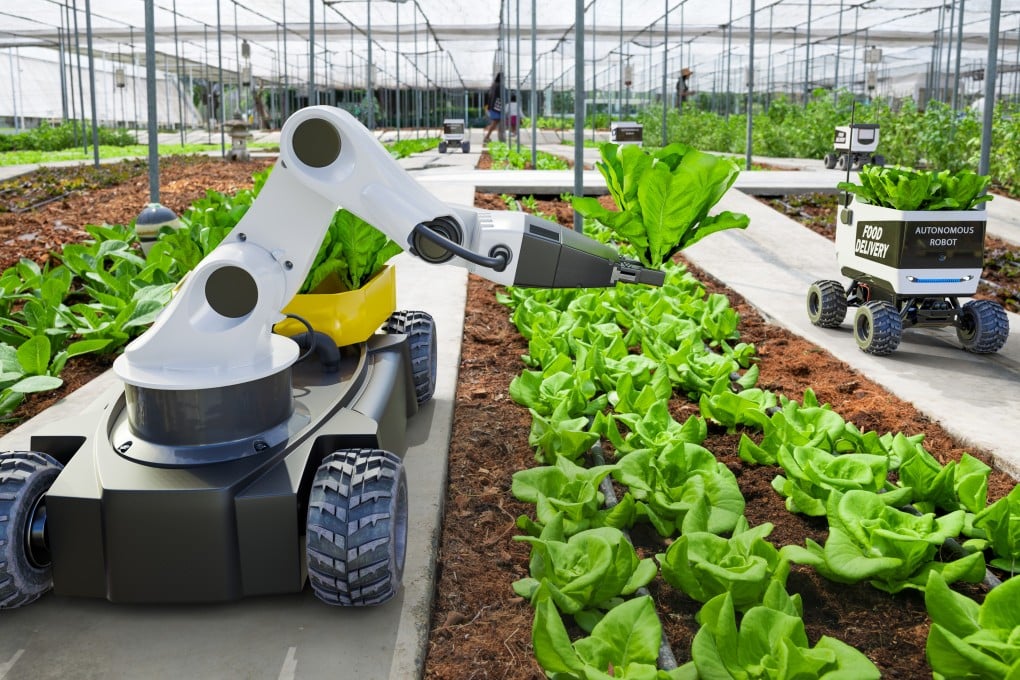
New Delhi: Artificial intelligence, robotics, and nanotechnology are among seven emerging deep technologies that are set to transform global agriculture, according to a new report released by the World Economic Forum (WEF). The report highlights several case studies from India, showcasing how these technologies are improving productivity, sustainability, and resilience in the sector.
The report, titled Shaping the Deep-Tech Revolution in Agriculture, was developed by the WEF in collaboration with stakeholders from industry and academia. It identifies seven key technologies—generative AI, robotics, satellite-enabled remote sensing, computer vision, edge Internet of Things (IoT), CRISPR-based genome editing, and nanotechnology—as drivers of a new wave of innovation in agriculture.
The WEF said these technologies “will boost resilience and productivity, while securing rural livelihoods.” It noted that agriculture worldwide faces a convergence of crises, including migration from rural to urban areas, climate extremes, and the degradation of soil and water resources. With one-third of the world’s soil degraded and 71 per cent of aquifers depleted, the report said meeting future food demands will require urgent adoption of advanced technology.
The report also explores how the convergence of these technologies can lead to high-impact applications such as autonomous swarm robotics, precision farm management, agentic AI systems, and carbon reporting. It features several examples from India, including climate-resilient rice varieties, precision farming in sugarcane, and satellite-based crop insurance systems.
In one case study, the Indian Council for Agricultural Research (ICAR) used CRISPR-based genome editing to develop two rice varieties. The first, DRR 100, has improved tolerance to drought, salinity, and climate stresses, resulting in a 19 per cent increase in yield and a 20 per cent decrease in greenhouse gas emissions. The second, Pusa DST Rice 1, can increase yields by 9.66 to 30.4 per cent in saline and alkaline soils, potentially leading to a 20 per cent increase in production.
Another example cited the use of remote sensing to improve efficiency in India’s Pradhan Mantri Fasal Bima Yojana (PMFBY). The programme replaced manual crop-loss assessments with a technology-driven system using satellite imagery, drones, and a mobile app for geotagged, real-time data collection. This approach “replaces subjective manual assessments with objective, verifiable data, streamlining the entire loss-estimation process,” the WEF said. The system enables faster claim settlements, improves transparency, and strengthens trust between farmers, insurers, and the government.
The report also referred to initiatives promoting nano inputs for soil health, satellite-enabled monitoring for carbon verification, and the scaling of generative AI and natural language processing through digital public infrastructure.
Among the examples highlighted was Bhashini, launched under India’s National Language Translation Mission. The government-led platform provides open-source datasets, language models, and APIs for automatic speech recognition, machine translation, and text-to-speech systems in Indian languages. It “reduces the barriers to entry by enabling the integration of vernacular voice and text interfaces into their use cases,” the report said, allowing deep-tech start-ups to reach non-English-speaking users and deploy tools at scale.
The WEF called on governments to “adopt agile policies and regulatory sandboxes to keep pace with technological advancement” and support the scaling of deep-tech innovations that can reimagine agricultural systems and strengthen rural economies.
The report was released under the WEF’s Artificial Intelligence for Agriculture Initiative (AI4AI), which since 2021 has worked with multiple stakeholders to bring digital technologies to over 895,000 farmers in India. Building on India’s example, the initiative is now supporting similar programmes in Saudi Arabia, Colombia, and Brazil.
BI Bureau