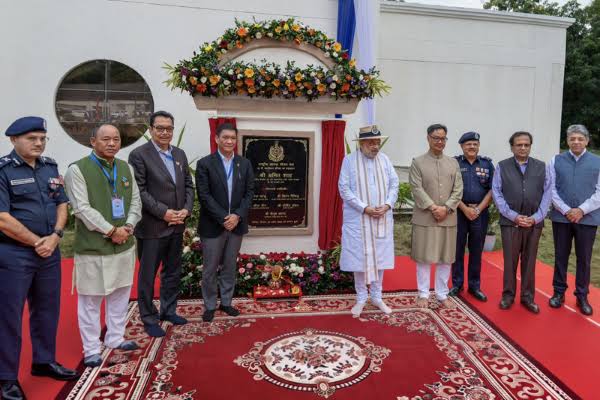
Union Home Minister Amit Shah inaugurated the campus of the 12th Battalion of the National Disaster Response Force (NDRF) in Itanagar, Arunachal Pradesh, on 22 November 2026. The facility is expected to strengthen disaster response capabilities across the Northeast and neighbouring regions.
The campus will also serve as a training centre for State Disaster Response Forces (SDRFs) of all eight northeastern states. Built with earthquake-resistant infrastructure, it includes an Olympic-size swimming pool and a diving tank for specialised personnel training.
The inauguration highlights India's shift from a largely relief-oriented disaster response system towards early warning, prevention, mitigation, preparedness and a Zero Casualty approach.
What is the National Disaster Response Force (NDRF)?
The National Disaster Response Force is a specialised force constituted to respond to natural and man-made disasters in India.
It was established under the Disaster Management Act, 2005, and functions under the Ministry of Home Affairs.
Its major responsibilities include:
- Conducting search and rescue operations during disasters.
- Providing emergency relief to affected communities.
- Responding to floods, cyclones, earthquakes, landslides and other emergencies.
- Conducting disaster preparedness and awareness programmes.
- Supporting State Governments during major disasters.
- Providing specialised training in disaster response.
According to the Ministry of Home Affairs, NDRF has conducted more than 11,000 rescue and relief operations and saved over 1.61 lakh lives.
What is the role of the new 12th Battalion campus?
The new campus at Itanagar is designed to strengthen disaster response infrastructure in the disaster-prone Northeast.
Its key features include:
- Regional response centre: It will serve Arunachal Pradesh, other northeastern states and adjoining regions.
- SDRF training: Personnel from the State Disaster Response Forces of all eight northeastern states will receive training at the facility.
- Earthquake-resistant infrastructure: Campus buildings have been constructed according to earthquake-resistant standards.
- Specialised training facilities: An Olympic-size swimming pool and diving tank will support the physical and technical training of personnel.
The facility is expected to strengthen round-the-clock disaster response operations in the region.
What is the difference between NDRF and SDRF?
The National Disaster Response Force and State Disaster Response Forces are specialised agencies responsible for disaster response at different administrative levels.
- NDRF: A specialised national-level force constituted under the Disaster Management Act, 2005, to respond to major disasters and assist States.
- SDRF: State-level disaster response forces established by State Governments to handle emergencies within their respective jurisdictions.
SDRFs generally respond first to disasters at the State level, while NDRF teams provide specialised support when required.
How has India's disaster management approach changed?
India's disaster management framework has gradually shifted from post-disaster relief and rehabilitation towards a comprehensive approach that focuses on reducing disaster risks before they occur.
The approach includes:
- Early warning: Using scientific and technological systems to provide advance information about potential disasters.
- Prevention: Taking measures to avoid or reduce disaster risks.
- Mitigation: Reducing the possible impact of disasters through infrastructure and planning.
- Preparedness: Training personnel, strengthening institutions and preparing communities.
- Response: Conducting timely rescue, evacuation and relief operations.
- Recovery: Restoring essential services, infrastructure and livelihoods after disasters.
The government has also promoted a Zero Casualty approach, which focuses on preventing loss of life through timely warnings, evacuation and coordinated response.
According to the Home Minister, cyclone warnings that were earlier available 24–48 hours in advance can now be issued up to seven days ahead, helping authorities prepare and evacuate vulnerable communities.
What is the Zero Casualty Approach?
The Zero Casualty Approach aims to minimise or prevent loss of human lives during disasters through advance planning and effective emergency response.
It involves:
- Timely and accurate early warning systems.
- Evacuation of people from vulnerable areas.
- Deployment of rescue teams before disasters strike.
- Community-level preparedness.
- Coordination between government agencies and local administrations.
It also involves protecting livestock and other vulnerable assets during evacuation operations.
What are the major institutions involved in disaster management in India?
India follows an institutional framework involving national, state and district-level agencies.
- National Disaster Management Authority (NDMA): Apex body responsible for laying down policies, plans and guidelines for disaster management in India. It is chaired by the Prime Minister.
- National Disaster Response Force (NDRF): Specialised force responsible for disaster response and rescue operations.
- State Disaster Management Authority (SDMA): Responsible for disaster management planning and coordination at the State level, generally chaired by the Chief Minister.
- State Disaster Response Force (SDRF): State-level specialised force for disaster response.
- National Institute of Disaster Management (NIDM): Responsible for training, research and capacity-building in disaster management.
- District Disaster Management Authority (DDMA): Coordinates disaster management activities at the district level.
What is the role of the community in disaster management?
Disaster preparedness is not limited to specialised forces. Local communities and grassroots institutions also play an important role.
The government has involved personnel such as Patwaris, NCC cadets, Scouts and trained community volunteers known as Aapda Mitras in preparedness and response activities.
Community participation helps in:
- Identifying vulnerable areas and populations.
- Disseminating early warnings.
- Supporting evacuation.
- Providing first response and basic assistance.
- Reducing casualties through local preparedness.
NDRF and international disaster response
India's disaster response capabilities have also expanded beyond its borders. The NDRF has participated in rescue and relief operations in countries including Japan, Nepal, Türkiye and Sri Lanka.
The year 2026 has been declared the Year of Capacity Building for NDRF, with emphasis on expanding its operational capabilities, modern equipment and specialised training.
Why is this Important for UPSC?
Disaster Management (GS Paper III): Disaster preparedness, mitigation, early warning systems, evacuation and institutional response.
Governance (GS Paper II): Centre-State coordination, institutional mechanisms and public participation in disaster management.
Internal Security (GS Paper III): Disaster response infrastructure in strategically important and border regions.
Geography (GS Paper I): Earthquakes, floods, cyclones, landslides and regional disaster vulnerability.
Science and Technology (GS Paper III): Use of technology in weather forecasting, early warning and disaster risk reduction.
UPSC Prelims Facts
Disaster Management Act, 2005
- Provides the legal and institutional framework for disaster management in India.
- Provides for the establishment of NDMA, SDMAs and DDMAs.
- Provides the framework for constitution of the NDRF.
National Disaster Response Force (NDRF)
- Established under the Disaster Management Act, 2005.
- Functions under the Ministry of Home Affairs.
- Specialises in disaster response and rescue operations.
National Disaster Management Authority (NDMA)
- Chaired by the Prime Minister of India.
- Lays down policies, plans and guidelines for disaster management.
Sendai Framework for Disaster Risk Reduction (2015–2030)
- Adopted at the Third UN World Conference on Disaster Risk Reduction in Sendai, Japan, in 2015.
- Focuses on reducing disaster risks and losses.
- Has four priorities for action: understanding disaster risk, strengthening disaster risk governance, investing in disaster risk reduction and enhancing disaster preparedness.
Aapda Mitra Scheme
- Aims to train community volunteers in disaster response.
- Focuses on strengthening local-level preparedness and first-response capabilities.
Possible UPSC Mains Question
Q. India has gradually shifted from a relief-centric approach to a comprehensive disaster risk reduction framework. Discuss the role of institutional preparedness, early warning systems and community participation in reducing disaster vulnerability.
Key points for an answer
- Disaster management requires prevention, mitigation, preparedness, response and recovery.
- Early warning systems enable timely evacuation and reduce casualties.
- NDRF and SDRFs strengthen specialised rescue and relief capabilities.
- Coordination between NDMA, State authorities and district administrations improves response efficiency.
- Community volunteers and local institutions strengthen last-mile disaster preparedness.
- Modern equipment, training and resilient infrastructure improve operational capacity.
- International cooperation enables the sharing of disaster response expertise.
- The Sendai Framework provides a global roadmap for disaster risk reduction.
Main information source: Press Information Bureau (PIB), Ministry of Home Affairs
Correct the disaster-management legal detailsAdd the missing eight-crore tree initiative
BI Bureau