Bureaucracy remains the backbone of governance, translating policies into action and ensuring that development reaches every citizen. Bureaucrats, through their dedication and administrative leadership, play a vital role in strengthening institutions, improving service delivery, and driving meaningful change on the ground.
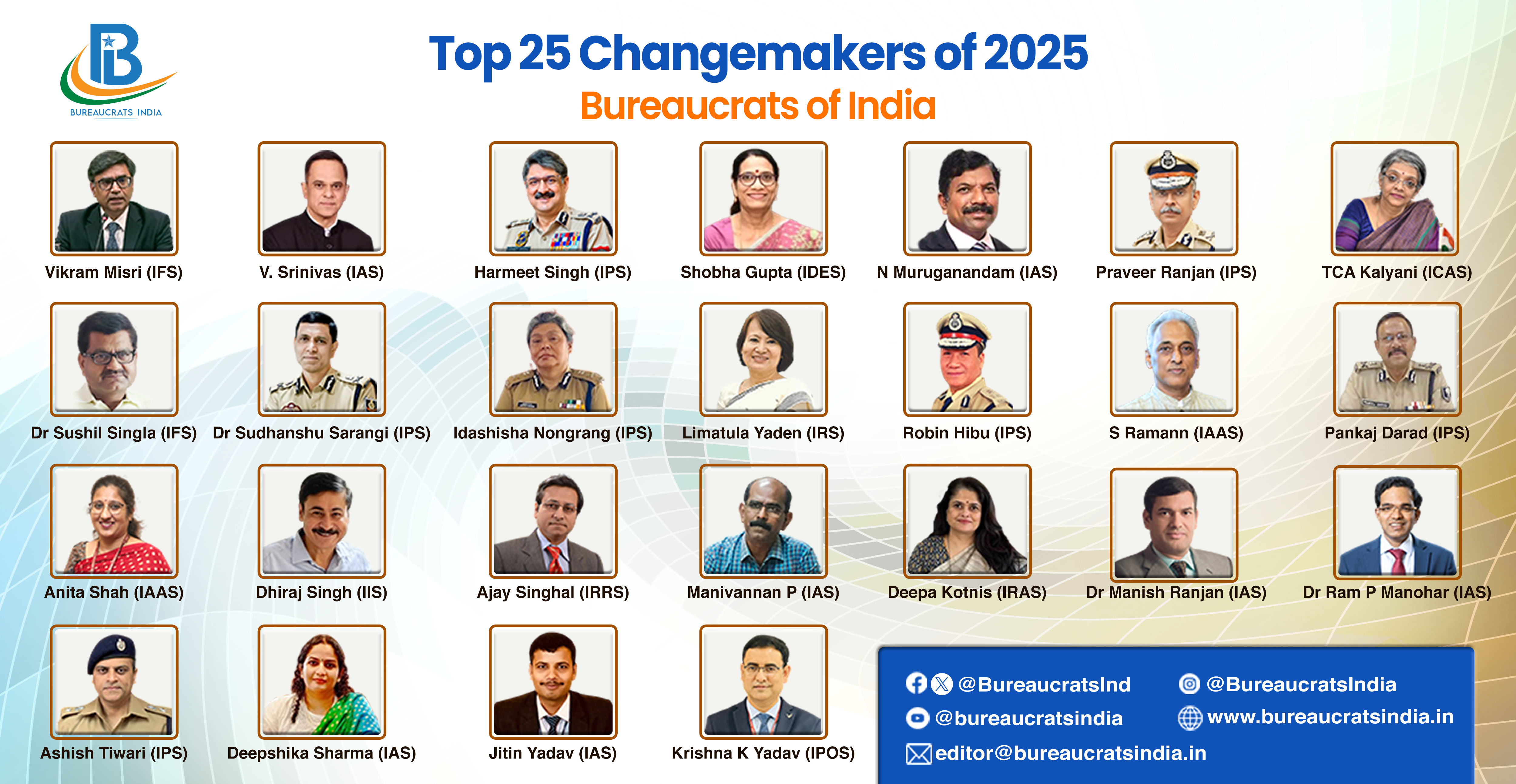
Bureaucrats India proudly presents the 25 illustrious bureaucrats of 2025 - officers who have demonstrated exceptional leadership, innovation, and commitment to public service. The selection was curated by the editorial team comprising Pragya Lal, Vigya Dwivedi, Pooja Rai, Naina Jha, Aparna Vats, and Vridhi Bhatia based on performance, integrity, policy impact, and dedication to innovation.
From strengthening inclusive governance to leveraging technology for better public delivery, each officer on this list has made a lasting difference to citizens’ lives. Their work reflects professionalism, resilience, and a shared commitment to India’s progress.
We extend our heartfelt congratulations to these exemplary public servants and acknowledge the dedication of thousands of bureaucrats across the country who work tirelessly to shape a stronger and more prosperous India.
The List
1. Vikram Misri, IFS, Foreign Secretary, Government of India
Vikram Misri, a 1989-batch officer, assumed charge as India’s 35th Foreign Secretary in July 2024. With over three decades in diplomacy, he has played a significant role in shaping India’s foreign policy, particularly on China and strategic affairs. He has served as Ambassador to China, Spain, and Myanmar, and later as Deputy National Security Adviser, contributing to national security planning and complex international negotiations.
He has had the rare distinction of working as Private Secretary to three Prime Ministers - I. K. Gujral, Manmohan Singh, and Narendra Modi gaining deep insights into high-level policy-making. Misri also held the post of Deputy National Security Adviser from January 2022 to June 2024. During Operation Sindoor, following the Pahalgam terror attack in April 2025, Misri emerged as the face of official communication, regularly briefing the public and reassuring the nation. He effectively navigated sensitive diplomatic and military developments with clarity and balance.
2. V. Srinivas, IAS, Chief Secretary, Rajasthan
V Srinivas, a 1989-batch officer of Rajasthan cadre, assumed charge as Chief Secretary of Rajasthan in November 2025. With over three decades of administrative experience, he is known for driving governance reforms, digital transformation, and citizen-centric public administration. As Secretary of the Department of Administrative Reforms & Public Grievances, Government of India, he strengthened the CPGRAMS grievance redressal system and modernised service delivery across ministries. Over 1.15 crore public grievances have been redressed in the period 2019-2025. The grievance redressal time has come down from 28 days in 2022 to 16 days in July 2025.
As Chief Secretary, Rajasthan, he has emphasised data-driven governance, energy reforms under PM-KUSUM, and the “Viksit Rajasthan 2047” roadmap. He was elected President of the International Institute of Administrative Sciences (2025–2028), reflecting global recognition of his administrative leadership.
3. Harmeet Singh, IPS, DGP Assam
Harmeet Singh, a 1992-batch officer of the Assam-Meghalaya cadre, has been advancing technology-driven, citizen-centric policing since taking charge as DGP Assam in May 2025. With strong expertise in counter-terrorism, cybersecurity, and de-radicalisation, he has significantly strengthened the state’s law and order and internal security framework. Assam’s crime rate has significantly come down from 349.5 in 2020 to 121.5 in 2025 to 101.9 in January 2026.
Known for his innovations and citizen-centirc policing, Singh has introduced important initiatives such as the Assam Police social media centre to improve public communication and the Sishu Mitra Programme to promote child-friendly policing, among others. Assam Police’s New Year Party social media campaign became a special attraction on social media, getting applauds from various quarters. Over the years, Singh has held several key leadership roles, including Commissioner of Police, Guwahati. He has received several prestigious gallantry and service awards, and his career shows strong dedication, innovative thinking, and a deep commitment to serving the public.
4. Shobha Gupta, IDES, Director General of Defence Estates
Shobha Gupta assumed charge as DGDE in September 2025. She has played a vital role in strengthening defence land governance and cantonment administration across India. Serving as Chief Executive Officer of several Cantonment Boards and Defence Estates Officer in multiple circles, she worked to improve urban civic services, land management transparency, and infrastructure planning in military areas.
In senior leadership roles across Central, South-West, and Western Commands, she contributed to policy implementation, land record modernisation, and efficient utilisation of strategic defence assets. As DGDE, Gupta now oversees vast stretches of defence land nationwide, ensuring professional management of critical national assets that directly support the operations and welfare of India’s Armed Forces while promoting countable and citizen focused administration in cantonments.
5. N Muruganandam, IAS, Chief Secretary, Tamil Nadu
N Muruganandam, a 1991-batch officer, is the state’s 50th Chief Secretary, widely respected for his steady, detail-oriented and results-focused administration. Over a distinguished career, he has served as Collector of key districts including Coimbatore, Karur and Chennai, and has led major departments such as Industries and Finance, earning trust across administrations for sustaining investment momentum even during the pandemic and negotiating large industrial deals.
As Finance Secretary, he played a crucial role in planning and implementing key welfare programmes, including financial support schemes for women and higher education initiatives. Known for collaborative governance and strategic insight, he has directed efforts to boost higher education enrolment and streamline administrative processes, reinforcing efficient public service delivery across the state.
6. Praveer Ranjan, IPS, Director General, CISF
Praveer Ranjan of 1991 batch is known for his strong focus on modernising policing and improving security systems in India. As DG of the Central Industrial Security Force (CISF), he has worked towards strengthening the security of airports and critical infrastructure through technology and better management practices. Earlier, as DGP Chandigarh, he introduced several digital policing initiatives such as e-FIR services, integrated command centers, and faster emergency response systems, making police services more accessible to citizens.
With experience in investigation, aviation security, and administration, he is recognised for promoting transparent governance, efficient policing, and welfare-focused leadership within security forces.
7. TCA Kalyani, ICAS, Controller General of Accounts
TCA Kalyani, a 1991-batch officer of the Indian Civil Accounts Service, assumed charge as the 29th Controller General of Accounts (CGA) of India. With over 34 years of experience, she has contributed significantly to strengthening public financial management and digital governance in India. She played an important role in implementing the Direct Benefit Transfer (DBT) system for fertilizer subsidies, ensuring transparent delivery of benefits to farmers and reducing leakages.
She also introduced online bill payment and kiosk services at Mahanagar Telephone Nigam Limited, promoting digital financial services. As CGA, she oversees government accounting, prepares Union accounts, and works with the Reserve Bank of India to ensure transparency and efficient management of public funds.
8. Sushil Kumar Singla, IFS, Administrative Secretary, Environment, Science & Technology and Climate Change, Himachal Pradesh
With over 31 years of public service, 1994 batch Indian Forest Service officer Sushil Kumar Singla has worked closely with communities across India, contributing to agriculture, forestry, environment, climate change, rural development, and natural resource management. His experience spans all levels of governance, from village and district administration to state and national policy-making, where he has been involved in planning, implementing, and monitoring development programmes.
A strong believer in decentralised governance, he has introduced reforms focused on sustainability, ease of living, and improving livelihoods, especially for rural communities. His work in forestry and biodiversity conservation has empowered local communities, particularly women. Passionate about environmental issues, he has authored a few books, with the recent one being ‘Forest Resources in India: Integrative Governance and Community Participation for Sustainable Future'.
9. Sudhanshu Sarangi, IPS, DG Fire Services & Commandant General Home Guards & Director Civil Defense, Odisha
Dr Sudhanshu Sarangi is a 1990-batch officer known for his people-centric policing and impactful leadership in law enforcement. During his stint as Twin City (Bhubaneswar-Cuttack) Police Commissioner, he strengthened policing systems through decisive action against organised crime, drug trafficking, and food adulteration by establishing a dedicated Drug Task Force.
During the COVID-19 lockdown, he led from the front, ensuring strict protocol enforcement while extending humanitarian support to citizens, earning widespread public trust and appreciation.
10. Idashisha Nongrang, IPS, Director General of Police (DGP) of Meghalaya
Idashisha Nongrang, a 1992-batch officer of the Assam-Meghalaya cadre, is the first woman and tribal officer to serve as Director General of Police (DGP) of Meghalaya, a historic milestone in the Northeast’s policing leadership. Her appointment broke longstanding barriers in a region where senior police leadership has seldom seen female representation.
As Meghalaya’s police chief, Nongrang has focused on women’s safety, improving traffic management, strengthening community policing, and addressing cybercrime as the state urbanises and digital use expands. She also initiated weekly public grievance meetings to make the police more accessible and responsive to citizens. Under her leadership, the Meghalaya Police have undertaken significant operations, including major anti-narcotics actions, reinforcing public safety and enforcement effectiveness. A seasoned officer rooted in her home state, Nongrang has held key roles including Director General of Civil Defence & Home Guards and Acting DGP prior to her elevation, earning respect for her leadership and deep understanding of local law-and-order challenges.
11. Limatula Yaden, IRS, Minister (Customs) at India’s Permanent Mission to the World Trade Organisation (WTO), Geneva
Limatula Yaden, an officer of 1996 batch, has built a career shaping India’s customs administration, indirect tax policy, and global trade engagement. Currently serving as Minister (Customs) at India’s Permanent Mission to the World Trade Organisation in Geneva, she represents the country in multilateral trade negotiations, dispute settlements, and discussions on tariff and non-tariff measures. Her earlier role as Joint Secretary in the Tax Research Unit (TRU-II), CBIC, placed her at the centre of indirect tax policy formulation and implementation.
Known for advancing trade facilitation and strengthening policy frameworks, Yaden has contributed significantly to modernising India’s customs and taxation ecosystem while promoting India’s interests in international trade governance.
12. Robin Hibu, IPS, Special Commissioner of Police, Delhi Police
Robin Hibu of the 1993 batch is widely recognised for combining policing with social service and community outreach. Currently serving as Special Commissioner of Police, he has held key leadership roles including Chief Security Officer at Rashtrapati Bhavan and Managing Director of the Delhi Police Housing Corporation.
As the first IPS officer from Arunachal Pradesh, he has consistently advocated women’s safety and supported Northeast communities. Through his NGO Helping Hands, he provided critical relief during COVID-19, earning support from boxer and MP Mary Kom while strengthening trust between citizens and law enforcement.
13. S Ramann, IAAS, Chairperson PFRDA
S Ramann took charge as Chairperson of the Pension Fund Regulatory and Development Authority (PFRDA) in June 2025. With extensive experience in public finance and governance, he has made important contributions to strengthening financial systems and improving transparency in India. As Deputy Comptroller & Auditor General, he worked to enhance audit and accountability practices, while his tenure as Chairman & Managing Director of SIDBI focused on supporting MSMEs and expanding access to finance.
A 1991-batch officer, he has also played key roles at SEBI and National E-Governance Services Limited, promoting digital innovation and efficient regulatory frameworks. His leadership reflects a strong commitment to financial stability, institutional growth, and inclusive economic development.
14. Pankaj Darad, IPS, ADG (Law & Order), Bihar
Pankaj Kumar Darad is a decorated officer known for his grit and operational excellence across militancy, Left-Wing Extremism, and border management domains. A 1995 batch officer, Darad spent seven years in Jammu & Kashmir, serving as SDPO Banihal (Doda), SP (Ops) Anantnag, and SP East Srinagar, tackling both hilly-terrain militancy and urban terror.
In Jharkhand, as SP in Ranchi, Gumla, Dhanbad, Sahebganj and Jamshedpur, he led sustained anti-Naxal operations.
Following his cadre transfer to Bihar in 2007, he held key posts from SP to ADG, strengthening crime control and administrative systems. On central deputation with SSB (2020–24), as Frontier IG Patna, he introduced innovative border initiatives like Cyber Senani and Seema Mitra. Currently, in Bihar he is also holding ATS and SVU charge and continues to reinforce internal security and vigilance mechanisms. He is one of the most decorated IPS officers having received numerous honours including President’s Police Medal for Distinguished Service (2022); Parakram Padak for fighting with militants in Srinagar (2002); DG SSB Commendation Desk for outstanding work on Bihar-Nepal border management (2023) among others.
15. Anita Shah, IAAS, Joint Secretary, Ministry of Corporate Affairs, Government of India
Anita Shah Akella, a 1996-batch Indian Audit & Account Service officer, is Joint Secretary in the Ministry of Corporate Affairs and CEO of the Investor Education and Protection Fund Authority, where she has been instrumental in shaping major reforms in India’s insolvency framework. She led the comprehensive drafting and stakeholder consultations for the Insolvency and Bankruptcy Code (Amendment) Bill, 2025, a three-year policy effort focused on streamlining insolvency processes, reducing procedural delays, and enhancing resolution effectiveness under the IBC.
As an ex-officio member of the Insolvency and Bankruptcy Board of India, she has driven inclusive, multi-version revisions to the Code, emphasising adaptive, resolution-centric law that aligns with evolving economic needs. Beyond insolvency reform, she champions investor protection, financial literacy, digital grievance platforms, and streamlined claim settlement processes, reinforcing transparency and efficient governance in corporate affairs.
16. Dhiraj Singh, IIS, Director of FTII, Pune
Dhiraj Singh, a 1995-batch officer, is guiding one of India’s premier film schools through a phase of creative and technological transformation. With over 30 years of experience in media, communication, and public policy, he has played key roles in shaping government communication strategies, including senior positions at the Prime Minister’s Office and the Press Information Bureau.
At FTII, Singh is focused on strengthening cinematic education by integrating traditional storytelling practices with the evolving demands of the digital and OTT era. An accomplished author, he is also recognised for his contributions to film literature, particularly through his anthology ‘Modern Masters of Cinema’, which explores influential voices, across the world, and evolving narratives in contemporary cinema.
17. Ajay Singhal, IRRS, Wireless Monitoring Organisation, Department of Telecom, Ministry of Communications, Government of India
Ajay Singhal has worked extensively in India’s spectrum management and monitoring ecosystem. Known for his innovation, Singhal strengthened regulatory enforcement from his early tenure in Jammu & Kashmir, taking decisive action against unauthorised wireless operations under challenging conditions. In Madhya Pradesh, he improved revenue realisation and established key monitoring stations.
Singhal’s transformative leadership at the International Satellite Monitoring Earth Station, Jalna, led to the creation of the indigenous “Sajag” monitoring system, earning national recognition. His portable spectrum scanning technology revolutionised cellular monitoring nationwide, while initiatives like Mission Invisible Intrusion and the National Spectrum Monitoring Station Manual significantly enhanced India’s telecom security and governance framework.
18. Manivannan Ponniah, IAS, Commissioner, Bangalore Development Authority
Major Manivannan Ponniah, a 1998-batch officer, is known for transforming urban governance, including the Bangalore Development Authority. He continues to work towards sustainable, citizen-centric urban development in Karnataka.
Over the past two decades, he has worked to empower citizens to actively engage with government institutions, promoting participative governance and collaborative problem-solving. Having managed large urban administrations as Commissioner and led utility organisations as CEO, he has effectively leveraged social media to strengthen citizen participation and public trust. During his tenure at BESCOM, he focused on improving Bengaluru’s power distribution and infrastructure.
19. Deepa Kotnis, IRAS, Executive Director, Indian Railway Finance Corporation (IRFC)
Deepa Kotnis, a 1999-batch Indian Railway Accounts Service officer, has contributed significantly to strengthening financial planning and long-term infrastructure financing for the rail sector. She played an important role in the successful 10-year zero-coupon bond issuance and in securing IRFC’s fifth consecutive ‘Excellent’ rating from the Department of Public Enterprises.
She recently led IRFC’s financial engagement for two major MoUs - Rs 20,000 crore with Jawaharlal Nehru Port Authority and Rs 25,000 crore with Sagarmala Development Company Limited - marking IRFC’s strategic entry into maritime infrastructure financing. These partnerships aim to strengthen multimodal logistics, port-led development, and integrated rail–port connectivity. Her previous roles in Indian Railways, Bangalore Metro Rail Corporation Limited, and Pension Fund Regulatory and Development Authority reflect strong expertise in infrastructure finance and public sector management.
20. Dr Manish Ranjan, IAS, Secretary, Rural Development Department, Government of Jharkhand
Dr Manish Ranjan, a 2002-batch officer, is widely recognised for blending governance practice with academic excellence. A trained development professional from Institute of Rural Management Anand, Ranjan earlier worked with National Dairy Development Board before joining civil services. He holds a Ph.D. in integrated development and a Master’s in Public Affairs from University of California, Berkeley, and is a Chevening Fellow with advanced training at University of Oxford, Johns Hopkins University, Korea Development Institute, Frankfurt School of Finance & Management, and International Training Centre of the ILO.
A prolific author with several books on decision-making, management, and professional development, he also writes extensively on poverty, inequality, and climate issues. His recent research and teaching case studies earned top honours at Indian Institute of Public Administration. He serves as visiting faculty at Lal Bahadur Shastri National Academy of Administration, National Institute of Rural Development and Panchayati Raj, University of Delhi, and Xavier Institute of Social Service, promoting policy-driven development and knowledge-led governance.
21. Dr. Ram Prasath Manohar, IAS, Chairman, BWSSB
As Chairman of the Bangalore Water Supply & Sewerage Board (BWSSB), Dr Ram Prasath Manohar leads transformative initiatives aimed at ensuring equitable, reliable, and future-ready water access for millions of citizens. His work focuses on modernising water infrastructure, integrating smart technologies into public service delivery, and strengthening citizen engagement for transparent governance.
An officer of the 2010 batch, Dr Manohar has played a key role in policy formulation, field administration, and cross-sector coordination, driving reforms that balance innovation with accountability. Committed to environmental stewardship and resilient urban planning, Dr. Manohar continues to advance sustainable resource management and improve quality of life through effective public service leadership.
22. Ashish Tiwari, IPS, SSP Saharanpur, Uttar Pradesh
Ashish Tiwari is a 2012-batch officer of Uttar Pradesh cadre and is currently serving as SSP Saharanpur. He is known for technology-driven, citizen-centric policing. Over the years, he has held key district leadership roles in Jhansi, Varanasi, Mirzapur, Etah, Jaunpur, Firozabad, and Ayodhya, where he strengthened community policing and digital governance systems. As district police chief in Ayodhya, he played a vital role in maintaining peace during sensitive periods.
An IIT Kharagpur graduate, Tiwari’s initiatives in countering fake news, tracing missing children, and institutionalising SMART policing have impacted millions across Uttar Pradesh. He also led grassroots women-led interventions against social crimes. Recognised among global “40 under 40” policing leaders by the International Association of Chiefs of Police, Tiwari has received multiple national awards for innovation in policing.
23. Deepshikha Sharma, IAS, Deputy Commissioner, Ferozepur, Punjab
Deepshikha Sharma, a 2015-batch officer, is currently serving as the Deputy Commissioner of Ferozepur, where she leads the district administration with a strong focus on development and good governance. Her work highlights sustainable water management through NAQUIM 2.0, promoting groundwater mapping, planning, and recharge to address water challenges. She has also worked on integrating Jal Shakti Jal Bhaag (JSJB 2.0) with MNREGA to improve rural development and strengthen water conservation efforts at the grassroots level.
Sharma has done a considerable work towards sustainable agriculture. She established a Chilli Development Centre as a one-stop facility covering sowing to marketing, and in collaboration with the Directorate General of Foreign Trade enabled farmers in Ferozepur to begin chilli exports for better market returns.
24. Jitin Yadav, IAS, Special Secretary, Science and Technology and Bio- Technology Department, Government of West Bengal
Jitin Yadav, a 2016-batch officer, has been promoting innovation-driven governance and institutional coordination. Before entering public service, he worked as a derivatives trader at Futures First in Gurgaon, gaining expertise in risk analysis and strategic decision-making. He later served as Assistant Security Commissioner in the Railway Protection Force, contributing to strengthening operational systems and public safety.
Known for his data-driven and citizen-centric administrative approach, Yadav has focused on efficient governance and technology-enabled policy execution. Beyond administration, Yadav is widely followed for his motivational outreach to civil services aspirants, with his journey and guidance frequently inspiring young candidates preparing for competitive examinations.
25. Krishna K Yadav, IPOS, PMG of the North Gujarat Region
Krishna K. Yadav, an Indian Postal Services officer and posted as Postmaster General, North Gujarat Region. With over two decades of service in India Post, Yadav is known for modernising last-mile governance through technology and citizen-focused initiatives. Serving across regions including Surat, Lucknow, Kanpur, Andaman & Nicobar Islands, Prayagraj, Jodhpur, Varanasi, and Ahmedabad, Yadav has strengthened administrative efficiency and digital service delivery.
Yadav recently led the launch of Gujarat’s first Gen-Z themed post office at Indian Institute of Technology Gandhinagar, aligned with the vision of Jyotiraditya M. Scindia to transform post offices into youth-centric, technology-enabled spaces. A noted litterateur, author, poet, and blogger, Yadav actively writes on social and contemporary issues, blending public service with literary engagement and outreach.
BI Bureau