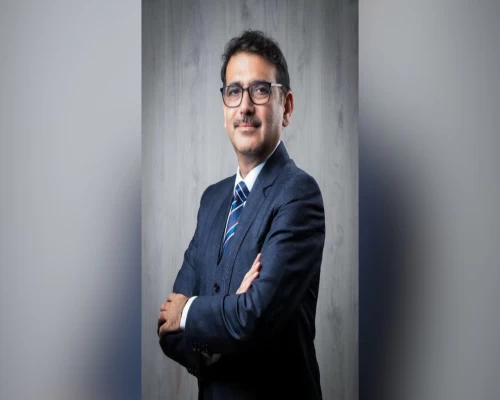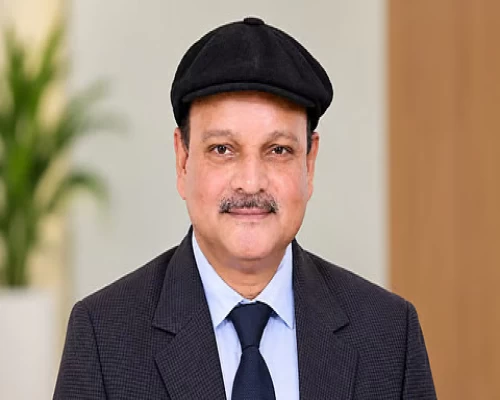
New Delhi: On the occasion of India’s 79th Independence Day, Indian Railway Finance Corporation (IRFC) Chairman and Managing Director, Manoj Kumar Dubey, outlined an ambitious vision for the organisation and the nation, asserting that financial strength, grit, and innovation will be decisive in India’s journey to becoming the world’s largest economy by 2047.
Setting a clear aspiration for the current financial year, Dubey declared, “We aim to cross the ₹7,000 crore PAT mark this year. This is not just a number, it is a statement of intent, a reflection of our capabilities, and a benchmark for the future we are building together.” He further added that once this milestone is achieved, the organisation’s next goal will be to take its profit after tax beyond ₹10,000 crore in the next four to five years.
Stressing on the strategic importance of financial stability, he noted, “For any country to stand secure and move forward, one of its strongest pillars must be financial strength. Around the world, we see what happens when that pillar is weak. If India is to claim its rightful place as the world’s largest economy by 2047, we must build this pillar stronger than ever and IRFC will play its part fully.”
His remarks come at a time when IRFC is delivering record-breaking results. In Q1 FY 2025–26, the corporation posted its strongest quarterly performance ever, with total revenue of ₹6,918 crore and profit after tax reaching an all-time high of ₹1,745 crore. The earnings per share climbed to ₹1.34, the highest in IRFC’s history, while net worth rose to ₹54,423 crore, further strengthening the financial foundation that supports the nation’s railway infrastructure. Notably, IRFC continues to maintain NIL NPAs, a rare distinction in the NBFC ecosystem.
Dubey highlighted that IRFC’s performance benchmarks are not just high by national standards but are among the best globally. Breaking down the figures, he observed that IRFC’s profit after tax per employee crosses ₹100 crore, while per employee income exceeds ₹500 crore, making it one of the most efficient financial institutions in the world. “We are constantly working to push these numbers even higher,” he said.
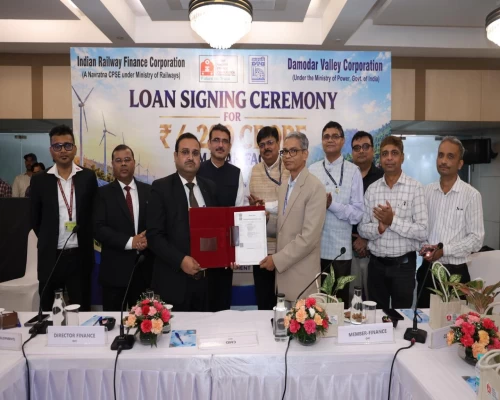
This performance is matched by impactful projects. Recently, IRFC facilitated a ₹2,539 crore refinancing for Angul Sukinda Railway Limited (ASRL), a vital freight corridor linking Odisha’s mineral-rich heartland with India’s coal, steel, power, and port hubs. This customised, revenue-aligned financing will empower ASRL to expand capacity, enhance operations, and secure its long-term sustainability. Earlier this year, IRFC also signed a ₹5,000 crore loan agreement with NTPC Limited to support the energy giant’s ongoing capacity expansion, another step that reinforces IRFC’s role in financing India’s growth story.
Dubey stressed that many government institutions, including IRFC, are directly contributing to nation-building by enabling the infrastructure and financial backbone that power India’s development. He called for diversifying business lines, innovating in low-cost financing solutions, and constantly seeking new ways to expand IRFC’s role in India’s growth story. “Our mandate is clear, fund the future, fuel the growth, and keep pushing the boundaries of what is possible,” he said.
Quoting poet Sarveshwar Dayal Saxena, he reminded the gathering, “Even in a challenging global environment, India stands at the cusp of a breakthrough. With effort, passion, and an attitude of service, institutions like IRFC can help transform the dream of a Viksit Bharat into reality.”
His address resonated beyond the IRFC campus, not merely as a speech marking Independence Day, but as a call to action. A call for institutional strength, innovative thinking, and collective resolve to anchor India’s economic ambitions in financial resilience and visionary execution.
BI Bureau