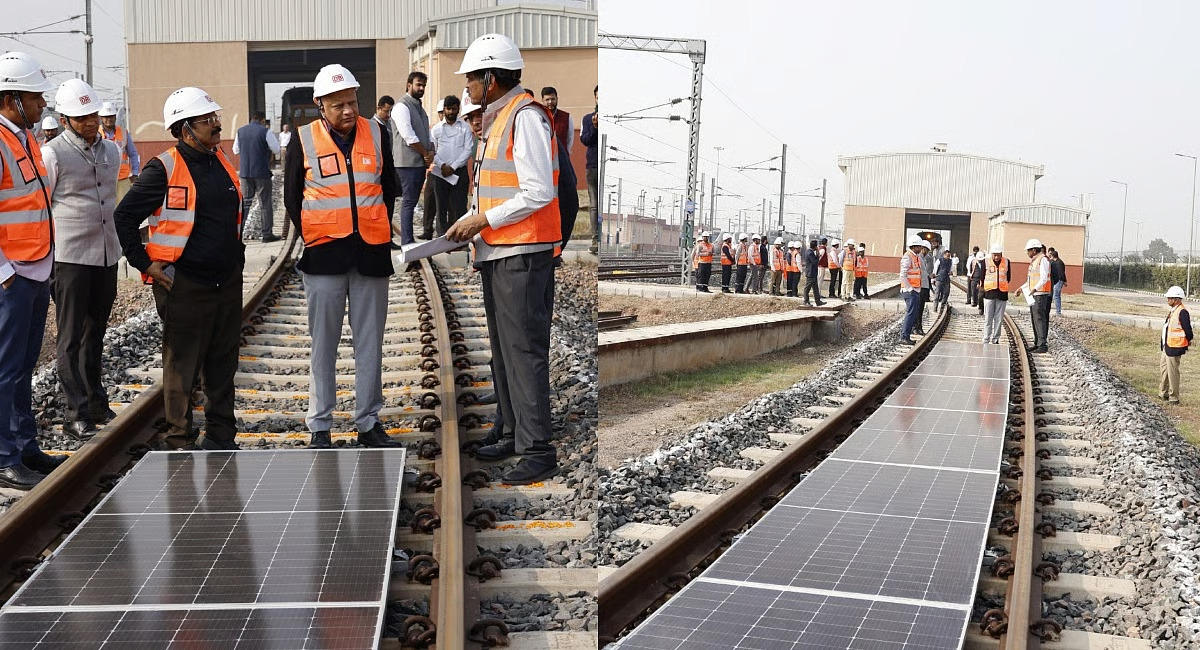
New Delhi: In a first for any metro or rapid rail network in the country, the National Capital Region Transport Corporation (NCRTC) has launched the innovative ‘Solar on Track’ project at the Namo Bharat Depot in Duhai. The initiative marks a significant stride towards integrating renewable energy directly into transport infrastructure.
Installed on the Pit Wheel Track at the Duhai Depot, the pilot project features 28 high-capacity solar panels of 550 Wp each, with a total plant capacity of 15.4 kWp spread over a 70-metre stretch of track. The system makes productive use of otherwise idle track space and is expected to generate nearly 17,500 kWh of clean energy annually, helping reduce carbon dioxide emissions by around 16 tonnes every year.
According to NCRTC, the project reflects its continued efforts to promote sustainable operations and develop innovative energy solutions aligned with India’s clean energy goals. By harnessing solar power directly from the tracks, the corporation aims to make the best use of existing infrastructure while moving towards its long-term target of net-zero energy consumption across all facilities.
Under its comprehensive solar policy, NCRTC plans to meet around 70 per cent of its total energy requirement from renewable sources. It is targeting the generation of 15 MW peak in-house solar power through installations on rooftops of stations, depots, and other buildings. So far, about 5.5 MW of solar power capacity is already operational, powering several components of the Namo Bharat corridor.
“The ‘Solar on Track’ system is a key step forward in scaling up this initiative and integrating clean energy into every layer of the regional rapid transit network,” said an official of the NCRTC.
The project also aligns with the National Solar Mission, strengthening India’s broader commitment to sustainable development and climate action.
In addition to solar installations, NCRTC has introduced a series of green initiatives such as rainwater harvesting systems, sewage treatment plants, and regenerative braking systems in Namo Bharat trains. The braking technology converts the train’s kinetic energy into electrical energy during deceleration, contributing further to overall energy efficiency.
BI Bureau