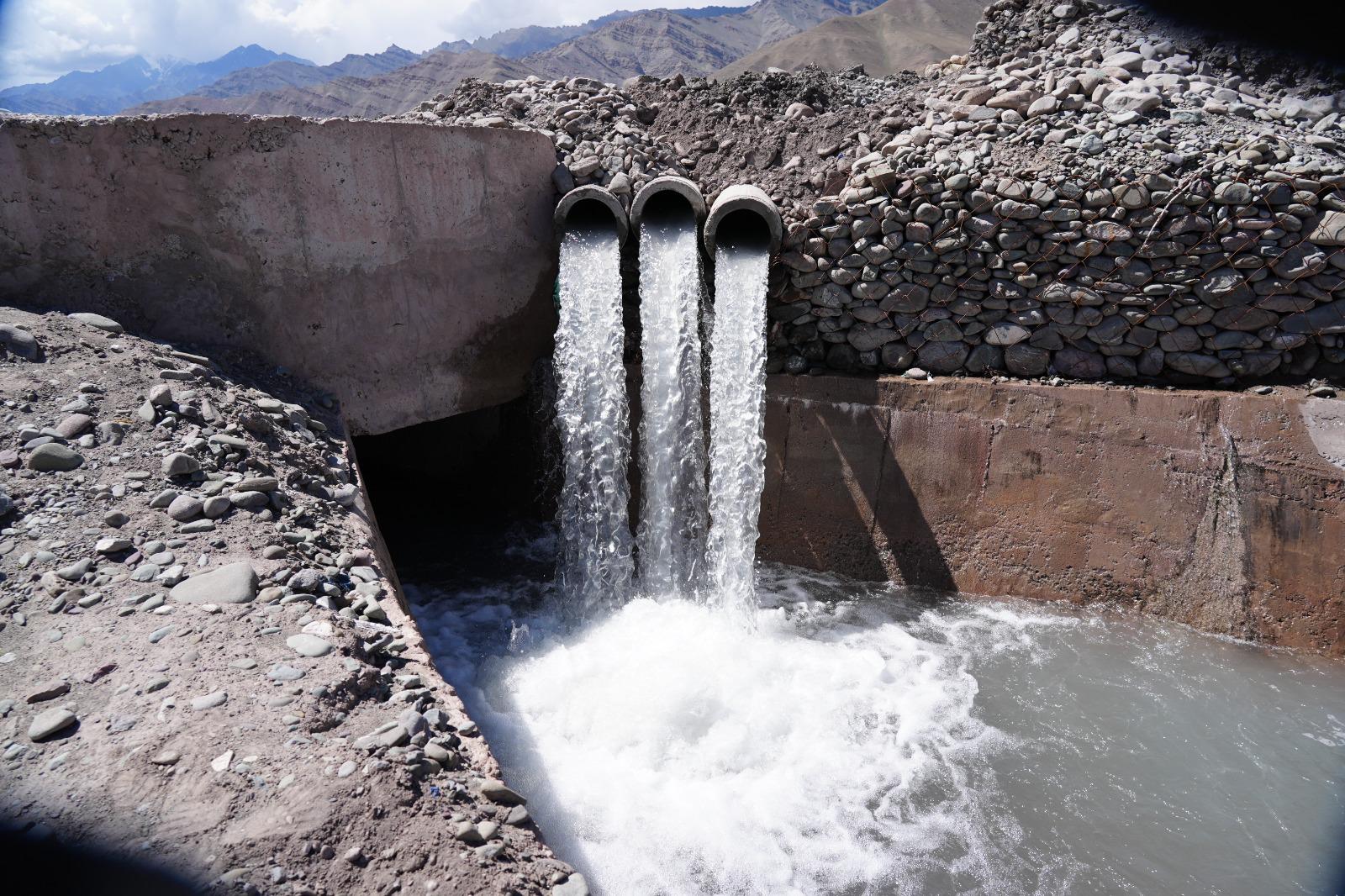
Leh: A major water management intervention in Ladakh is turning previously untapped glacier runoff into a source of irrigation for farms across nearly a dozen villages. The administration has begun diverting around 90 million litres of glacial water every day from Stok village Nallah into the Igoo-Phey Irrigation Canal, increasing water availability for more than 1,000 acres of agricultural land.
The intervention was initiated under the direction of Lieutenant Governor Vinai Kumar Saxena and relies on a simple approach: intercepting excess glacier runoff before it flows into the River Indus and directing it into an existing irrigation network. The work involved creating two trenches with a JCB and did not require any capital expenditure.
The Stok Nallah, fed by the Stok Kangri Glacier near Leh, was recorded as carrying approximately 36.60 cusecs of water downstream. Of this, 26 cusecs are now being diverted into the canal system, with 19 cusecs directed towards Igoo and seven cusecs towards Phey. Planning is underway to utilise the remaining 10 cusecs.
The additional water is expected to raise the flow in the Igoo-Phey Canal from around 50 cusecs to nearly 80 cusecs. Until now, the canal’s limited supply meant that water had to be distributed among villages according to a roster. The increased availability is expected to allow all 12 villages served by the system to receive water daily.
The development also brings renewed attention to the history of the 43-kilometre Igoo-Phey Canal. Construction began in 1979 and was completed in 2005. Around 200 metres of the canal was built underground so that the Stok Nallah could continue flowing over it without disrupting the canal.
Despite the presence of the water source for decades, its potential for irrigation had not been harnessed. As a result, the canal continued to face water shortages and was eventually left defunct.
The administration identified Stok Nallah during visits to villages and is now looking at other streams that could be connected to existing irrigation infrastructure. Matho Nallah, Tuchik Chenmo Nallah, Tuchik Chon Nallah and Stakna Nallah have been identified for similar interventions.
“By successfully saving 90 million litres of glacier water daily and diverting this huge volume of water from the Stok Nallah into the Igoo Phey and Yokyur canals, we have proven that large-scale, sustainable water management is entirely feasible in our cold desert. This is a monumental step toward our vision of a Green, Water-Secure, and Self-Sustaining Ladakh. Our administration’s unwavering commitment is to harness every single drop for irrigation. This successful model is just a blueprint. We will expand these cost-effective interventions across Ladakh, transforming scattered glacier flows into a permanent lifeline for agricultural prosperity, revitalised rural economies, and long-term climate resilience for the people of Ladakh,” said LG, Shri Saxena.
The planned interventions will follow a gravity-based approach, with an emphasis on low-cost engineering, minimal water wastage and environmental sustainability. By connecting seasonal glacier flows with established irrigation infrastructure, the administration aims to expand irrigated areas, improve crop intensity and provide more reliable water supplies to farmers.
For Ladakh’s cold desert agriculture, the immediate gain is greater access to water. Over time, the administration expects improved irrigation to support higher crop yields, increase farm incomes and create more opportunities for rural employment.
BI Bureau