India’s space economy, currently valued at nearly USD 9 billion, is projected to grow to USD 40–45 billion in less than a decade, with private companies expected to play a major role in this expansion. The transformation follows policy reforms that have opened the sector to private participation, encouraged investment and expanded opportunities for indigenous technology development.
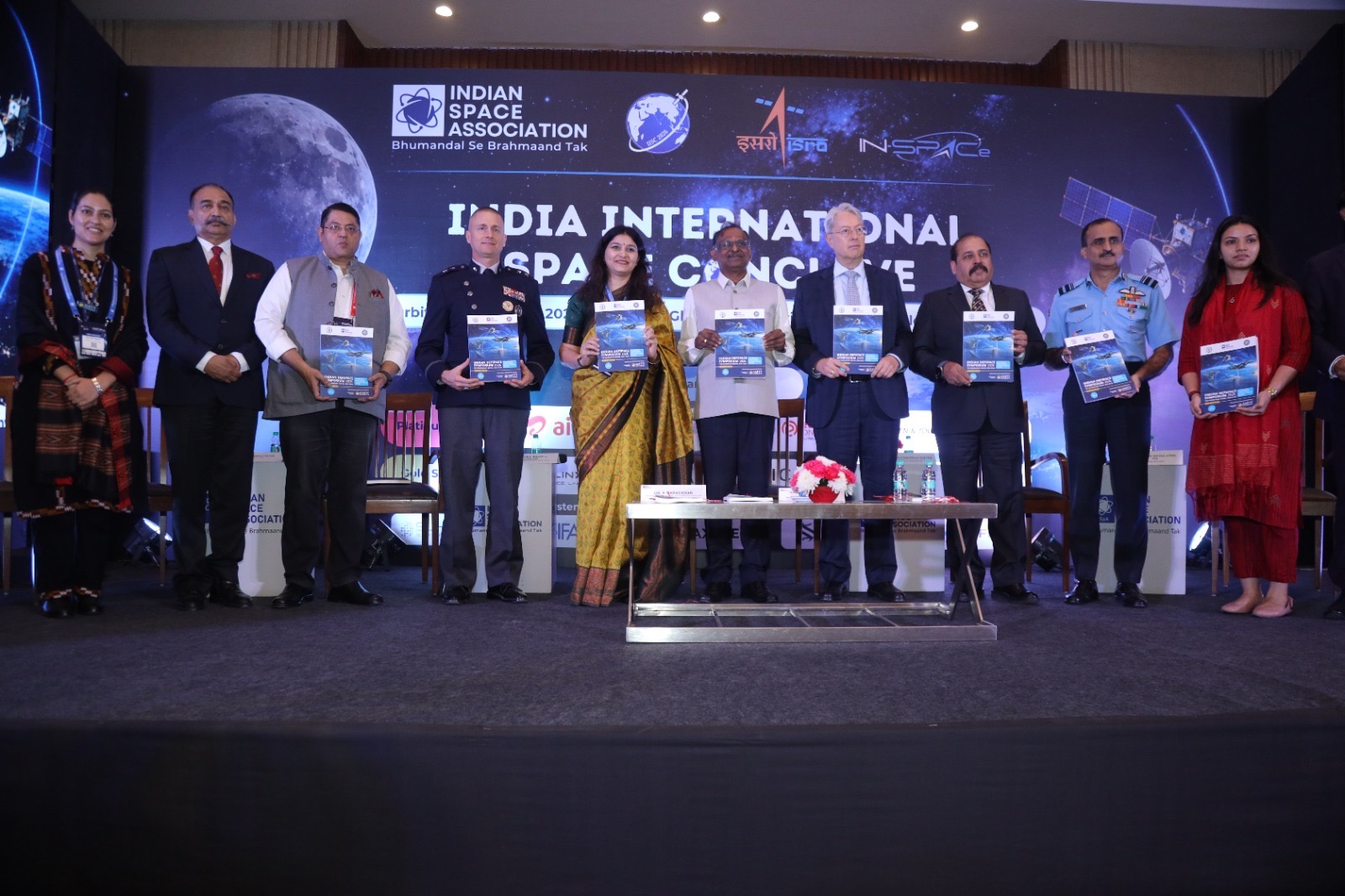
Addressing the fifth India International Space Conclave 2026 in New Delhi on November 24, Union Minister Dr Jitendra Singh said India’s space ecosystem had grown from a handful of startups to nearly 400–500 companies in just a few years. He also highlighted the growing use of space technology in infrastructure, railways, defence, communication, healthcare and other public services.
The two-day conclave, organised by the Indian Space Association (ISpA) on November 23–24, was held under the theme ‘Shaping the Future of Space through Innovation, Governance, Human Potential and Global Collaborations’. The event also saw the launch of the report ‘Space Economy 2036: The India Blueprint’.
What is the space economy?
The space economy covers the range of economic activities connected with space-based technologies, infrastructure, services and applications.
It includes:
- Upstream activities: Designing and manufacturing satellites, launch vehicles, rocket engines and other space equipment.
- Downstream activities: Using satellite data and services for navigation, communication, weather forecasting, agriculture, mapping and disaster management.
- Supporting activities: Research and development, ground stations, data processing, software, insurance and other services that support space operations.
Therefore, the economic value of the space sector is not limited to rocket launches or satellite sales. Satellite-based services can also improve productivity, reduce costs and support decision-making across several sectors.
How did India open its space sector to private participation?
For decades, India's space programme was largely led by government institutions, particularly the Indian Space Research Organisation (ISRO). A series of policy and institutional reforms created opportunities for private companies to participate in space activities.
Three important developments highlighted by Dr Jitendra Singh are:
1. New Space India Limited (NSIL)
Established in 2019, NSIL is a public sector undertaking under the Department of Space. It is responsible for commercially exploiting the research and development work of ISRO and enabling greater industry participation in the space sector.
2. IN-SPACe
The Indian National Space Promotion and Authorisation Centre (IN-SPACe) was established in 2020 as an autonomous agency under the Department of Space.
Its role is to promote, authorise and supervise the participation of non-government entities in space activities. It also facilitates access to ISRO infrastructure and technical facilities for private players.
3. Opening up the space sector
The reforms enabled private companies to undertake activities across the space value chain, including satellite manufacturing, launch vehicle development, satellite-based services and other space-related applications.
Together, these measures have created an institutional framework for government and private enterprises to work alongside each other.
Private companies driving India's space ambitions
The growth of India's space startup ecosystem reflects the expanding role of private enterprise in developing indigenous technologies.
Dr Jitendra Singh cited the progress of companies such as Skyroot Aerospace and Agnikul Cosmos.
- Skyroot Aerospace: The Minister referred to the company's maiden launch vehicle flight on July 18, 2026, its multi-mission launch agreement and unicorn status as milestones in the development of India's private space industry.
- Agnikul Cosmos: The company is among the private players developing advanced propulsion systems and privately built rocket engines.
Other companies are working on earth-observation technologies, satellite imaging and related capabilities. Their participation is expanding the scope of India's domestic space industry beyond traditional government-led missions.
How does space technology support sectors beyond space exploration?
One of the key points made by the Minister was that the contribution of space technology should also be assessed through the economic efficiencies and public benefits it creates on the ground.
Its applications include:
- Infrastructure planning: Satellite imagery and geospatial data can help assess land use, plan infrastructure and monitor projects.
- Railways: Remote sensing and satellite-based systems can support infrastructure monitoring, mapping and operational planning.
- Agriculture: Satellite data can help monitor crop conditions, assess drought and support agricultural planning.
- Disaster management: Satellite-based observation and communication support weather monitoring, early warnings and disaster response.
- Communication: Satellite communication can improve connectivity in remote and geographically difficult areas.
- Defence: Space-based assets support communication, navigation, surveillance and strategic operations.
- Healthcare and education: Satellite connectivity can help extend services to underserved and remote regions.
The Minister specifically cited the PM Gati Shakti National Master Plan as an example of how space-based applications can improve infrastructure planning, help maintain project timelines, reduce costs and minimise wastage and leakages.
What is PM Gati Shakti?
Launched in October 2021, PM Gati Shakti is the National Master Plan for Multi-modal Connectivity. It aims to improve coordinated infrastructure planning by bringing together data from different ministries and departments on a common digital platform.
The initiative seeks to reduce delays, avoid duplication of infrastructure and improve connectivity through better coordination among roadways, railways, ports, airports and other infrastructure networks.
Geospatial technology and satellite-based data are important inputs for this integrated planning approach.
Indigenous capabilities and international cooperation
Dr Jitendra Singh said technological sovereignty and international collaboration should not be treated as competing objectives.
He stressed the need to strengthen indigenous sources, technologies and projects while remaining open to mutually beneficial international partnerships.
This approach is important for a sector with strategic applications in communication, navigation, defence and national security. Building domestic capabilities can reduce external dependence, while international partnerships can support knowledge exchange, research and access to global markets.
The Minister also referred to India's progress under the National Quantum Mission, launched in 2023 with an eight-year mandate. He said India had achieved 1,000 kilometres in secure quantum communication in three years, against the original target of 2,000 kilometres over eight years.
He highlighted the connections between space technology, quantum technologies, semiconductors and nuclear science as areas with significant potential for technological advancement and commercial growth.
What is the National Quantum Mission?
The National Quantum Mission is a Government of India initiative aimed at developing scientific and industrial capabilities in quantum technologies.
Its focus areas include quantum computing, quantum communication, quantum sensing and metrology, and quantum materials and devices.
Quantum communication has potential applications in secure information transmission, including for strategic and sensitive networks.
How can research and investment strengthen the space ecosystem?
The Minister called on domestic companies to increase investment in the space sector and encouraged industry leaders to facilitate greater overseas investment into India's space ecosystem.
He also highlighted two government initiatives aimed at strengthening research and innovation:
- Anusandhan National Research Foundation (ANRF): Established under the ANRF Act, 2023, it aims to promote and support research and development across universities, colleges, research institutions and research and development laboratories.
- Research, Development and Innovation (RDI) Fund: The initiative is intended to support private-sector participation in research, development and innovation, including investment in emerging technologies.
Dr Jitendra Singh also urged companies to direct greater Corporate Social Responsibility (CSR) support towards scientific research and development. He called for a stronger culture of scientific philanthropy, arguing that support for research should be seen as a contribution to society rather than being limited to machinery and infrastructure.
Organisations involved in India's space ecosystem
- Department of Space (DoS): The government department responsible for India's space programme and related policy and institutional oversight.
- ISRO: India's national space agency, responsible for developing space technologies and carrying out space missions.
- NSIL: The commercial arm of the Department of Space, responsible for commercialising space products and services.
- IN-SPACe: The agency that promotes and authorises the participation of non-government entities in space activities.
- Indian Space Association (ISpA): An industry association representing stakeholders in India's space and satellite ecosystem.
Why is this important for UPSC?
The expansion of India's space economy connects with several areas of the UPSC Civil Services syllabus.
GS Paper II: Governance
- Role of government institutions and regulatory bodies.
- Public-private partnerships and reforms in strategic sectors.
- Institutional mechanisms for promoting private participation.
GS Paper III: Science and Technology
- Developments in space technology and their applications.
- Indigenous research, innovation and technological self-reliance.
- Emerging technologies such as quantum communication.
- Commercialisation of research and development.
GS Paper III: Indian Economy
- Growth of the space economy and emerging industries.
- Private investment, startups and entrepreneurship.
- Research and development as drivers of economic growth.
- Role of technology in infrastructure development and productivity.
GS Paper III: Internal Security
- Strategic applications of satellites in communication, navigation and surveillance.
- Importance of indigenous space capabilities for national security.
UPSC Prelims facts
1. ISRO: Established in 1969, it functions under the Department of Space.
2. NSIL: Established in 2019 as a Central Public Sector Enterprise under the Department of Space.
3. IN-SPACe: Established in 2020 to promote and authorise private participation in India's space sector.
4. PM Gati Shakti: Launched in October 2021 as the National Master Plan for Multi-modal Connectivity.
5. National Quantum Mission: Approved in 2023 with an eight-year implementation period.
6. ANRF: Established under the Anusandhan National Research Foundation Act, 2023, to strengthen the research and innovation ecosystem.
7. Downstream space activities: Include the use of satellite data and services in areas such as communication, navigation, agriculture and disaster management.
Possible UPSC Mains question
India's space sector is moving from a predominantly government-led model towards a collaborative ecosystem involving private enterprises. Examine the role of recent policy reforms in this transformation and discuss the opportunities and challenges in developing India as a competitive global space economy.
Key points for an answer
- Explain the traditional government-led structure of India's space programme.
- Discuss the role of NSIL, IN-SPACe and reforms opening the sector to private players.
- Highlight the growth of startups and indigenous capabilities in launch vehicles, propulsion systems and satellite technologies.
- Examine applications of space technology in infrastructure, agriculture, communication, defence and disaster management.
- Discuss opportunities in investment, employment, exports, research and technological innovation.
- Address challenges such as access to capital, advanced technology, skilled manpower, regulatory clarity, global competition and space sustainability.
- Conclude with the need to balance technological self-reliance, private-sector growth and international cooperation.
Main information source: Press Information Bureau (PIB)