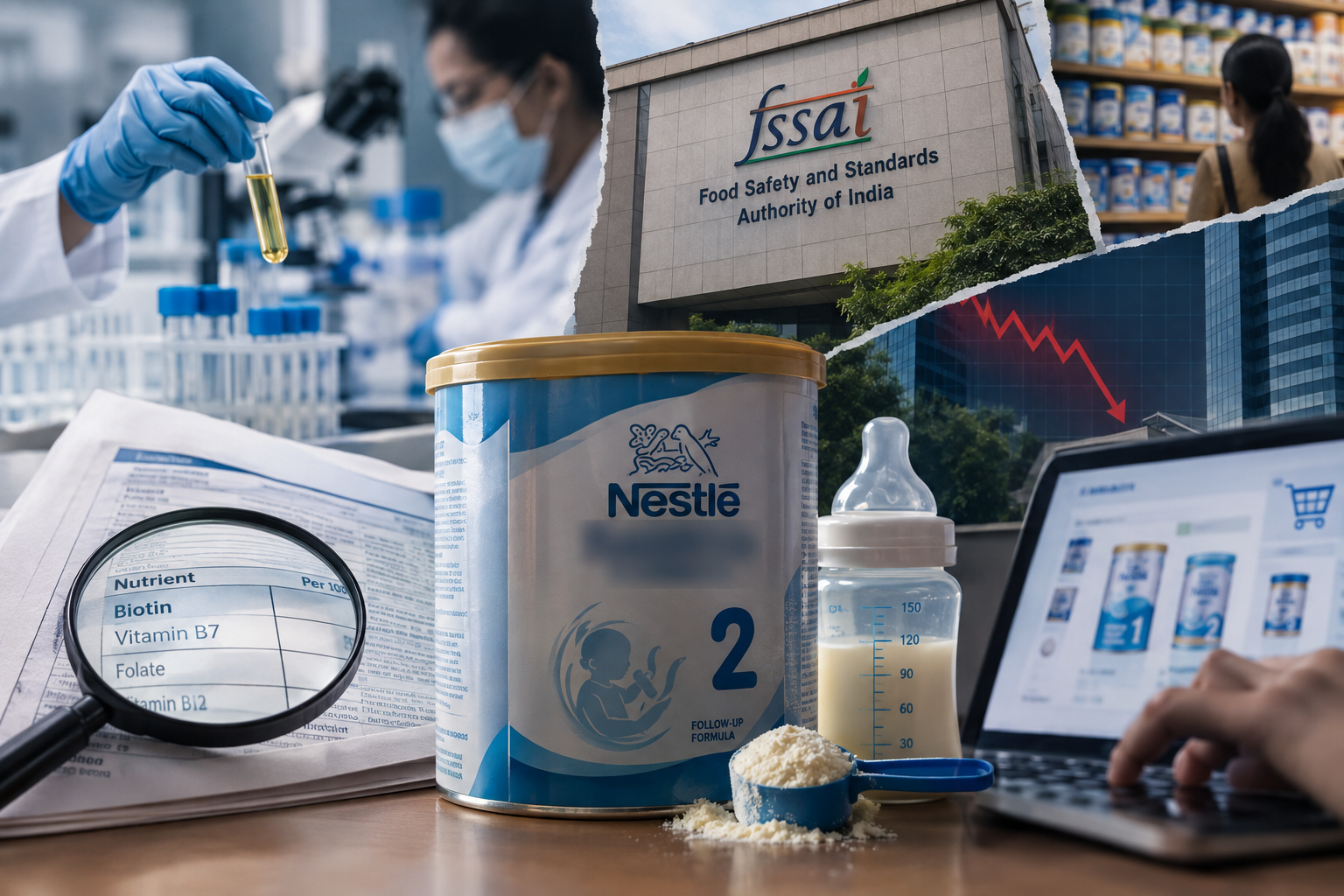
New Delhi: India's food safety regulator has opened three adjudication cases against Nestlé India over its infant nutrition products, including a follow-up formula whose sample failed the prescribed biotin requirement not once but twice, in laboratory testing, and again on re-analysis at a referral laboratory.
The Food Safety and Standards Authority of India (FSSAI) announced the action on September 18, following scrutiny of the products and their promotional material on e-commerce platforms. Two of the three cases concern marketing. For NAN Excella Pro Stage 1, the regulator flagged claims relating to "5 HMOs" and "Whey Protein". For Lactogen Pro 1, it questioned a claim describing the whey protein as "easy to digest". Such promotional claims, FSSAI said, are contrary to provisions governing foods for infant nutrition, including the bar on material intended to increase the saleability of infant foods. It also cited the Infant Milk Substitutes, Feeding Bottles and Infant Foods (Regulation of Production, Supply and Distribution) Act, 1992.
The third case is the one that matters most to parents. Biotin, or vitamin B7, is a water-soluble vitamin involved in several metabolic processes. In an adult's diet it is one input among many. For an infant on formula, the tin is not a supplement. It is the entire diet. A shortfall on the label is not a marketing quibble; it is a gap between what a mother was promised and what she fed her child.
Nestlé India has maintained that its products are fully compliant with applicable regulations. The company says NAN EXCELLA PRO and LACTOGEN PRO, along with their labels, were approved by an FSSAI expert committee, and that it has filed a detailed response to the regulator. The adjudication process will determine the final position.
The commercial stakes are considerable. Milk products and nutrition, the category housing infant formula and baby food, was Nestlé India's largest revenue source in the year to March 2026, generating roughly $2.4 billion, about a third of its total product sales in the country. The market responded faster than parents did: the stock fell nearly three percent on September 18.
What makes the episode hard to read in isolation is the file behind it.
In March 2014, a food inspector in Barabanki picked up routine samples of Maggi noodles. A Gorakhpur laboratory found monosodium glutamate in a product carrying a prominent "No MSG" label. Nestlé contested it and sought a definitive test at the Central Food Laboratory in Kolkata. That test, in April 2015, found lead at 17.2 parts per million — nearly seven times the permissible 2.5 ppm. The company argued the batch had expired and could not have reached consumers. Regulators were unpersuaded. Uttar Pradesh ordered a recall, other states followed, and by June 2015 Maggi was off shelves nationwide. Nestlé destroyed stock worth Rs 320 crore. In the same weeks, consumers in Coimbatore separately alleged live beetles in one Nestlé product and worm infestation in tins of Cerelac, the company's baby cereal.
Nine years later it was baby food again and this time over what had been added. In April 2024, the Swiss investigative organisation Public Eye examined about 150 Nestlé baby food products across dozens of countries. All 15 Cerelac variants tested in India carried an average of nearly 2.7 grams of added sugar per serving. The same formulations sold in Germany and the United Kingdom carried none. The pattern held across low- and middle-income markets, reaching 6 grams per serving in Thailand. Nestlé did not dispute the figures and said it had cut added sugars in its infant cereal range by up to 30 percent over the preceding five years.
These are distinct episodes involving different products, and they should not be collapsed into a single charge sheet. But noodles with lead, cereal with sugar for Indian babies and none for European ones, and now a formula sample that missed its biotin mark twice describe a company whose Indian labels keep needing defending.
For Anjali, a mother in Pune who switched brands the week the biotin finding broke, the pattern stopped being a debating point some time ago. "Every time there is a controversy, they apologise to the shareholders in one sentence and to us in a press statement nobody reads," she says. In Lucknow, Radha fed her twins Nestlé products for over a year before she first heard the word biotin, on the news. "We trusted the Swiss name," she says. "Nobody tells you the label might be lying to you."
Nestlé's shares will probably recover, as they have after every previous controversy. The cases will move through their process. What recovers more slowly is the calculation a parent now makes each time she reads a Nestlé label and wonders whether the numbers printed on it are the ones that went into the tin. Our email to Nestle India for a response went unanswered.
BI Bureau