loader
  • Home
  • Central Government
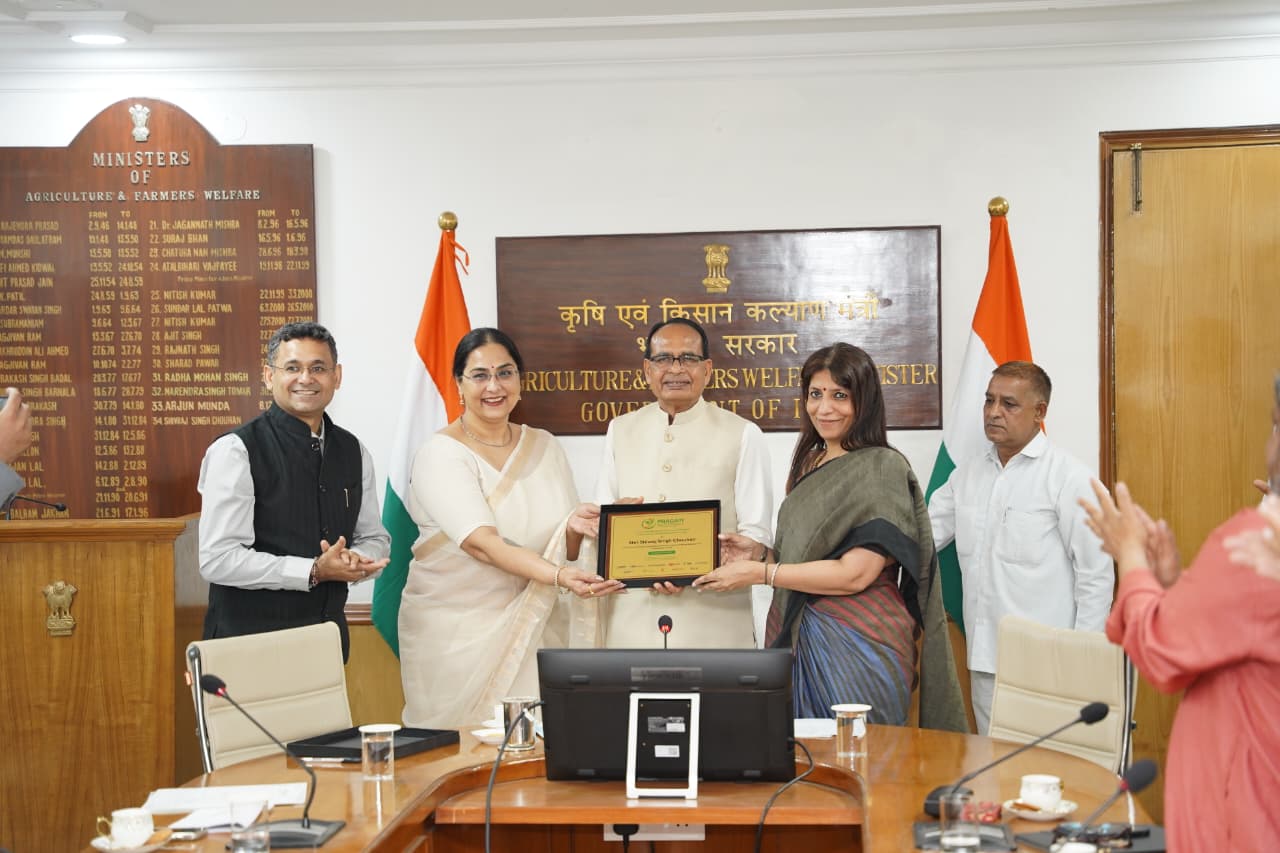
  • Hon’ble Union Minister of Agriculture and Farmers Welfare & Rural Development, Govt. of India, Shri. Shivraj Singh Chouhan launched Landmark Initiative ‘PRAGATI’ to Empower 20,000 rural youth as Agri-Entrepreneurs and directly Support 20 Lakh Farmers

PRAGATI LAUNCH

Hon’ble Union Minister of Agriculture and Farmers Welfare & Rural Development, Govt. of India, Shri. Shivraj Singh Chouhan launched Landmark Initiative ‘PRAGATI’ to Empower 20,000 rural youth as Agri-Entrepreneurs and directly Support 20 Lakh Farmers

PRAGATI aims to create a nationwide ecosystem of 20,000 agri-entrepreneurs on top of existing network of 26,000+ agri-entrepreneurs, with a strong emphasis on inclusive participation, targeting balanced representation within the field.

Hon’ble Union Minister of Agriculture and Farmers Welfare & Rural Development, Govt. of India, Shri. Shivraj Singh Chouhan launched Landmark Initiative ‘PRAGATI’ to Empower 20,000 rural youth as Agri-Entrepreneurs and directly Support 20 Lakh Farmers

New Delhi: In a significant milestone for India’s rural development landscape, Hon’ble Union Minister of Agriculture and Farmers Welfare & Rural Development, Shri Shivraj Singh Chouhan launched Landmark Initiative ‘PRAGATI’ to Empower 20,000 Agri-Entrepreneurs and Directly Support 20 Lakh Farmers. Leading national and global institutions, a pioneering programme designed to catalyse large-scale, inclusive, and climate-resilient regenerative agriculture initiative to transform smallholder farmers. 

PepsiCo Foundation, State Bank of India Foundation (SBIF), Gates Foundation, IDH, Heifer International, Environmental Defense Fund (EDF), Global Agri Entrepreneurship Academy, The Sustainable Agriculture Foundations International Association (SAFIA), and Agri Entrepreneur Growth Foundation (AEGF), & Transform Rural India Foundation (TRIF) have come together to launch the ambitious 20K Agri Entrepreneurs Initiative, PRAGATI.  

This programme has been built on the learnings from prior agri-entrepreneurship initiatives implemented in several states across India. PRAGATI aims to create a nationwide ecosystem of 20,000 agri-entrepreneurs on top of existing network of 26,000+ agri-entrepreneurs, with a strong emphasis on inclusive participation, targeting balanced representation within the field. The initiative is expected to positively impact over 2 million smallholder farmers, with intentional outreach to help ensure broad participation across farmers. The programme will be implemented across key agricultural states, including Madhya Pradesh, Bihar, Uttar Pradesh, Assam, West Bengal, Jharkhand, Maharashtra, and Rajasthan.

PRAGATI will work to help transform the livelihoods of over 2 million farmers by delivering advisory services and sustainable farming knowledge at scale. The initiative aims to help drive the adoption of regenerative agriculture and diversified income opportunities among at least 20% of participating farmers, while targeting a minimum 30% increase in farmer incomes and a 15-20% boost in yields of key crops such as paddy, maize, and potato. By strengthening financial literacy and expanding access to formal financial systems, PRAGATI aims to empower at least half of all associated farmers to build more resilient and prosperous futures.

Speaking about the initiative, Hon’ble Union Minister of Agriculture and Farmers Welfare & Rural Development, Govt. of India, Shri. Shivraj Singh Chouhan, said that the vision of Viksit Bharat (Developed India) cannot be achieved without a developed agricultural sector and prosperous villages. He said the government's focus is not limited to increasing agricultural production, but also includes reducing cultivation costs, increasing farmers' incomes, promoting crop diversification, and making agriculture more profitable. He emphasized that traditional farming alone is not sufficient for small and marginal farmers. Therefore, promoting value addition, food processing, and agriculture-based entrepreneurship is essential. He said that PRAGATI is an extension of this vision and will help create pathways to increase farmers' incomes by connecting them with technology, farm mechanization, soil health management, and better market access.

Shri Chouhan said that farming alone will not be enough, and farmers need to move towards value addition and diversification. He added that areas such as horticulture, livestock, fisheries, and beekeeping have the potential to significantly increase farmers' incomes. He also highlighted the use of technology—including drones, digital advisory services, and scientific farming—as the foundation of the future of agriculture.

India’s agriculture sector continues to face persistent challenges, ranging from climate vulnerability and rising input costs to limited access to finance, technology, and markets. These challenges disproportionately affect smallholder farmers who often remain excluded from entrepreneurial and economic opportunities. PRAGATI emerges as a strategic response to these systemic constraints, positioning agri-entrepreneurship as a powerful vehicle for inclusive and sustainable rural transformation.  

The initiative builds on a proven foundation, the Agri-Entrepreneurship (AE) model, developed and refined through years of on-ground implementation. The AE model has already led to the incubation of over 26,000 agri-entrepreneurs, collectively supporting more than 2.6 million farmers across India. With demonstrated success in enhancing farmer incomes, enabling diverse locally led enterprises, and strengthening last-mile service delivery, PRAGATI seeks to scale this impact to an unprecedented level.

Through this initiative, participants will be supported through training, mentorship, and resources to develop as local. entrepreneurs delivering a comprehensive suite of services to farmers. These services will span agronomy advisory, access to soil health services, mechanization solutions, credit linkages, market access, and livelihood opportunities. In parallel, the programme will advance financial and digital inclusion by facilitating access to credit, insurance, savings, and government entitlements, supported by the establishment of 20,000 agri-entrepreneur-led kiosks.

A strong emphasis will be placed on promoting regenerative and climate-smart agricultural practices, helping ensure that productivity gains are aligned with ecological sustainability. At the same time, inclusivity will remain central to the initiative’s design, with local farmers positioned not only as beneficiaries but as entrepreneurs, leaders, and key agents of change within rural economies. PRAGATI is underpinned by a robust collaborative framework that leverages the unique strengths of each partner institution. The programme will be guided by a comprehensive monitoring, evaluation, and learning framework, intended to enable real-time tracking of outcomes, rigorous impact measurement, and continuous adaptation based on evidence and insights.

“At PepsiCo, farmers are at the heart of our business, with every product we make starting in the field as a crop that helps sustain communities for the future,” said Monica Bauer, Senior Vice President, Global Social Impact, PepsiCo, and President, PepsiCo Foundation. “They play a vital role in driving local economies, and supporting their livelihoods is essential to building a more resilient food system. Through this partnership, the PepsiCo Foundation is proud to work alongside program partners to help expand access to the tools and knowledge farmers need to grow more sustainably and help strengthen food systems for generations to come.”

Jagrut Kotecha, Chief Executive Officer, PepsiCo India and South Asia, said: "At PepsiCo India, we believe the future of agriculture lies in building ecosystems that create long-term value for farmers, communities, and the broader value chain. PRAGATI is a much needed intervention that brings together organizations with a shared intent, and the expertise, to help create new opportunities for farmers and rural entrepreneurs. Through greater access to knowledge, regenerative agriculture practices, and market opportunities, PRAGATI aims to enable farmers improve productivity, diversify incomes, and build more secure livelihoods. For PepsiCo, PRAGATI reflects our Partnership of Progress philosophy, bringing together the right partners to create meaningful impact at scale. Together, we can help build a more inclusive, sustainable and thriving future for Indian agriculture." 

Swapan Dhan, MD & CEO, SBI Foundation, said: “The future of Indian agriculture lies in empowering those closest to the farmer. Guided by our philosophy of Service Beyond Banking, PRAGATI is not just about creating Agri-Entrepreneurs, it brings along institutions with diverse expertise to carve out a nationwide movement of local changemakers who will drive farmer prosperity, climate resilience, and financial inclusion. This alliance reflects our belief that collaboration is the key to achieving sustainable impact at scale. Together, we are creating a model that can transform Indian agriculture for generations to come.”

Alan Johnson, Director at Global AE Academy & Lead-Smallholder Farmers Supply Chain, IFC (The World Bank Group), said: "The future of agriculture depends on empowered local leaders. Through PRAGATI, we are scaling a proven agri-entrepreneurship model that equips rural youth and women with the skills, networks, and opportunities to become catalysts of economic growth, innovation, and sustainable agricultural transformation across India.”

Hisham Mundol, Chief Advisor - India, Environmental Defense Fund, said: “PRAGATI represents a powerful step toward transforming India’s agricultural systems by placing farmers and local entrepreneurs at the center of climate-smart, efficient solutions. By combining data-driven insights with strong last-mile delivery, this initiative can improve productivity and farmer incomes while reducing resource use and environmental impact. At Environmental Defense Fund (EDF), we are proud to partner in building an ecosystem that makes sustainable agriculture practical, scalable, and accessible to millions of farmers across India.”

Dr. Simon Winter, Executive Director, Sustainable Agriculture Foundation’s International Association, Switzerland, said: “PRAGATI is a bold step towards enabling a new generation of rural changemakers to accelerate the transition to regenerative and climate-resilient agriculture. By investing in youth and women entrepreneurs, we are building the human infrastructure needed to transform food systems to be more inclusive and resilient at scale and improve the livelihoods of millions of smallholder farmers.”

Rina Soni, Executive Director, Passing Gifts Private Limited (PGPL), a wholly owned subsidiary of Heifer International, said: "At Passing Gifts, a wholly owned subsidiary of Heifer International, we believe that lasting rural transformation happens when smallholder farmers are supported not as passive beneficiaries of the food system, but as entrepreneurs, leaders, and changemakers within their own communities. PRAGATI provides exactly this kind of platform, enabling enterprising rural youth and women to translate technology, finance, and regenerative farming practices into accessible village-level services. Together, this initiative can help make farming a profitable, sustainable, and aspirational choice for the next generation. We are proud to join our partners in PRAGATI to scale these opportunities and help build more resilient, inclusive, and sustainable food systems across India."

With its scale, ambition, and emphasis on sustainability and inclusion, PRAGATI is poised to become India’s largest privately led agri-entrepreneurship initiative, setting a new benchmark for collaborative agriculture and rural development. By placing local entrepreneurs at the heart of systemic change, the programme seeks to unlock enduring socio-economic value while building resilience within India’s agricultural systems.

As India stands at the intersection of climate urgency and rural transformation, PRAGATI represents a bold and timely initiative to help build an inclusive, resilient, and regenerative future for India’s rural economy.