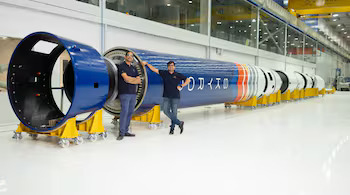
Hyderabad: Prime Minister Narendra Modi inaugurated Skyroot’s Infinity Campus in Hyderabad, Telangana via video conferencing. Addressing the gathering, the Prime Minister said the nation is witnessing an unprecedented opportunity in the space sector and highlighted that India’s space ecosystem is experiencing a major leap with the private sector taking flight. He said Skyroot’s Infinity Campus reflects India’s new thinking, innovation and youth power, and noted that the innovation, risk-taking ability and entrepreneurship of the country’s youth are reaching new heights. Modi said today’s programme reflects how India will emerge as a leader in the global satellite launch ecosystem in the coming years. He extended his best wishes to Pawan Kumar Chandana and Naga Bharath Daka, noting that the two young entrepreneurs are an inspiration for many young space entrepreneurs across the country. He said both trusted themselves, did not shy away from taking risks, and as a result the nation is witnessing their success today, with the country feeling proud of them.
Pointing out that India’s space journey began with limited resources but not limited ambition, Modi said that from carrying rocket parts on a bicycle to developing the world’s most reliable launch vehicles, India has shown that the height of dreams is determined by resolve, not resources. “ISRO has for decades given new wings to India’s space journey and stressed that credibility, capacity, and value have established India’s distinct identity in the sector”, he said.
Speaking about the changing times, Modi said the expansion of the space sector is clear, as it now supports communication, agriculture, marine monitoring, urban planning, weather prediction and national security. He said this is why major reforms were undertaken in the space sector, with the government opening it to private innovation and preparing a new Space Policy. He added that efforts were made to connect startups and industry with innovation, and IN-SPACe was set up to provide ISRO’s facilities and technology to startups. “In just the past six to seven years, India has transformed its space sector into an open, cooperative, and innovation-driven ecosystem”, he said, adding that today’s programme reflects this transformation.
Modi said India’s youth place national interest above everything else and make the best use of opportunities. He said that after the space sector was opened, the country’s youth, especially Gen-Z, came forward to take full advantage of it. He noted that more than 300 space startups are giving new hopes to India’s space future, and said many of them began with very small teams working from small rented rooms with limited resources but strong determination. “This spirit has given birth to the Private Space Revolution in India”, he said. He added that Gen-Z engineers, designers, coders and scientists are creating new technologies in propulsion systems, composite materials, rocket stages and satellite platforms, and said India’s youth are working in areas that were unimaginable a few years ago. He said India’s private space talent is building a distinct identity globally and added that global investors are now looking at India’s space sector with great interest.
Modi said the global demand for small satellites is rising sharply, along with launch frequencies. He said new companies are entering the field to provide satellite services and that space has now become a strategic asset. He said the global space economy is set to grow significantly in the coming years and that this represents an important opportunity for India’s youth.
“India possesses space sector capabilities that only a few countries in the world have, noting the presence of expert engineers, a high-quality manufacturing ecosystem, world-class launch sites, and a mindset that encourages innovation”, he said, adding that India’s space capability is both cost-effective and reliable. He said global companies want to manufacture satellites in India, use launch services from India and seek technology partnerships with India, and emphasised that the nation must make the most of this opportunity.
Modi said the changes seen in the space sector are part of a wider startup movement in India. He noted that a new wave of startups has emerged across FinTech, AgriTech, HealthTech, ClimateTech, EduTech and DefenceTech, and said India’s youth, especially Gen-Z, are creating solutions in every field. He said their creativity and positive mindset can inspire Gen-Z across the world. Modi said India is now the world’s third-largest startup ecosystem and pointed out that startups, once limited to large cities, are now emerging from small towns and villages. He said the country has more than 1.5 lakh registered startups, with many reaching unicorn status.
He noted that India is no longer limited to apps and services and is now moving rapidly towards deep-tech, manufacturing and hardware innovation. He said the semiconductor sector is a key example, with historic steps strengthening India’s tech future. He said semiconductor fabrication units, chip manufacturing and design hubs are taking shape across the country, and that from chips to systems, India is building a strong electronics value chain. He said this is part of the effort for self-reliance and will make India a strong and trusted part of the global supply chain.
Modi said the scope of reforms is expanding and noted that just as space innovation was opened to the private sector, India is now moving towards opening the nuclear sector as well. He said a strong role for the private sector is being planned in this field, which will create opportunities in small modular reactors, advanced reactors and nuclear innovation. He said this reform will strengthen India’s energy security and technological leadership.
Saying that the future will depend on the research being carried out today, the Prime Minister said the government is focused on creating opportunities for youth in research. He highlighted the National Research Foundation and said the “One Nation, One Subscription” initiative has made access to international journals easier. He said the ₹1 lakh crore Research, Development, and Innovation Fund will provide major support to young researchers. He said more than 10,000 Atal Tinkering Labs have already been set up to build a spirit of research and innovation, and work is underway to establish 50,000 new labs soon. He said these efforts are laying the foundation for new innovations and stated that the coming era belongs to India, its youth and its innovations. He recalled speaking on Space Day about India’s space aspirations and said that in the next five years India will increase its launch capacity and create five new unicorns in the space sector. He said the progress made by Skyroot shows that India will achieve all its goals.
The Prime Minister assured every young person, startup, scientist, engineer and entrepreneur that the government stands with them at every step. He congratulated the Skyroot team and extended his best wishes to everyone contributing to India’s space journey. He concluded by calling upon everyone to make the 21st century the century of India, on Earth and in space.
Union Minister G Kishan Reddy was present among other dignitaries at the event.
BI Bureau