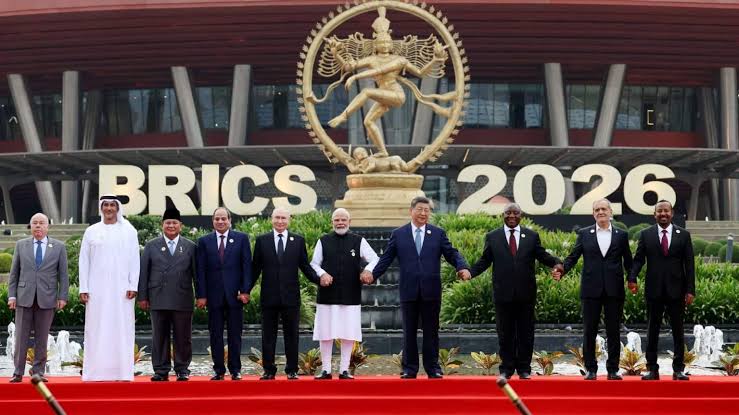
New Delhi: The 18th BRICS Summit in New Delhi has concluded on a successful note, with India securing consensus among an expanded and increasingly diverse grouping on a wide-ranging New Delhi Declaration. Adopted unanimously after intensive negotiations, the 45-page declaration with 140 points reflects the breadth of the BRICS agenda - from terrorism and global conflicts to trade, finance, energy, technology, health and sustainable development.
For India, the summit was also an opportunity to underline country's growing role as a bridge-builder within the Global South and a proponent of practical, people-centric multilateralism. Under India's chairship, the BRICS agenda was anchored around resilience, innovation, cooperation and sustainability, with an emphasis on converting declarations into tangible outcomes.
1. A stronger voice for the Global South
At the heart of the New Delhi Declaration is the call for a more representative and equitable global order. BRICS reaffirmed its support for comprehensive reform of the United Nations, including the Security Council, and greater representation for developing countries in global decision-making.
The declaration places the Global South at the centre of the emerging multipolar order, arguing for institutions that better reflect today's economic and geopolitical realities.
For India, this closely mirrors PM Modi's larger message at the summit: developing countries should move from being “rule-takers” to “rule-shapers” in areas that will define the future, including AI, biotechnology, cyberspace and critical technologies.
2. A clear and unequivocal message on terrorism
One of the most significant outcomes for India was the strong language on terrorism. The declaration condemned terrorism in all its forms and manifestations and specifically condemned the April 22, 2025, terrorist attack in Pahalgam, Jammu and Kashmir, in which 26 people were killed.
BRICS called for zero tolerance towards terrorism, including cross-border movement of terrorists, terror financing and safe havens. It also reiterated that terrorism cannot be associated with any religion, nationality, civilisation or ethnic group and called for accountability for those involved.
The declaration also called for the early finalisation of the Comprehensive Convention on International Terrorism under the UN framework.
3. Diplomacy over conflict
The declaration reinforces BRICS' preference for dialogue, diplomacy and peaceful resolution of conflicts.
On West Asia, it called for restraint, protection of civilians and unhindered humanitarian assistance, while reaffirming support for a two-state solution based on the internationally recognised 1967 borders. The grouping also expressed concern over unilateral military action and called for diplomatic engagement to resolve conflicts.
The ability to arrive at a common position among an expanded grouping that includes countries with sharply different geopolitical positions was, in itself, an important diplomatic outcome of the summit.
4. Pushback against tariffs and protectionism
Trade was another major area of consensus. BRICS expressed concern over unilateral tariff and non-tariff measures that distort international trade and create uncertainty for businesses and global supply chains.
The declaration reaffirmed support for a rules-based multilateral trading system centred on the WTO and called for a stronger, more responsive multilateral trading architecture.
The emphasis is particularly relevant for emerging economies seeking predictable access to global markets and more resilient supply chains.
5. Greater use of local currencies
BRICS continued its efforts to reduce vulnerabilities in cross-border transactions by supporting greater use of local currencies in trade and payments.
The declaration acknowledges ongoing work on interoperability between payment and messaging systems and encourages mechanisms that can facilitate trade settlements and investment in local currencies. This is less about creating an immediate common currency and more about building greater resilience and choice into the international financial system.
6. Energy security meets the transition agenda
Energy received a broad treatment, reflecting the differing economic realities of BRICS members.
The declaration supports energy security, diversified sources, resilient infrastructure and a just, orderly and inclusive energy transition. Cooperation spans renewables, nuclear energy, hydropower, hydrogen and other low-carbon technologies while recognising the differing circumstances of member countries.
India also advanced cooperation on smart grids and energy storage, areas critical to the next phase of the clean-energy transition.
7. AI: From technology adoption to global rule-making
Artificial Intelligence emerged as a strategic priority rather than merely a technology issue.
BRICS recognised AI's potential to drive economic growth and sustainable development while stressing the need for safety, security, inclusiveness, reliability and accessibility. The declaration also commits members to implementing the BRICS Leaders' Statement on Global Governance of AI.
India's hosting of the AI Impact Summit earlier in 2026 was specifically acknowledged. PM Modi's emphasis on ensuring that developing countries participate in shaping the rules governing emerging technologies gives this agenda a distinctly Global South dimension.
8. Health security gets a stronger institutional push
The summit moved beyond traditional health cooperation towards preparedness and prevention.
BRICS welcomed the establishment of a dedicated sub-working group to advance an Integrated Early Warning System for Mass Infectious Diseases. The grouping also strengthened cooperation on vaccines, medical products, digital health, traditional medicine and mental health.
India's NIMHANS has been designated as the coordinating Centre of Excellence for the BRICS mental-health network, adding an important institutional dimension to the initiative.
9. Resilient supply chains and stronger business cooperation
The declaration recognises that geopolitical disruptions have made resilient and diversified supply chains a strategic necessity.
BRICS has advanced a Global Value Chains Action Plan for 2026–2030, alongside efforts on logistics, connectivity, technology transfer and greater participation of developing countries in higher-value segments of global manufacturing.
For businesses, the agenda is complemented by new initiatives around MSMEs and startups, including the BRICS MSME Cooperation Portal, an incubator network and a startup innovation fund.
10. Climate resilience and sustainable cities
Sustainability was woven through the declaration rather than treated as a standalone issue.
BRICS welcomed guidelines on disaster-management early warning systems and voluntary principles for climate-resilient urban infrastructure. The grouping also established an Urban Research and Knowledge Network to promote research, knowledge-sharing and capacity building around resilient and liveable cities.
This is particularly significant for the developing world, where climate shocks increasingly intersect with urbanisation, infrastructure gaps and economic vulnerability.
11. From summit declarations to practical cooperation
Perhaps the defining feature of India's BRICS chairship was its effort to broaden the grouping beyond summit-level diplomacy.
The New Delhi Declaration notes that more than 400 meetings and engagements were held across 30 cities in India, bringing together ministers, parliamentarians, officials, experts, businesses and civil society.
The focus was therefore not merely on producing a joint document, but on creating platforms and mechanisms that can sustain cooperation in health, energy, technology, urban development, science, skills, business and people-to-people exchanges.
The New Delhi Summit comes at a consequential moment for the global order. BRICS is now larger, more geographically diverse and more politically complex than when it began two decades ago.
The successful adoption of the New Delhi Declaration, despite the grouping's internal diversity, is perhaps the clearest measure of India's BRICS chairship. It leaves behind a framework that seeks to move BRICS from voice to impact—from declarations to delivery.
As PM Modi put it at the summit, “If our future is shared, then the right to shape that future must also be shared.” New Delhi's BRICS outcome is an attempt to turn that principle into a more durable framework for cooperation.
BI Bureau