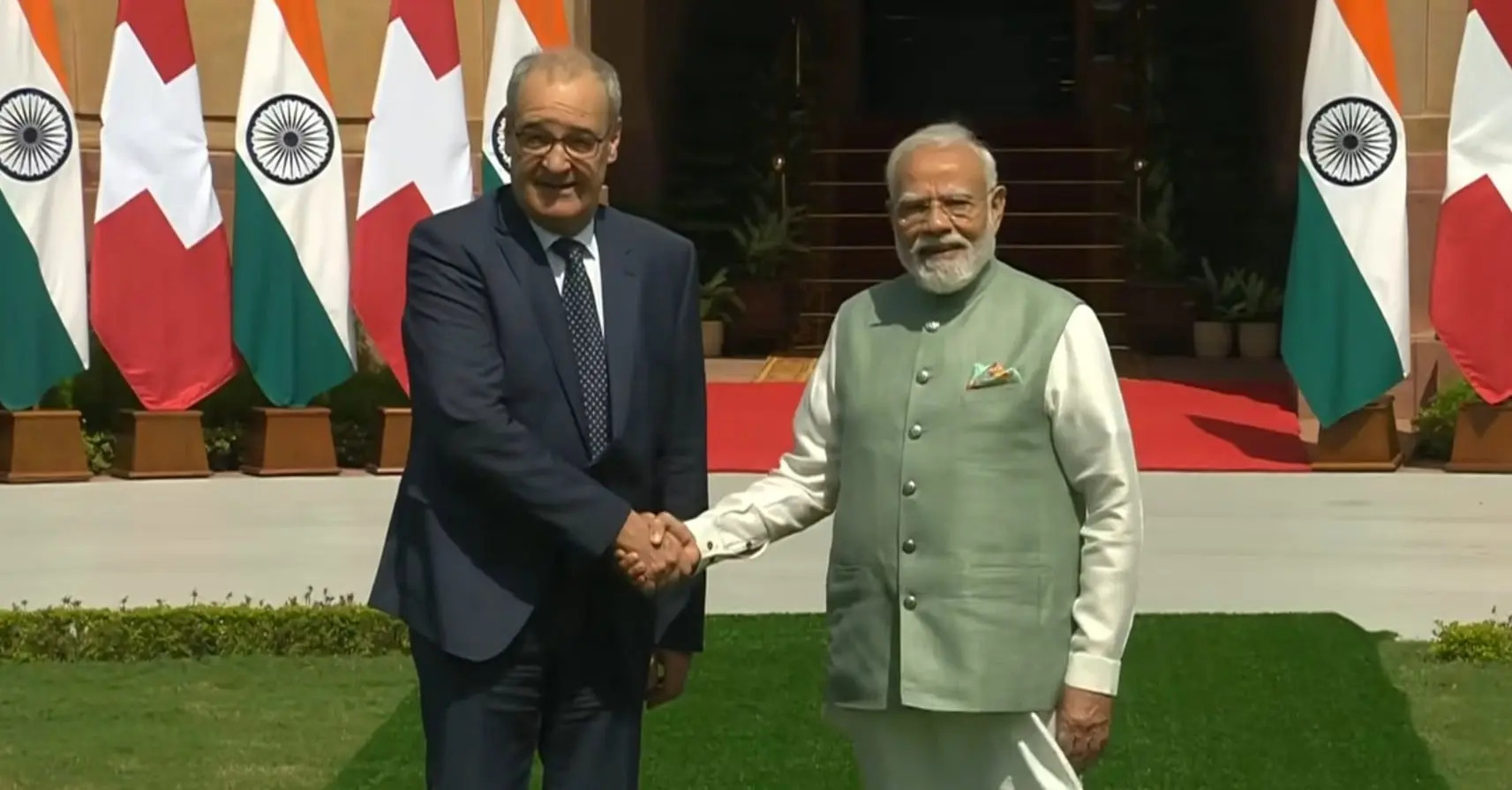
New Delhi: India and Switzerland have given a fresh impetus to their longstanding bilateral partnership, with Prime Minister Narendra Modi and Swiss President Guy Parmelin holding wide-ranging discussions on trade, investment, mobility, infrastructure, defence, nuclear energy, science and technology.
The two countries also announced five cooperation instruments covering migration and mobility, young professionals, transportation technologies, scientific research, and innovation and entrepreneurship. The agreements underline a growing shift in India-Switzerland relations towards a more technology-driven and investment-oriented partnership.
The discussions come almost a year after the India-European Free Trade Association (EFTA) Trade and Economic Partnership Agreement (TEPA) came into force in October 2025. The agreement, signed with EFTA members Switzerland, Norway, Iceland and Liechtenstein, has been positioned as a major framework for investment, employment and economic cooperation.
Prime Minister Modi said the TEPA has the potential to facilitate $100 billion in investment into India and create one million direct jobs over 15 years. He also highlighted opportunities to increase Indian exports of agricultural products, pharmaceuticals, textiles and engineering goods to Switzerland, while attracting Swiss investments in sectors such as biotechnology, life sciences, banking, insurance, food processing and sustainability.
One of the most significant outcomes of the visit is the Migration and Mobility Partnership (MMP), which seeks to strengthen cooperation while addressing irregular migration, human exploitation and trafficking.
The agreement provides for multiple-entry visas valid for up to five years, with stays of up to six months on each visit, along with renewable one-year student permits.
A separate Young Professionals Agreement will enable temporary employment opportunities for young people in each other's countries. Initially, up to 300 young professionals annually from each country can participate, with the possibility of increasing the number to 500.
The agreements are expected to create greater opportunities for Indian students, researchers, professionals and young people seeking international exposure and work experience.
Infrastructure and mobility have emerged as another important pillar of the partnership. India's Ministry of Road Transport and Highways and Switzerland's Federal Department of Economic Affairs, Education and Research signed an MoU covering transportation technologies, mobility systems and infrastructure. The cooperation will focus on areas including electric mobility, ropeways, tunnelling, circular economy and sustainable transport infrastructure.
India has already benefited from Swiss expertise in specialised infrastructure projects. PM Modi referred to the Varanasi ropeway, Jewar Airport and railway and tunnelling projects in mountainous areas as examples of existing cooperation.
With India's large infrastructure expansion underway, greater participation by Swiss companies could bring expertise in specialised engineering, mobility systems, design, technology and capacity building.
The two countries also strengthened their research and innovation ecosystem. A Letter of Intent between India's Department of Science and Technology and the Swiss National Science Foundation will facilitate long-term cooperation between Indian and Swiss research communities, including exploratory scientific collaboration and future joint research.
Another implementation arrangement between the Department of Science and Technology and the Zurich University of Applied Sciences will promote innovation, technology transfer and entrepreneurship. It will support the Indo-Swiss Academia-Industry Training programme for early-stage startups through exchanges, workshops, capability building and networking.
Joint research initiatives are expected to focus on priority areas including health, clean energy and space, adding a new dimension to the already established scientific partnership.
Beyond economics and technology, India and Switzerland also discussed strategic cooperation. The two leaders identified new possibilities for military exchanges and defence production, while agreeing to deepen cooperation in nuclear energy. The discussions indicate an expansion of bilateral engagement beyond traditional areas such as trade, education and tourism into sectors of strategic and technological importance.
PM Modi described India-Switzerland ties as a relationship with deep historical roots, while emphasising that innovation, infrastructure and advanced technology have now emerged as strong pillars of the partnership.
Switzerland's President Guy Parmelin is visiting India from October 5 to 7, accompanied by business and academic delegations. The visit coincides with the first anniversary of the implementation of TEPA, with an India-EFTA Prosperity Summit scheduled for October 7 to explore concrete investment and business opportunities.
The economic relationship is already substantial. Switzerland's official data says it had around 350 companies operating in India at the end of 2024, while Swiss direct investment in India stood at CHF 10.2 billion. TEPA is expected to provide additional momentum to these flows.
For India, the latest agreements therefore represent more than a broadening of bilateral ties. They create a framework that connects market access with investment, infrastructure with technology, and mobility with skills and talent.
As India and Switzerland look to build on the momentum generated by TEPA, the partnership is increasingly moving towards a model centred on innovation, sustainable infrastructure, skilled mobility and long-term economic value creation.
BI Bureau